Hall of Ma'at Myth Meaning & Symbolism
The soul's journey to the afterlife, where the heart is weighed against the Feather of Truth to determine eternal fate in the presence of Osiris.
The Tale of Hall of Ma’at
Listen, and let [the sands of time](/myths/the-sands-of-time “Myth from Greek culture.”/) part. The sun has set on your mortal life, and now you walk a path lit by stars older than memory. You are a Ba, a breath-soul, and the silent, jackal-headed guide, Anubis, leads you by the hand. The air is not air, but a substance thick with whispers—the prayers of the dead, the recitations of the living.
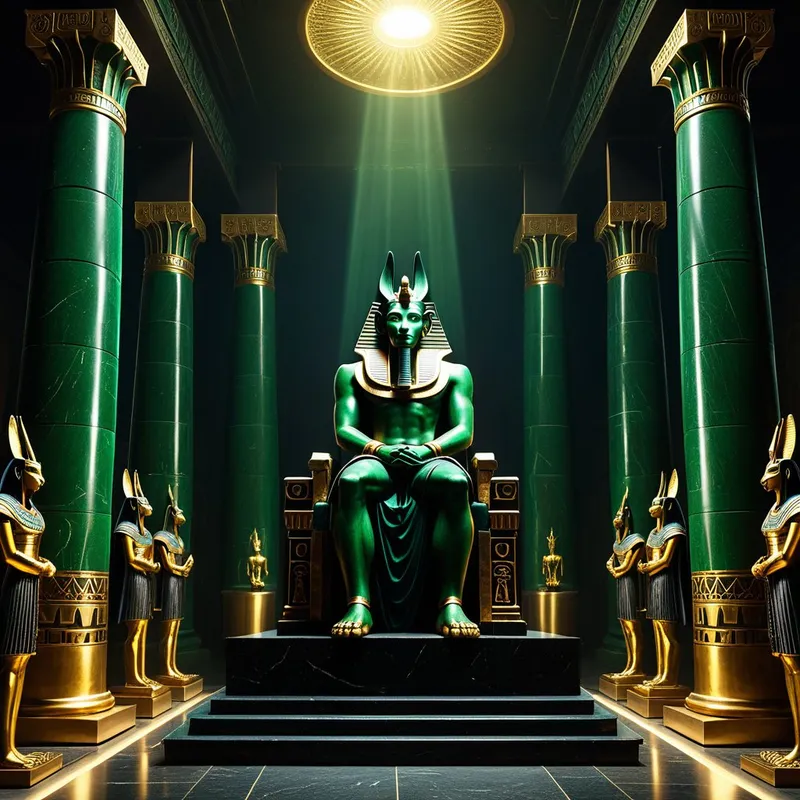
You enter the Hall of [Ma’at](/myths/maat “Myth from Egyptian culture.”/). It is a cavern of the cosmos, its pillars reaching into a darkness that smells of incense and deep [water](/myths/water “Myth from Chinese culture.”/). At the far end, upon a throne of lapis lazuli and electrum, sits [Osiris](/myths/osiris “Myth from Global/Universal culture.”/), the Lord of the Silent. His skin is the green of fertile Nile silt after [the flood](/myths/the-flood “Myth from Biblical culture.”/), his gaze is patient, ancient, and utterly inscrutable. To his side stands [Ma’at](/myths/maat “Myth from Egyptian culture.”/) herself, not as a woman, but as a presence—the palpable feeling of a perfectly balanced scale, the certainty of the sunrise.
But you cannot look at them yet. For arrayed before the throne are the Forty-Two. They are the Assessor Gods, their forms a terrifying mosaic of the animal kingdom and human visage. One has the head of a flame, another the jaws of a crocodile. They do not speak, but their names echo in your soul: “I have not stolen. I have not caused pain. I have not told lies.” These are the Negative Confessions, and you must speak them, addressing each god by name. Your voice is the only sound, and truth is its only timber.
Then, the moment of reckoning. Anubis, with fingers as careful as a surgeon’s, leads you to the center. Upon a pedestal rests the great golden scale. With a reverence reserved for the most sacred of rites, he reaches into the center of your being—not your chest, but the essence of all you have done and been—and draws forth your heart, the Ib. It glows with a light of its own, pulsing with every joy, every rage, every secret kindness, every hidden shame. He places it upon the left pan of the scale.
Upon the right pan, [Thoth](/myths/thoth “Myth from Global/Universal culture.”/), ibis-headed and steady of hand, places the [Feather of Ma’at](/myths/feather-of-maat “Myth from Egyptian culture.”/). It is blindingly white, the embodiment of cosmic order, of truth so light it has no weight of deceit.
The hall holds its breath. The scale trembles. If your heart, heavy with falsehood and corruption, sinks below the feather, the wait is over. The beast beside the scale—Ammit—will surge forward. Her crocodile jaws will snap shut, and your soul will know the second death, a non-existence of utter dissolution.
But if the scales balance… if your heart is as light as the feather… then Thoth will record the verdict. A smile, subtle as a shift in starlight, may touch the lips of Osiris. He will speak the words of justification: “Your heart is true. You have Ma’at within you.” And you will be led by [Horus](/myths/horus “Myth from Egyptian culture.”/) to the Field of Reeds, to join the justified ones, the Maa-Kheru, forever.
Cultural Origins & Context
This was not merely a story to frighten children, but the central organizing principle of an entire civilization’s ethical and spiritual life. The myth of [the Hall of Ma’at](/myths/the-hall-of-maat “Myth from Egyptian culture.”/) is detailed in the <abbr title="" A collection of funerary spells and texts intended to guide the deceased through the afterlife”>Book of the Dead (known to the Egyptians as the “Book of Coming Forth by Day”), [papyrus](/myths/papyrus “Myth from Egyptian culture.”/) scrolls placed in tombs from the New Kingdom onward. It was a democratization of the afterlife. Initially, only [the pharaoh](/myths/the-pharaoh “Myth from Egyptian culture.”/), the living embodiment of divine order, was guaranteed passage to Osiris. By the Middle Kingdom, this hope extended to any Egyptian who could afford the spells and who lived by Ma’at.
The ritual was performed not just in death, but in life. The declarations to the Forty-Two were a moral code, a societal contract. Priests acted as the representatives of Ma’at in temples that were seen as microcosms of the universe. The [Pharaoh](/myths/pharaoh “Myth from Egyptian culture.”/)‘s primary duty was to “put Ma’at in the place of Isfet (chaos).” Thus, the myth was a continuous reinforcement: your actions have cosmic weight. Your community, your king, and the gods themselves are all invested in the balance of your heart.
Symbolic Architecture
The Hall is not a place, but a state of [consciousness](/symbols/consciousness “Symbol: Consciousness represents the state of awareness and perception, encompassing thoughts, feelings, and experiences.”/)—the ultimate [moment](/symbols/moment “Symbol: The symbol of a ‘moment’ embodies the significance of transient experiences that encapsulate emotional depth or pivotal transformations in life.”/) of self-confrontation. Every element is a profound [symbol](/symbols/symbol “Symbol: A symbol can represent an idea, concept, or belief, serving as a powerful tool for communication and understanding.”/) of an internal process.
The heart is not judged for its passions, but for its alignment. A heart heavy with guilt, deceit, or unresolved conflict cannot ascend; a heart made light by integrity, even if scarred, finds equilibrium.
The [Feather](/symbols/feather “Symbol: A feather represents spiritual elevation, lightness, and the freedom of the spirit. It often symbolizes messages from the divine and connection to ancient wisdom.”/) of Ma’at is the perfect standard: [truth](/symbols/truth “Symbol: Truth represents authenticity, honesty, and the quest for knowledge beyond mere appearances.”/) is not a crushing burden, but a state of effortless being. Lies, hatred, and selfishness are the true weights. The Forty-Two Assessors represent the internalized voices of conscience and social [responsibility](/symbols/responsibility “Symbol: Responsibility in dreams often signifies the weight of duties and the expectations placed upon the dreamer.”/), the specific ways we can betray ourselves and our [community](/symbols/community “Symbol: Community in dreams symbolizes connection, support, and the need for belonging.”/). Anubis, the guide, is our own instinctual wisdom leading us to the point of self-[evaluation](/symbols/evaluation “Symbol: A process of assessment, judgment, or measurement of worth, performance, or quality, often implying external scrutiny.”/) we both seek and fear. Thoth is the objective intellect, the [recorder](/symbols/recorder “Symbol: The Recorder symbolizes simplicity in musical communication and nostalgia for childhood creativity, representing a gateway to artistic exploration.”/) who cannot be swayed. And Osiris, the resurrected god, represents the potential state of wholeness that awaits on the other side of truthful judgment—he is the promise that [death](/symbols/death “Symbol: Symbolizes transformation, endings, and new beginnings; often associated with fear of the unknown.”/) (of [the ego](/myths/the-ego “Myth from Jungian culture.”/), of the old self) can lead to renewal.

The Dreamer’s Resonance
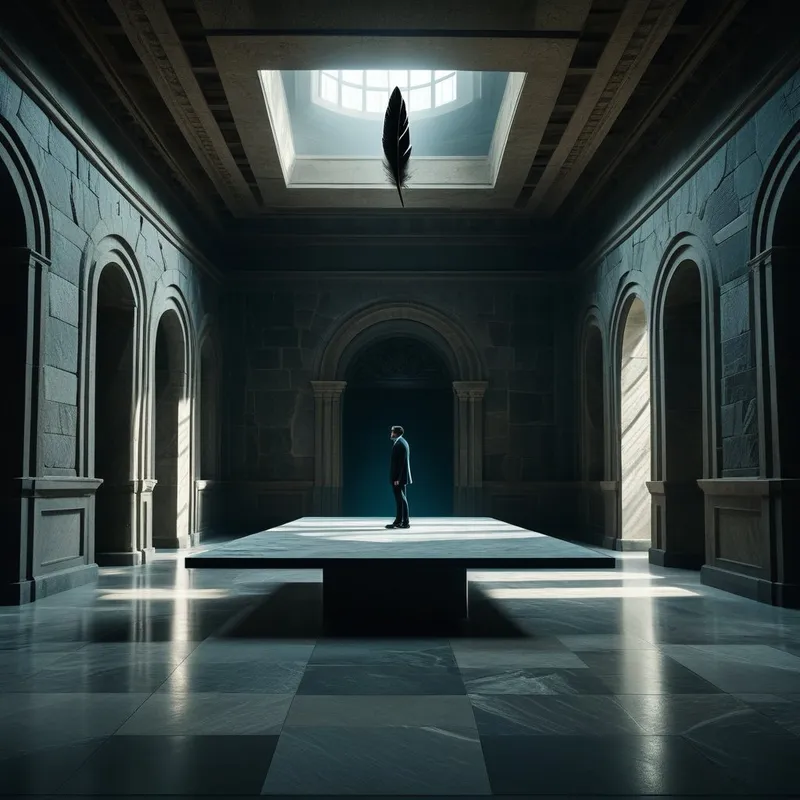
When this myth stirs in the modern dreamscape, it rarely appears with Egyptian iconography. Instead, the dreamer finds themselves in a sterile courtroom, a corporate review board, or standing before their own family, naked and exposed. The feeling is universal: you are being judged on the essence of who you are.
Somatically, this can manifest as a tightness in the chest—the “heart” being weighed. The dream often occurs during life transitions (career change, relationship end, personal crisis) where one’s past actions and core identity are under review. The terrifying figure of Ammit is the [psyche](/myths/psyche “Myth from Greek culture.”/)‘s representation of the fear of psychic annihilation—the terror that if we are truly seen, we will be found worthless and consumed by our own shame. To dream of the scales balancing, however, signals a profound internal reconciliation. It is the psyche’s way of affirming, “You have been honest with yourself. You may proceed.”
Alchemical Translation
The journey through the Hall of Ma’at is a perfect map for the Jungian process of individuation—becoming the integrated, authentic self. It models the necessary, terrifying, and ultimately liberating work of shadow integration.
The first alchemical stage is the [Nigredo](/myths/nigredo “Myth from Alchemical culture.”/), the descent into darkness. This is the journey to the Hall, the confrontation with [the shadow](/myths/the-shadow “Myth from Jungian culture.”/) material represented by the Assessor Gods. “I have not been envious. I have not been violent.” To say these words truthfully requires admitting where you have been these things. This is the weighing—holding your complex, flawed humanity (the heart) against the ideal of your highest self (the feather).
The alchemical gold is not a heart of pure, untarnished light. It is a heart that has acknowledged its full density, its leaden failures, and through the fire of honest appraisal, has transmuted them into the precise weight that balances the feather.
The moment of balance is the Albedo, the whitening. It is the clarity and purity that comes after ruthless self-honesty. Thoth recording the verdict is the conscious ego accepting this new, integrated truth about itself. Osiris’s welcome is the emergence of the Self, the psychic ruler of the new, inner kingdom. You are declared Maa-Kheru—“true of voice.” Your inner voice and your outer actions are now in harmony. [The Field of Reeds](/myths/the-field-of-reeds “Myth from Egyptian culture.”/) is not a geographical afterlife, but the state of being where one lives from this place of hard-won, balanced integrity. The myth teaches that paradise is not a reward for being perfect, but the natural state of existence for one who has courageously faced their own truth.
Associated Symbols
Explore related symbols from the CaleaDream lexicon: