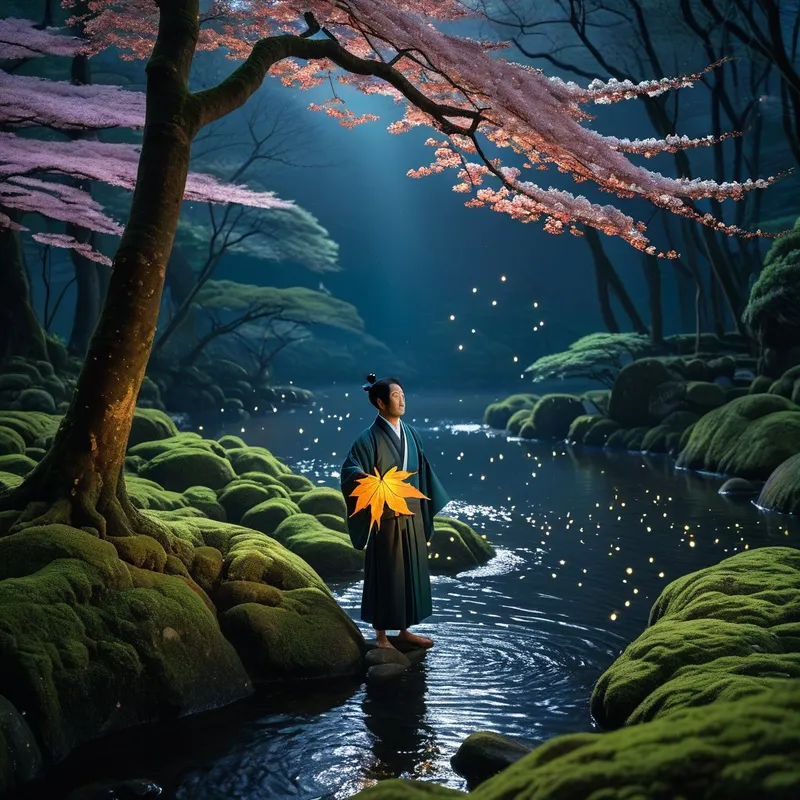
Haiku Myth Meaning & Symbolism
A myth of the poet who captured a fleeting moment of the world's soul, forging a vessel of stillness from the river of time.
The Tale of Haiku
In the time when the world was a conversation between the wind and the water, there lived a poet whose name has been lost to the river of years. He was not a lord of the court, nor a warrior of renown. He was a listener. He walked the mountain paths where the kami whispered through the cedar boughs, and he knelt by the ponds where the silence was so deep it had its own sound.
One autumn evening, as the sun bled into the western hills, a great melancholy settled upon him. He saw the relentless flow of the samsaric stream: the cherry blossoms that bloomed for a day, the dew that vanished by noon, the urgent cries of the cicadas that would be stilled by frost. All beauty was a prisoner of time, and all moments dissolved like salt in the sea. His heart ached with the futility of capturing any of it. What was the use of words, which themselves faded from memory, against such an inexorable tide?
He wandered to a forgotten temple garden, where a stone basin, a tsukubai, caught the drip of a bamboo pipe. Kata-kata. Kata-kata. The sound was the very heartbeat of passing time. In despair, he sat, his brush and paper untouched beside him. The moon rose, a perfect silver disc, and cast the world into monochrome beauty—the black pine against the grey sky, the white gravel path. A frog, unseen, leapt from a rock. The sound of water echoed in the stillness.
Plop.
In that instant—the fracture of the moon’s reflection on the water, the sound swallowed by the night—something within him shattered and then coalesced. It was not an idea, but a presence. The moment itself, in its impossible fullness, stood before him. It contained the entire garden: the waiting moon, the journeying frog, the ancient sound of water, and his own vast loneliness. It was not a fragment of time, but a window into the timeless soul of the world.
His hand moved as if guided. No grand stanzas, no elaborate metaphor. Only the essential bones of the experience, laid bare. Seventeen sounds, measured on the breath. When he finished, the characters seemed to glow on the page. He read them aloud, and as the last syllable faded, a profound silence descended, deeper than before. It was the silence not of absence, but of completion. The captured moment now lived in the vessel of the poem, no longer fleeing the current. He had not described the moment; he had become its shrine. The great melancholy lifted, replaced by a quiet, enduring awe. He had held a grain of sand and found the universe within it.

Cultural Origins & Context
This is not a myth of a single deity, but the myth of a practice—the spiritual and aesthetic genesis of the poetic form known as haiku. Its origins are woven into the fabric of Japanese culture, emerging from the earlier collaborative verse form, renga. The great masters, like Matsuo Bashō, are its legendary heroes. The myth was passed down not around campfires, but in poetry gatherings, in travel diaries like Bashō’s Oku no Hosomichi, and in the meticulous transmission from master to disciple.
Its societal function was multifaceted. It was a spiritual discipline, a form of zazen with words, training the mind to perceive the suchness of reality without the interference of the ego. It was a connective tissue between humans and the natural world, honoring the kami in all things. Culturally, it refined sensibility and enforced a minimalist elegance, principles that permeated tea ceremony, ink painting, and garden design. To compose haiku was to participate in an ancient ritual of attentive gratitude, a way of weaving oneself into the cosmic order.
Symbolic Architecture
The myth’s core symbols form a precise map of a psychological event. The poet represents the conscious ego, initially separate and lamenting its separation from the flow of existence. The fleeting moment (the frog, the moon, the sound) is the Self—the totality of the psyche, vast and eternal, which only ever reveals itself in brief, numinous glimpses. The river of time is the stream of consciousness, the endless chatter of the mind and the linear perception of reality that obscures the eternal present.
The haiku is not a description of an experience, but the linguistic fingerprint of an encounter with the Self.
The act of capturing the moment is the central alchemy. It is not an act of possession, but of sacred hospitality. The ego, in a moment of surrendered attention, becomes a clear vessel. The seventeen-syllable structure is the ritual container, the himorogi, within which the infinite can briefly dwell. The resulting silence after the poem is read is the symbol of integration—the ego’s noise has ceased, and the Self resonates in the quiet. The moment, once lost, is now eternally found in the space between the words.
The Dreamer's Resonance
When this mythic pattern stirs in the modern dreamer, it often manifests as dreams of profound, fleeting beauty that vanishes upon waking: a sublime landscape that dissolves, a face of perfect understanding that turns away, a melody that cannot be recalled. The somatic experience is one of acute, bittersweet longing—a tightness in the chest, a gasp at the moment of loss.
Psychologically, this signals a process where the unconscious is offering a content of the Self, a glimpse of wholeness. The dreamer is in a state similar to the poet’s initial despair: aware of the richness of their inner world but feeling powerless to integrate it, watching their own insights and emotions pass by like untouchable scenery. The dream is both the gift (the glimpse) and the frustration (its disappearance). It is an invitation from the psyche to develop the faculty of attention—to stop chasing the stream and learn how to build a well.
Alchemical Translation
The myth of Haiku models the individuation process as the art of crafting consciousness from moments of unconscious grace. The initial melancholy is the necessary suffering of the ego that realizes its own limitations and its alienation from the deeper source of being. This is the nigredo, the dark night of the soul.
The act of attention by the tsukubai is the meditatio, the stilling of the psychic waters. It is the suspension of judgment, agenda, and interpretation. In psychological terms, it is the temporary withdrawal of projections, allowing a thing—an emotion, a memory, an insight—to be exactly as it is.
The transmutation occurs not in the expansion of thought, but in its radical contraction to a point of absolute presence.
The writing of the poem is the albedo, the whitening. The raw, overwhelming experience is distilled into its pure, essential form. Psychically, this is the process of taking a chaotic emotion or a powerful complex and giving it a precise, bounded form—naming it, perhaps in a journal, a drawing, or a conversation. This gives the unconscious content a vessel in consciousness where it can be seen, held, and integrated.
Finally, the resonant silence is the rubedo, the reddening, the achievement of the philosopher's stone. It is the state where the ego, having served as the vessel, is now transformed by the content it holds. The separation between the observer and the observed, the ego and the Self, dissolves into a participatory unity. The individual no longer has an experience of wholeness; they operate from it. Each moment of life, however ordinary, becomes a potential haiku—a meeting place between time and eternity.
Associated Symbols
Explore related symbols from the CaleaDream lexicon: