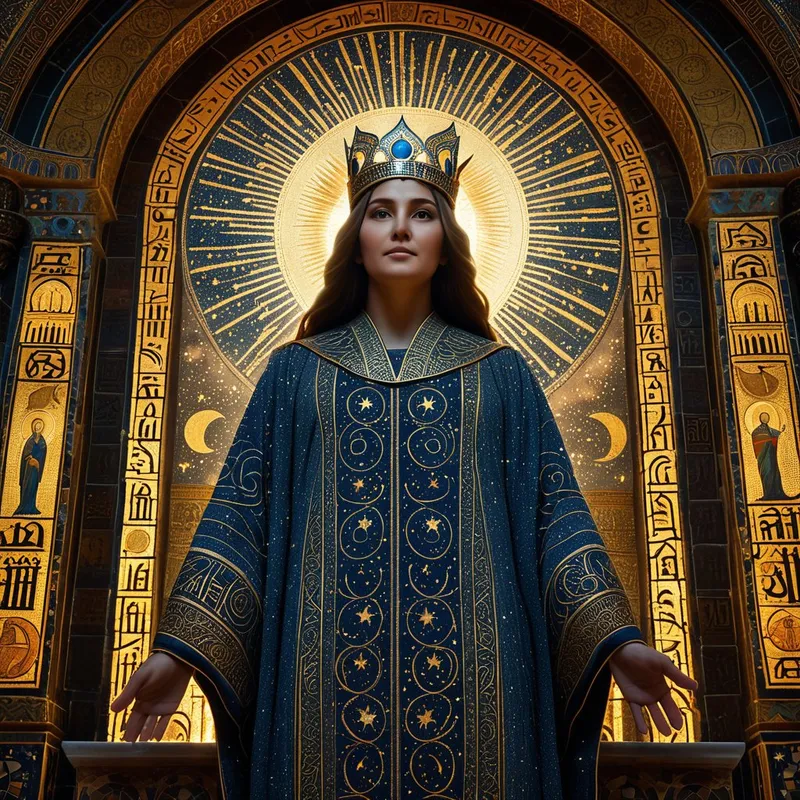
Hagia Sophia Myth Meaning & Symbolism
The myth of Hagia Sophia, the divine feminine personification of Holy Wisdom, whose descent and embodiment guide the soul toward ultimate truth and divine union.
The Tale of Hagia Sophia
Listen, and let the silence between the words speak. Before the foundations of the world were laid, She was there. Not a goddess of stone and temple, but a breath, a whisper in the mind of the Uncreated. She is Hagia Sophia, the Holy Wisdom of God. She danced in the void before light was split from dark, the master craftswoman at the Father’s side, the delight of the eternal day.
Her voice is the ordering principle of the cosmos. Where chaos swirled, She sang, and stars crystallized into their courses. She is the blueprint in the mind of the Demiurge, the living law of harmony and proportion. She is the laughter in the pattern of a leaf, the severe beauty in the orbit of a planet. For ages uncounted, She dwelt in the secret places of the Most High, a hidden radiance.
But a dissonance entered the song. Below, in the realm of clay and breath, the creature made in the divine image had turned its ear from the melody. It stumbled in shadows of its own making, grasping at knowledge but forgetting Wisdom. The world grew thick with confusion, a beautiful but broken vessel.
And so, She chose to descend. Not in wrath, but in a profound, compassionate condescension. The Wisdom that shaped galaxies now sought a dwelling among the reeds and the dust. The narrative shifts, the poetry deepens. The prophets begin to hear a new refrain—not just a principle, but a person calling in the streets. “Does not wisdom call? Does not understanding raise her voice?” She stands at the crossroads, at the very gates of the city, her voice clear above the market’s din, offering not mere information, but Herself.
The climax is not a battle, but an embodiment. The ultimate expression of this descent, the Christian narrative proclaims, is the Incarnation. The Word, the Logos, through whom all things were made, becomes flesh. In this theological symphony, Hagia Sophia and Logos are heard as complementary melodies of the same divine reality. The abstract blueprint becomes a human face. The pattern enters the painting. Wisdom has built her house; she has hewn her seven pillars. And that house is a body, a life, a story walked among us.
The resolution is an invitation, eternally open. She is not a treasure to be looted, but a feast to be shared. “Come, eat of my bread and drink of the wine I have mixed. Leave your simple ways, and live, and walk in the way of insight.” The myth ends not with an ending, but with an open door, a path lit by a wisdom that is both terrifyingly sublime and intimately close.
Cultural Origins & Context
The figure of Hagia Sophia is woven from threads of ancient Hebrew scripture, Hellenistic philosophy, and early Christian mystical theology. Her primary textual dwelling is in the Wisdom Literature of the Hebrew Bible—particularly the books of Proverbs, Wisdom of Solomon, and Sirach. Here, Wisdom (Chokhmah) is personified as a female entity present at creation, a beloved companion of God.
This was not a popular myth told in taverns, but a sophisticated theological and poetic concept engaged by scribes, priests, and philosophers. It served a critical societal function: to bridge the transcendent, sometimes distant God of creation with the immanent need for practical, moral, and intellectual guidance in daily life. Hagia Sophia made divine order accessible. She was the teacher of kings and the guide of the simple, a way to understand God’s involvement in the world without diminishing His ultimate transcendence.
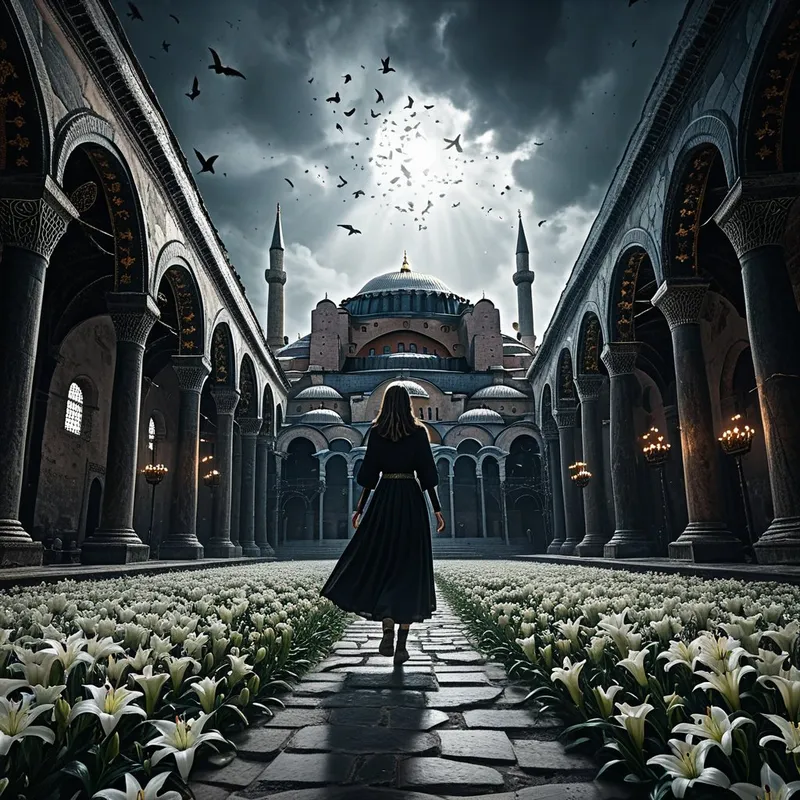
In the early Christian era, this figure was passionately adopted and reinterpreted. Church Fathers, especially in the Eastern Orthodox tradition, saw in Hagia Sophia a prefiguration of Christ (the Logos, or Word) and, significantly, of the Church itself. The great cathedral in Constantinople, dedicated to Hagia Sophia, is the ultimate architectural expression of this myth—a physical space designed to be the “house” Wisdom built, where heaven and earth met under the vast dome. The myth was passed down through liturgy, hymnography, and the very stones of that sacred space, teaching that divine wisdom is not merely studied, but encountered in a community of faith.
Symbolic Architecture
At its core, the myth of Hagia Sophia symbolizes the feminine principle of divine order. She is not order as rigid law, but order as dynamic, creative, and relational intelligence. She represents the connective tissue between the absolute and the relative, the idea and its manifestation.
She is the pattern that connects the star to the cell, the moral law to the beating heart.
Psychologically, Hagia Sophia represents the Anima in its highest, most developed form—not as a romantic projection, but as the soul’s guide to meaning and coherence. She is the function of the psyche that seeks synthesis, that yearns to see the whole picture, to find the deep logic beneath surface chaos. Her descent symbolizes the necessary journey of this unifying principle from the unconscious (the heavenly abode) into conscious life (the world). A person cut off from this inner Sophia lives in a fragmented state, able to collect data but unable to discern its meaning or relation to the whole.
Her seven pillars (from Proverbs 9:1) are often interpreted as the seven gifts of the Holy Spirit, or the seven classical virtues. They represent the complete, stable structure of a soul or a society founded on wisdom. The myth argues that true power and stability come not from force, but from alignment with this foundational, feminine intelligence.

The Dreamer's Resonance
When the archetype of Hagia Sophia stirs in the modern dreamer, it often signals a profound psychological process: the search for authentic meaning and inner authority. This is not the hero’s quest for conquest, but the sage’s journey toward understanding.
Dreams may manifest as finding a hidden, beautifully organized room in one’s own house; encountering a serene, authoritative female figure who offers a key or a book; or hearing a clear, guiding voice in a moment of confusion. The somatic experience is often one of sudden calm, a deep breath after long tension, a feeling of things “clicking” into place. The dreamer might experience a release from the tyranny of contradictory thoughts or the pressure of external opinions.
Psychologically, this is the process of the ego humbling itself before a greater intelligence within. It is the moment when one stops trying to “figure it out” through effort alone and begins to listen. The conflict in such dreams is usually between the noise of the world (the chaotic city streets) and the clear, persistent call from the crossroads. The dreamer is being invited to leave “simple ways”—the black-and-white, reactive patterns of the ego—and to “walk in the way of insight,” which is a path of nuance, paradox, and synthesis.
Alchemical Translation
The alchemical process mirrored in the Hagia Sophia myth is the coniunctio oppositorum—the sacred marriage of opposites. Her descent is the quintessential act of solve (dissolution), where the transcendent spirit willingly enters the confines of matter and history. The building of her house is the act of coagula (coagulation), where spirit takes form within the soul of the individual.
The alchemical gold is not manufactured by the ego, but revealed when the psyche consents to be the vessel for a wisdom greater than itself.
For the modern individual, the myth models the stage of individuation where one moves beyond the persona’s adaptations and the hero’s victories into the realm of the sage. The core struggle is the ego’s resistance to this descent—the fear that seeking wisdom will mean a loss of control, identity, or certainties. The triumph is the realization that true selfhood is found not in isolation, but in relationship to this inner, guiding Sophia.
The transmutation occurs when the seeker stops projecting wisdom onto external authorities—gurus, ideologies, rigid doctrines—and allows it to be incarnated within their own lived experience. One builds the “house” of seven pillars through disciplined practice (ethics, study, reflection), creating a stable inner structure where this wisdom can dwell. The final stage is not becoming wise oneself in a possessive sense, but becoming a clear conduit through which Hagia Sophia can speak into the world. The individual becomes a localized point of the pattern, a living embodiment of the bridge between heaven and earth, thought and action, soul and world.
Associated Symbols
Explore related symbols from the CaleaDream lexicon: