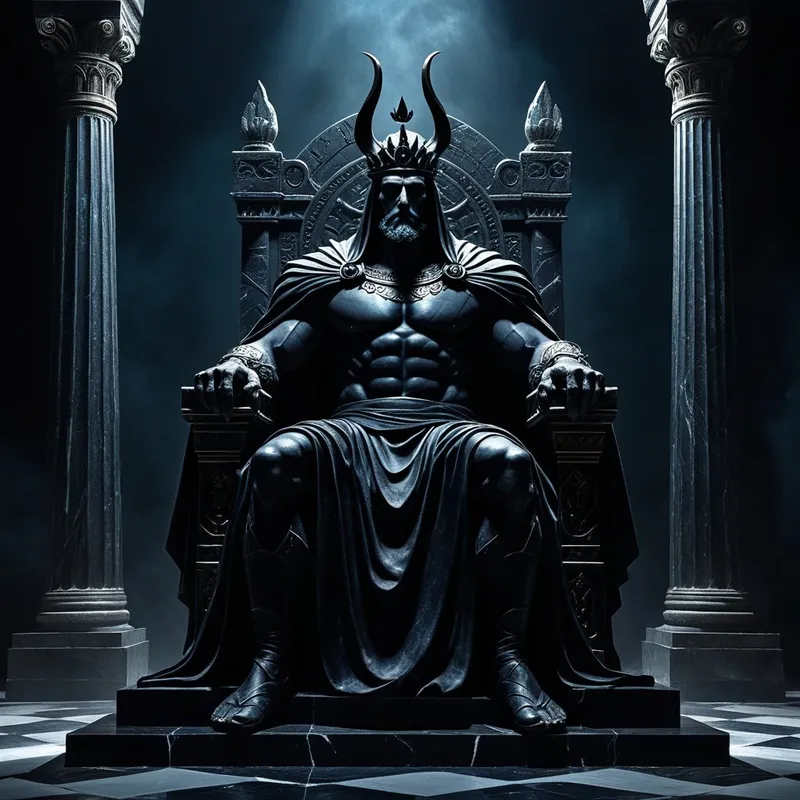
Hades/Pluto Myth Meaning & Symbolism
The abduction of Persephone by Hades initiates a cycle of loss, sovereignty, and rebirth, revealing the underworld as a crucible for the soul's deepest transformation.
The Tale of Hades/Pluto
Hear now the story not of light, but of the deep earth. It begins not with a battle cry, but with a whisper from a crack in the world.
In the time when the gods divided the cosmos, the eldest brothers drew lots. Zeus took the boundless sky. Poseidon claimed the restless seas. And to Hades, the silent brother, fell the dominion of all that lies beneath—the vast, unseen kingdom of the dead. He withdrew, a sovereign without sunlight, and built his realm in perfect, solemn order. His palace was of shadow and memory, his crown a helm of darkness, his scepter a bident that could cleave the very earth. And in his halls, he ruled alone, a king of echoes.
Above, in the world of the living, Demeter tended her daughter, Persephone, whose laughter was the first green shoot of spring. One day, as Persephone gathered flowers with her nymphs in a Sicilian meadow, she strayed from her companions, drawn to a single, breathtaking narcissus of unearthly beauty. As she reached for its bloom, the earth beneath her feet groaned and split asunder. From the yawning chasm, a chariot of polished jet erupted, drawn by immortal, smoke-dark steeds. At its reins stood Hades, his presence both terrifying and majestic. In one swift, silent motion, he gathered the shrieking maiden into his arms and plunged back into the depths. The earth sealed itself, leaving only trampled flowers and a silence that screamed.
Demeter’s grief was a blight upon the world. She roamed the earth, a torch in each hand, her sorrow so profound that the fields lay fallow, the trees bore no fruit, and mankind faced extinction. The sun, witness to all, told her of Hades’ deed, but not even Zeus’s commands could sway the Lord of the Dead or soothe the Mother’s rage.
Meanwhile, in the Underworld, Persephone sat, a queen in a gilded cage. She refused all food, a ghost among ghosts. Hades, in his stark way, offered not apology but domain. This was his kingdom, and she was now its mistress. Yet, the Fates had decreed a cruel law: whoever consumes the food of the dead is bound to them forever. Seeing her despair, Hades offered her a pomegranate, its seeds glistening like coagulated blood. In her loneliness and perhaps a dawning acceptance of her new power, Persephone ate six seeds.
Above, Demeter’s winter threatened to become an eternal death. Confronted with the end of all life, Zeus sent the swift messenger Hermes down the dark road to Hades’ hall to negotiate a return. Hades, the unyielding, agreed—but only partially. Because Persephone had tasted the food of his realm, she was forever tied to it. A compromise was struck, a rhythm for the world: for each seed eaten, a month of the year she must reign as Queen beside him in the depths. For the rest, she could walk again in the sun.
Thus, Persephone ascended, and where her feet touched the frozen ground, flowers erupted. Demeter’s joy restored life to the world. But the maiden was now also the queen. And so, the cycle was sealed: spring and summer for her ascent, autumn’s harvest and winter’s sleep for her descent. The world learned that life is born not only from light, but from a necessary, recurring agreement with the dark.

Cultural Origins & Context
This central myth, often called the Homeric Hymn to Demeter, was a cornerstone of ancient Greek religious life, particularly the secret rites of the Eleusinian Mysteries. Unlike the public, Olympian festivals, these mysteries were initiatory, promising initiates a better lot in the afterlife and a profound understanding of the cycle of life, death, and rebirth. The myth was not merely a story but a sacred narrative performed and experienced, providing a framework for understanding the most terrifying human realities: the descent of loved ones into death and the annual "death" of the fertile earth.
The figure of Hades himself was so feared that his true name was often avoided; he was called Plouton (Pluto), "the Rich One," both for the mineral wealth under the earth and the countless souls in his domain. This reflects a cultural practice of appeasing powerful, chthonic forces through respectful language. The myth functioned as an agricultural allegory, yes, but more deeply as a theological and psychological map for navigating loss, the unseen, and the acquisition of sovereignty through ordeal.
Symbolic Architecture
The myth’s power lies in its perfect symbolic architecture. Hades is not a villain, but an inevitable principle—the ruler of all that is hidden, repressed, and foundational.
The underworld is not a place of punishment, but of essence. It is where the un-lived life, the forgotten memory, and the unacknowledged power reside, awaiting recognition.
Persephone’s abduction is not a random act of violence, but a necessary calling of the psyche. The maiden, representing the conscious, untested ego-life, is summoned by the deep Self (Hades) to engage with the totality of her being. The pomegranate seeds are the ultimate symbol of conscious choice within fate. By eating them, Persephone actively participates in her own binding, transitioning from a passive victim to an active queen who understands both realms.
Demeter represents the powerful, life-giving force of the conscious world that must learn to endure loss and cyclical change. Her grief is valid and world-altering, but it is not the final word. The resolution is not a rescue, but a negotiation, establishing a rhythm between above and below, consciousness and the unconscious, life and what lies beyond life.

The Dreamer's Resonance
When this mythic pattern stirs in modern dreams, it often signals a profound, involuntary encounter with the personal shadow or the collective depths. Dreaming of being pulled underground, of finding hidden rooms in a basement, of meeting a solemn, authoritative figure in the dark, or of eating a strange, potent fruit—these are somatic echoes of Persephone’s descent.
The psyche is initiating a process of nekya—a symbolic descent into the underworld for knowledge. This is not pathology, but a natural psychological process often triggered by loss, depression, major life transitions, or a deep sense that one’s surface life has become barren. The dreamer is being compelled to confront what they have ignored or repressed (their personal Hades realm) to retrieve a vital, queenly aspect of themselves that can only be forged in that darkness. The somatic feeling is often one of weight, pressure, or chilling awe, followed by a slow, hard-won sense of inner authority.

Alchemical Translation
For the modern individual striving for wholeness or individuation, the Hades/Pluto myth is the ultimate alchemical manual. The process begins with the abduction: a crisis that shatters the comfortable, sunlit ego (Persephone in the meadow) and forces it into the crucible of the unconscious.
The treasure is always guarded by a dragon, and the dragon is the shadow we refuse to own. Hades is that dragon, and his treasure is the soul’s own sovereignty.
The descent is the nigredo, the blackening—a period of depression, confusion, and stripping away of old identities. Here, one must do as Persephone did: first refuse the false comforts (fasting), then eventually consciously engage with the substance of the place. Eating the pomegranate seeds is the pivotal act of acceptance and integration. It is saying "yes" to the difficult truths, the inherited traumas, the buried talents, and the potent rage that reside within one’s own depths.
The return is not to the old life, but to a new one, cyclically renewed. The modern Persephone becomes a mediatrix, capable of bringing the wealth of the underworld (Pluto’s riches: self-knowledge, resilience, profound creativity) back to the surface world. The alchemical gold forged in this process is a personality that no longer fears the dark, because it knows itself to be the rightful ruler of both realms. The ego, once a maiden, becomes a queen in partnership with the vast, foundational Self. Life becomes not a linear march toward light, but a sacred, seasonal cycle of depth and bloom.
Associated Symbols
Explore related symbols from the CaleaDream lexicon: