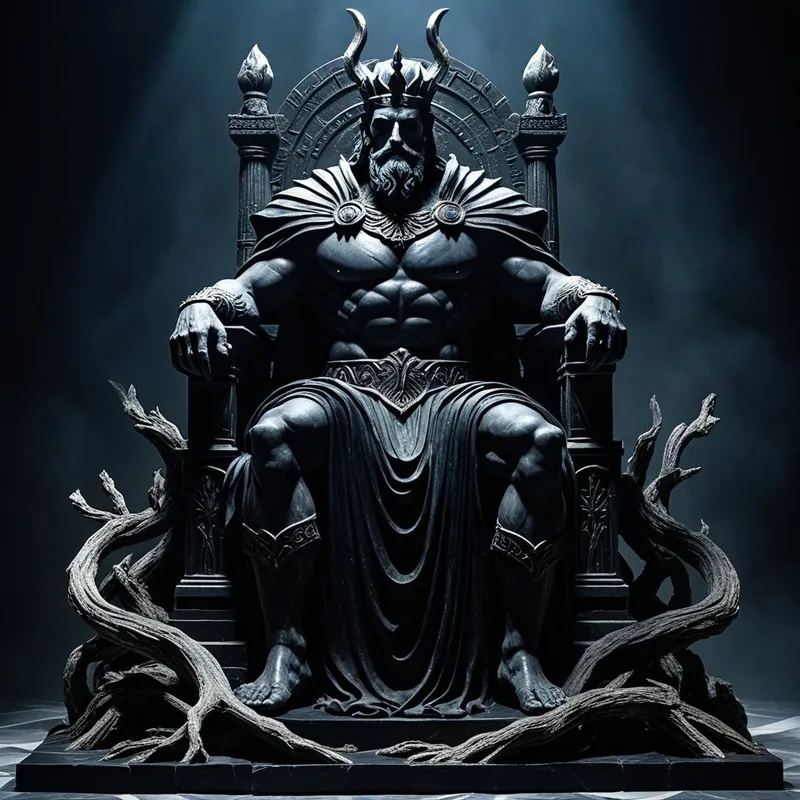
Hades Myth Meaning & Symbolism
The story of Hades, lord of the underworld, and his abduction of Persephone, a myth of descent, sovereignty, and the cyclical nature of life and death.
The Tale of Hades
Listen, and hear the tale not of the sunlit peaks of Olympus, but of the deep, silent places where all things must, in time, return.
In the beginning, after the great war of the Titans, the three brothers—Zeus, Poseidon, and Hades—cast lots for their kingdoms. Zeus won the shimmering sky, Poseidon the restless sea. And to Hades fell the world below, the sunless realm of the dead, the Hades. He became its sovereign, a king in a kingdom of whispers, far from the laughter of the gods above.
Yet, a king alone is no king at all. In his vast, echoing halls, seated upon a throne of ebony, Hades felt the weight of eternal solitude. His gaze turned upward, through the layers of earth and stone, to the world of the living. There, in the fields of Demeter, her daughter Persephone danced. She was the very soul of spring, her laughter causing flowers to burst from the soil, her steps leaving trails of hyacinth and violet.
A deep, silent longing took root in the Lord of the Dead. He went to his brother Zeus and spoke of his desire. Zeus, who gives and withholds with a nod, gave his silent assent, knowing the storm it would summon.
On a day when the sun hung heavy and golden, Persephone wandered far from her companions, drawn to the edge of a meadow by a flower of breathtaking beauty—a narcissus, planted by the will of Hades itself. As she reached for its blinding bloom, the earth beneath her feet roared and cracked. The fertile soil split open, and from the abyss came a thunder of hooves that shook the very roots of the world. A chariot of polished jet, drawn by four immortal horses the color of starless midnight, erupted into the light. And there was Hades, his form immense and clad in shadows. In one swift, terrifying motion, he seized the shrieking goddess, pulled her into the chariot, and plunged back into the deepening chasm. The earth sealed itself above them, leaving only a trampled meadow and a fading cry.
Above, Demeter’s grief was a force of nature. She roamed the earth, a torch in each hand, her sorrow turning the world to frost and famine. No seed sprouted; no child was born. The earth grew silent and gray, a mirror of her despair.
Below, in the world of shades, a different transformation unfolded. Persephone, in her initial terror and grief, refused all sustenance. But Hades was not a cruel jailer; he was a patient king. He showed her his realm—the fields of Asphodel, the mournful waters of Acheron, the silent majesty of his palace. He offered her a throne, not a cage. Slowly, the raw terror subsided, replaced by a profound, unsettling awe. In this world of finalities, she was alive, a spot of vibrant color in a monochrome eternity.
Then came the fateful act. Overcome by a hunger not just of the body but of the soul—a need to bind herself to this new, strange reality—Persephone accepted a pomegranate from Hades’ hand. She ate six of its glistening, blood-red seeds.
This simple act echoed through the cosmos. Demeter’s lament reached Olympus, and a barren world forced Zeus to intervene. A bargain was struck, dictated by the ancient law of the Fates: for each seed consumed, a month must be spent below. And so, Persephone, now Queen of the Underworld, rises each spring, bringing life with her, and descends each autumn, taking it with her, weaving the very cycle of the world with her journey.

Cultural Origins & Context
This central myth of abduction and return, known as the Eleusinian Mysteries, was not merely a story for the ancient Greeks; it was a sacred narrative at the heart of one of their most profound religious experiences. Passed down through generations and ritually re-enacted at Eleusis, it was a mystery in the truest sense—its deepest meanings were revealed only to initiates, sworn to secrecy. The storytellers were priests and priestesses, and the function of the myth was multifaceted: it explained the seasonal cycle, yes, but more importantly, it offered a template for understanding death, rebirth, and the promise of something beyond mortal terror. It provided a cultural container for the most fundamental human anxieties, transforming the bleak finality of death into a cycle with a pattern, presided over by a queen who had experienced both life and death.
Symbolic Architecture
The myth of Hades is a masterful map of the psyche’s deepest terrain. Hades himself is not evil; he is the archetype of the Shadow and the Unconscious. His realm is not a place of punishment for all, but simply what is below—the repository of all that is forgotten, repressed, and ended.
The Underworld is not hell; it is the necessary basement of the soul, where what is finished awaits transformation.
Persephone’s abduction is the inevitable, often traumatic, encounter with this hidden self. It is the crisis, the depression, the loss that forces a descent out of the “meadow” of conscious, sunny identity. Her initial resistance mirrors our own when facing the dark. The pomegranate seeds are the critical symbol of conscious choice within the unconscious realm. By eating them, she does not merely submit; she actively ingests the reality of the underworld, making it a part of her own substance. She transitions from abducted girl to sovereign queen, integrating the power of the depths.
To eat the seeds of the underworld is to accept the nourishment of shadow, transforming victimhood into sovereignty.
Demeter represents the conscious mind and the ego’s attachment to a previous, “fruitful” state of being. Her grief is the ego’s rage and despair when the psyche must journey beyond its control. The resulting compromise—the cyclical division of the year—symbolizes the enduring truth of the integrated self: one is never wholly of the light or the dark again, but moves between them, each phase giving meaning to the other.

The Dreamer's Resonance
When this mythic pattern stirs in modern dreams, it signals a profound initiation into the depths of the self. Dreaming of being pulled underground, of finding oneself in vast, empty palaces, of encountering a solemn, powerful figure in the shadows, or of being offered dark, jewel-like fruit points to an active process of psychic descent.
Somatically, this may feel like a “dark night of the soul,” a period of depression, lethargy, or existential ennui where the familiar world loses its color. Psychologically, it is the unconscious asserting its claim. The ego is being called to relinquish its sole sovereignty, to acknowledge the powerful, often terrifying, realities it has excluded: unresolved grief, buried trauma, unexpressed rage, or innate potentials that are too vast for the persona to contain. The dream is not a prophecy of doom, but an invitation to the throne room of the disowned self.

Alchemical Translation
The alchemical journey, or individuation, follows the path of Persephone. The first stage, the descent (nigredo), is the abduction—the involuntary plunge into chaos, depression, or crisis that shatters the old conscious attitude. This is the “death” of the innocent, sunlit self.
The second stage, the encounter (albedo), occurs in the underworld. Here, in the reflective silence of the depths, one must face the Hades-figure—the inner Other, the shadow, the animus/anima. This is not a battle to win, but a sovereignty to recognize. The offering and acceptance of the pomegranate seeds is the critical moment of coniunctio—the sacred marriage. It represents the conscious choice to engage with, learn from, and ultimately integrate the power of the unconscious.
The alchemical gold is forged not in the sun, but in the marriage of the above and the below, the conscious and the unconscious.
The final stage is the return (rubedo), but it is a return transformed. Persephone emerges not as Kore the Maiden, but as Queen. The individual who completes this cycle does not return to their old life, but lives a life informed by both realms. They carry the wisdom of the depths into the world of action, and understand the light because they have known the dark. They become whole, cyclical, and sovereign over the full spectrum of their being, capable of both creating life and presiding over necessary endings. The myth thus models the ultimate psychic triumph: not escaping the underworld, but earning a crown within it, and thereby changing the nature of the world above.
Associated Symbols
Explore related symbols from the CaleaDream lexicon: