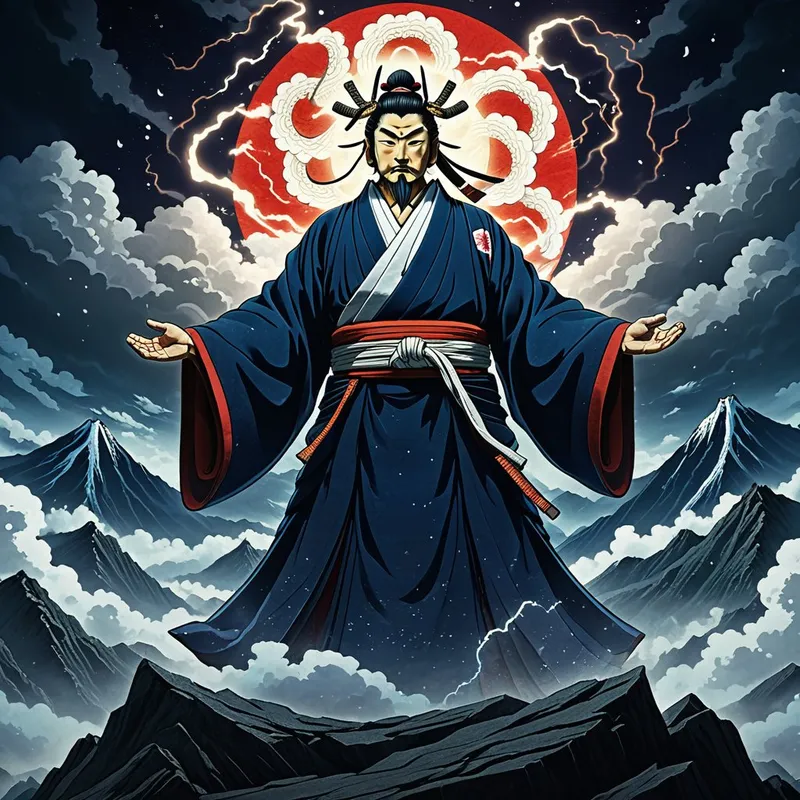
Hachimaki Myth Meaning & Symbolism
The story of a sacred cloth born from divine breath and mortal resolve, transforming into a symbol of unbreakable focus and spiritual armor.
The Tale of Hachimaki
Listen, and hear the breath that binds the spirit.
In the age when the world was still soft clay and the kami walked with footsteps that shook the mountains, there was a great stirring. Not a war of gods, but a war within the human heart. A fog of distraction, a chaos of desire and fear, had descended upon the people. Their thoughts were like scattered leaves in a typhoon, their wills too weak to hold a single purpose. They built shrines with crooked walls, sang prayers with forgotten words, and their hands, which could shape beauty, created only confusion.
Seeing this sorrow, a humble artisan named Takumi retreated to his silent workshop high in the misty hills. His heart ached not for gold or glory, but for clarity. For a single, pure line of intent. For seven days and seven nights, he fasted, meditated, and prayed to Amaterasu-Ōmikami. He did not ask for power, but for a vessel—a simple thing that could hold a human’s fleeting resolve.
On the dawn of the eighth day, as the first light pierced the mountain mist, a warmth filled his chest. It was not a voice, but a knowing. He took the finest, undyed hemp, threads as plain as a sincere thought. As he began to weave, he did not move his hands alone. With each pass of the shuttle, he breathed. He breathed out his doubts, his fatigue, his scattered hopes. He breathed into the cloth his unwavering intent, his plea for focus. The air in the room grew still and heavy, charged with the weight of a soul being poured into form.
The cloth was simple: a band of pure white. But as Takumi lifted it, it felt alive with a quiet hum. He tied it around his brow, and the world shifted. The chaotic noise of his own mind hushed. The path ahead, once shrouded, became a clear line of light. His hands, now steady as ancient stone, created works of such sublime beauty that they seemed to capture sunlight itself.
Word of the artisan’s transformation spread like wind through bamboo. People came—farmers with fields plagued by blight, warriors whose courage wavered, mothers with sick children. To each, Takumi offered not the cloth from his own head, but the teaching. “Weave your own breath,” he said. “Weave your own resolve.” And they did. They learned to bind their wandering spirits to a single point between their eyes, the seat of perception. The hachimaki became their armor not against steel, but against dissipation. It was the visible sign of an invisible act: the gathering of the self.

Cultural Origins & Context
The hachimaki is not born from a single, canonical myth recorded in the Kojiki or Nihon Shoki. Its mythology is folkloric, woven into the practical fabric of Japanese life over centuries. Its origins are diffuse, emerging from the intersection of Shinto practice, Buddhist discipline, and the exigencies of physical labor and warfare.
In Shinto, the head is considered sacred, the dwelling place of the spirit. Purification rituals often involve binding the hair or head with white paper or cloth (shide) to mark a state of ritual purity and concentration. The hachimaki can be seen as a personal, portable version of this sanctification. Samurai adopted it, tying it tightly before battle to ward off distraction, fear, and literally to keep sweat from their eyes—a perfect fusion of spiritual and practical purpose. It was worn by firefighters, construction workers, students cramming for exams, and participants in arduous festivals. The myth of its creation, as told in folk stories and through the act of wearing it, is a democratization of sacred intent. It asserts that the power to focus one’s spirit, to become a vessel for determined action, is not the sole province of priests or nobles, but is available to anyone willing to perform the simple, profound ritual of tying the cloth.
Symbolic Architecture
The hachimaki is a masterclass in symbolic economy. A simple strip of cloth becomes a map of the human will.
The knot tied at the back of the head signifies the binding of the unconscious, the taming of the chaotic inner world so that the conscious mind, facing forward, can act with clarity.
Its primary color, white, is the color of purity, death, and rebirth in Japanese symbolism. It represents the blank slate of intention, the state of mushin one must achieve before a great endeavor. The act of tying it is a ritual of self-consecration, a physical gesture that creates a psychological boundary. It marks a transition from the mundane, scattered self to the focused, purposeful self. The location—the forehead—is critical. It covers the ajna chakra, the seat of insight and command. Psychologically, it represents the ego’s fortress, the command center that must be fortified against both external distraction and internal doubt.
The hachimaki is also a symbol of contained energy. It is a band that holds in the heat of effort, the steam of passion, and the light of consciousness, directing it all forward like a laser. It turns the wearer’s head into a lantern, with the white band as the visible glow of their concentrated spirit.
The Dreamer's Resonance
When the hachimaki appears in a modern dream, it rarely does so as a literal cloth. It manifests as the feeling of binding, focusing, or preparing. One might dream of desperately trying to tie a bandage around their head that keeps slipping, or of finding a simple, powerful object that, when held, silences mental noise. The somatic sensation is often one of pressure around the temples or brow—a psychic headache seeking form.
This dream motif signals a critical psychological process: the ego’s struggle to consolidate itself amidst overwhelming complexity or anxiety. The dreamer is in a life situation requiring immense focus—a career challenge, a creative project, a period of intense study, or a need to maintain emotional stability in crisis. The slipping hachimaki reflects a fear of losing that focus, of being unable to “hold it together.” Finding one, or successfully tying it, symbolizes the nascent, hard-won ability to center the self, to choose a single point of awareness amidst the chaos. It is the psyche’s innate ritual for self-armoring, emerging from the depths when conscious will is frayed.

Alchemical Translation
The myth of the hachimaki models the individuation process as an act of sacred, self-applied constraint. Individuation is not a wild explosion of potential, but a conscious, disciplined focusing of the personality around a central, authentic core.
The alchemical vessel is not the flask of gold; it is the bounded space of one’s own committed attention. The prima materia is the chaotic stream of consciousness; the hachimaki is the ritual that contains and directs it.
The first step, as Takumi demonstrated, is retreat and purification (the nigredo). One must withdraw from the distracting outer world to confront the inner fog. The “breath” woven into the cloth is the conscious life force, the libido, which is usually scattered. The act of weaving is the patient, repetitive work of analysis and self-observation (the circumambulatio), gathering disparate psychic elements.
Tying the hachimaki is the creation of the vas, the sealed vessel. It is the ego saying, “For this task, for this period, I define my boundaries. I exclude the irrelevant.” This creates the necessary pressure for transmutation. The focused energy, held within this bound space, intensifies and clarifies. What emerges is not a new thing, but the essence of the old, purified and potentiated: the focused will, the capable hand, the clear mind (the albedo and rubedo).
For the modern individual, the “hachimaki” is any conscious ritual of focus. It is the turning off of notifications to write, the morning meditation, the deep breath before a difficult conversation. It is the psychological technology of binding one’s own scattered spirit to a purpose, transforming the base metal of anxiety and potential into the gold of accomplished action. The myth teaches that the power to do so is not granted by the gods, but breathed into being by the human who dares to concentrate their entire being into a single, white-hot point of intent.
Associated Symbols
Explore related symbols from the CaleaDream lexicon: