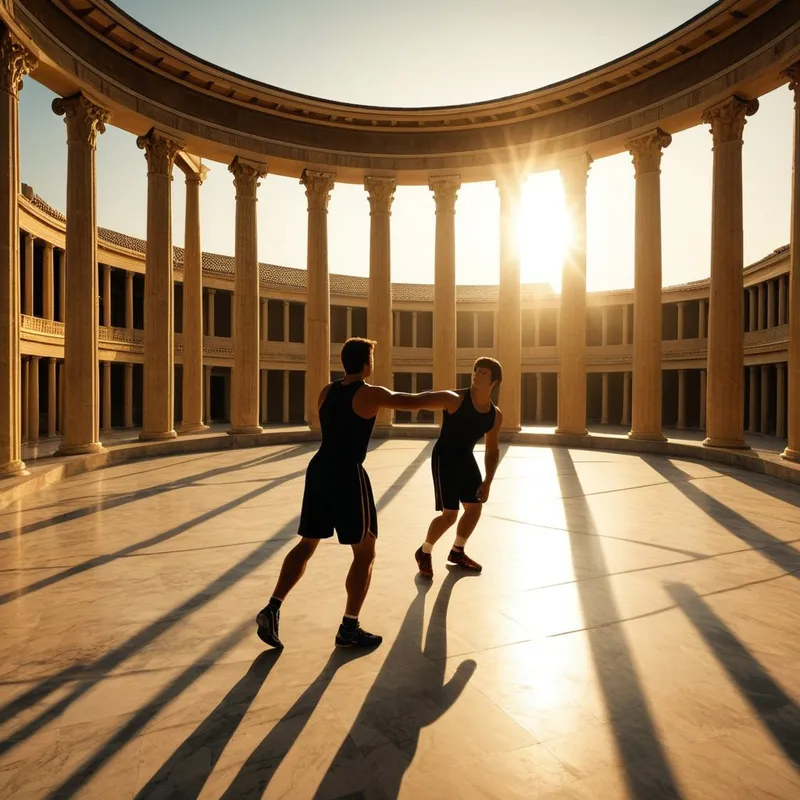
Gymnasium Myth Meaning & Symbolism
The myth of the Gymnasium tells of a sacred precinct where youth trained not just in body, but in virtue, under the watchful eyes of gods and philosophers.
The Tale of Gymnasium
Hear now, not of a single hero, but of a sacred precinct, a temple not of stone alone but of striving flesh and aspiring spirit. In the heart of the polis, where the clamor of the agora faded, there lay a clearing of packed earth and colonnaded shade—the Gymnasium.
The air here was different. It tasted of dust kicked from the skamma, the wrestling pit, and of the sharp, clean scent of olive oil scraped from gleaming skin. It hummed with a low music: the grunt of effort, the slap of palm on thigh, the rhythmic thud of the halteres—the jumping weights. But listen closer. Beneath the physical symphony whispered another: the murmur of dialectic, the recitation of verse, the quiet argument about justice and the nature of the good.
This was the domain of Hermes, whose swift statue stood at the entrance, a reminder that the path here was a journey. And it was watched by Heracles, whose labors were painted upon the walls, a silent testament to the agony and glory of surpassing one’s limits. The youth came here as raw clay. They were anointed with oil, not as kings, but as initiates. Their tutors, the paidotribes, were taskmasters and priests of the body, guiding them through the sacred movements of the pankration, the discus, the footrace.
The conflict was not against a monster, but against the chaos within—the laziness of the limb, the cowardice of the heart, the dullness of the mind. The rising action was the daily ritual: the stripping bare of social pretense, the plunge into the cold waters of the loutron, the relentless repetition until movement became instinct, until breath became rhythm. Friends became opponents in the pit, striving not for humiliation, but for mutual excellence, their bodies a living dialogue of force and balance.
And the resolution? It was not a trophy, but a state of being. It was the moment the sweat-drenched youth, his lungs burning, could sit on the sun-warmed steps and turn his mind, now clear and focused from the bodily struggle, to the words of a philosopher walking among the columns. It was the integration of the panting breath with the soaring idea. The myth of the Gymnasium is the story of this alchemy—where the leaden self is placed in the forge of discipline and emerges, for a moment, touched by gold.

Cultural Origins & Context
The Gymnasium was not a mere athletic club; it was a foundational institution of Hellenic society, particularly from the 6th century BCE onward. Its origins are intertwined with the very ideal of paideia—the holistic education of a citizen. It was the practical embodiment of the maxim mens sana in corpore sano, though the concept is purely Greek.
These spaces were publicly owned and central to civic life. While young men (ephebes) underwent formal training for war and citizenship, the Gymnasium was also a social and intellectual hub for adult men. Philosophers like Plato, Aristotle, and later the Stoics and Cynics, taught in gymnasia (Plato’s Academy was adjacent to one). The culture was one of public, masculine virtue, where excellence (arete) was displayed and judged by the community. The myth was “told” not in a single narrative, but in the daily rituals, the architecture, the votive statues, and the philosophical dialogues that used the gymnasium as their setting. Its societal function was nothing less than the production of the ideal citizen: physically capable, mentally disciplined, and ethically grounded.
Symbolic Architecture
Psychologically, the Gymnasium represents the contained space of the Self where opposites are forced into dialogue. It is the archetypal vessel for individuation.
The raw earth of the wrestling pit is the unconscious, primal and untamed. The colonnade that borders it is the conscious mind, imposing order and structure. True strength is born in the traffic between the two.
The Hermes figure symbolizes the necessary psychic function that mediates between our animal physicality and our lofty ideals. He guides the transition from brute force to skillful art. The elaion (olive oil) is rich symbolism: it protected the skin, but also made the body luminous, a literal shining forth of the inner effort. It represents the libido or psychic energy that must be consciously applied to the work of self-formation.
The act of stripping naked (gymnos means “naked”) is the ultimate symbol of psychic honesty—the removal of persona, status, and armor to confront the essential self, with all its flaws and potential, in the full view of the objective psyche (the community/ the gods).

The Dreamer's Resonance
To dream of a gymnasium is to dream of a phase of intensive self-work. The specific imagery reveals the nature of the struggle.
Dreaming of endlessly running on a track may point to a feeling of life as repetitive training without a clear goal, a somatic expression of running from or toward an undefined finish line. Being unable to lift weights that others handle easily speaks to a profound sense of inadequacy in shouldering life’s burdens or one’s own potential. A dream of wrestling with a familiar figure—a friend, a sibling—often symbolizes engaging with a shadow aspect of oneself that is projected onto that other.
The somatic process is one of building tension to achieve release. The dream gymnasium is where the psyche gathers its diffuse energies and applies them to a specific, often arduous, task. It is the mind-body complex signaling a need for discipline, for the conscious application of effort to integrate a neglected aspect of the self. The anxiety in such dreams is the fear of being judged inadequate by the inner paidotribes (the inner critic or the ideal self).

Alchemical Translation
The myth of the Gymnasium is a precise manual for psychic alchemy. The prima materia is the unrefined individual, a mixture of chaotic impulses, lazy habits, and unrealized ideals.
The first operation is separatio: stripping bare, removing the comforts and disguises of the persona. This is the cold plunge, the shock of confronting the self without its stories. The second is nigredo: the blackening, the struggle in the dust of the pit. This is the phase of frustration, fatigue, and despair—the “dark night of the soul” encountered in any meaningful endeavor.
The sacred marriage (coniunctio oppositorum) occurs not in a temple, but in the moment the exhausted body sits and the mind, purified by exertion, becomes capable of receiving insight. Flesh and spirit are wedded in effort.
The applied heat of the process is disciplina—the daily, repetitive practice. This sustained heat causes the transmutatio: the heavy lead of instinctual life begins to gleam with the gold of conscious will and embodied wisdom. The final product is not a perfected being, but the philosophical athlete: an individual who can hold tension, engage conflict, endure suffering, and emerge with greater coherence. The goal is not to win the race, but to become the kind of being for whom the race is a sacred dialogue with the limits of the human condition. The Gymnasium, therefore, is the eternal inner space where we are forever both the student and the master, the clay and the sculptor, engaged in the never-complete, always-necessary work of becoming.
Associated Symbols
Explore related symbols from the CaleaDream lexicon: