The Unseen Curriculum: When Dreams Demand Your Education
The Somatic Echo
It begins not as a thought, but as a weight. A dense, metallic pressure behind the sternum, as if you’ve swallowed a forgotten key. The breath becomes shallow, a student’s breath, held in anticipation of a test for which you know you have not studied. There is a dryness in the throat, the ghost of chalk dust and unspoken answers. The body remembers the posture before it knows the subject: a slight hunch of the shoulders, a subtle bracing against an invisible authority. This is the somatic echo of the Education dream. It is the visceral memory of being instructed, of a system external to your being attempting to impose its logic upon your flesh. Before any image of a classroom or textbook forms, the nervous system is already broadcasting the core dilemma: a deep, structural part of you is being called to the mat. It is being summoned not to learn a new fact, but to undergo a fundamental reorientation—a curriculum written in the language of your own becoming.
The Dreamer's Log
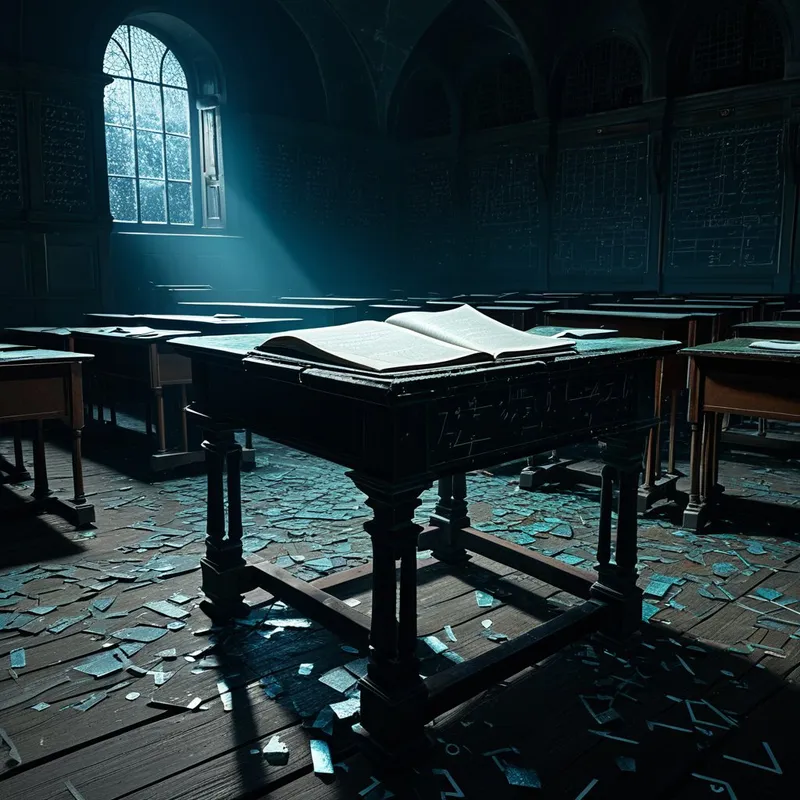
She is back in the university library, but the books are made of cold, polished stone. She knows her final exam is moments away, a test on a subject she has never attended a single lecture for. She runs her fingers over the unreadable glyphs carved into a granite tome, and a profound, chilling certainty settles in her bones: she is being tested on her own life, and she has failed to study it. This is the alchemy of the forgotten syllabus: the dream exposes the terrifying gap between who you have been performing as, and who your soul requires you to become.
The False Lead
This theme is not about literal regret over a missed degree or anxiety about a work presentation. To interpret it as such is to mistake the symphony for a single off-key note. The Education dream is not concerned with the accumulation of external credentials or social validation. Its terror is not about failing a class, but about failing the initiation. It points to a place within you where an old, foundational operating system—a way of perceiving, valuing, and navigating the world—has been declared obsolete by your deeper Self. The grief here is not for a lost opportunity in the world, but for a version of yourself that must now be compassionately decommissioned. It is the signal of a required death, not of potential, but of a limiting identity.
Psychological Architecture
Beneath the dream of the forgotten exam lies the shadow work of individuation—the process of ceasing to be a mere reflection of your family’s expectations, your culture’s scripts, or your own outdated survival strategies. The “classroom” is your internalized world, the “teacher” is often the accumulated voice of authority (parental, societal, religious) you have installed as your inner critic. The curriculum, however, is set by the Self. To fail this exam is to remain a loyal student in a prison of someone else’s design. To pass it is to become the author of your own epistemology.
This is a dismantling. You are not adding new furniture to the room of your psyche; you are being asked to recognize that the room itself was built on faulty bedrock. The “homework” is the often excruciating daily work of noticing: When do I contract into the good child? When do I perform understanding to please a ghost? Where have I outsourced my inner authority? The Education dream makes the process visceral. It is the psyche’s way of saying the theoretical must become embodied. Knowledge must become gnosis—a knowing that is felt in the marrow, a truth that rewires your nervous system. This is the architecture of sovereignty: building a center of gravity that is yours alone, constructed from the raw materials of your own lived, unfiltered experience.
Mythic Resonance
We see this eternal curriculum in the myth of the Garden of Eden. It is often framed as a fall from grace due to disobedience. But through the lens of the Education dream, it is the first and most profound allegory for compulsory learning. Adam and Eve are in a state of innocent, pre-conscious unity—the ultimate “pass/fail” system managed by an external, divine authority. Eating from the Tree of Knowledge of Good and Evil is not mere rebellion; it is the agonizing, necessary act of enrolling in the curriculum of consciousness. They are expelled from the static paradise of unquestioned truth and thrust into the relentless school of lived experience, of choice, of consequence, of self-awareness. The dream of the forgotten exam is the echo of that primordial terror and longing: the cost of leaving the garden of simple answers for the complex, self-authored world of meaning.
Symbolic Nodes
- Forgotten Exams/Unprepared Presentations: The core confrontation with the unintegrated self.
- Endless Corridors/Labyrinthine Schools: The psyche’s complex, often confusing internal structure.
- Teachers as Authority Figures (feared or revered): The internalized voices of judgment, expectation, or wisdom.
- Textbooks in Unknown Languages: The soul’s curriculum, written in symbols the conscious mind has yet to decipher.
- Lost Lockers or Classrooms: Repressed memories, talents, or aspects of self waiting to be reclaimed.
- Being Late or Unable to Find the Room: Resistance to the necessary lesson, or the feeling of being out of sync with one’s own development.
Archetypal Resonance
The energy at the core of the Education dream is that of The Sage Archetype—specifically, its shadow aspect, The Shadow Sage (Dogmatic/Judgmental). Initially, the dreamer is in thrall to this Shadow Sage: the internalized, harsh professor who deals in absolutes, rigid hierarchies of knowledge, and the cold fear of failure. This is the voice that administers the impossible test. The somatic echo—the chest pressure, the shallow breath—is the body’s reaction to this internal tyranny. Yet, the dream’s very occurrence is the first spark of the true Sage’s emergence. The alchemical potential lies in the transmutation of this dynamic: from being the anxious student judged by an internalized dogma, to becoming the humble, lifelong learner guided by your own hard-won wisdom. The goal is not to become the all-knowing professor, but to dissolve that hierarchical model entirely and embrace the Socratic truth: that wisdom begins in the acknowledgment of your own necessary, beautiful ignorance.
The Alchemical Process
The alchemical vessel for this theme is the mind itself. The prima materia is the raw, often painful data of your lived experience—your failures, your confusions, your "unprepared" moments. The heat is applied through conscious disillusionment. This is the intense, voluntary pressure of questioning every "should," every "they say," every inherited belief that no longer serves your soul's expansion. It is the fire of asking, "Who would I be if I stopped trying to pass this test?"
The pressure is sustained introspection, the refusal to let the uncomfortable question go unanswered. In this crucible, the old, dogmatic knowledge (lead) does not simply vanish. It breaks down. Its useful essence—the core longing for truth and understanding—is separated from the toxic slag of judgment and rigidity. This essence then recombines with the gold of your authentic experience. The transmutation is complete when the terror of the exam hall dissolves, and you realize you are no longer in a classroom, but in a personal observatory. You are not being tested; you are learning to perceive. The curriculum is no longer imposed; it is revealed through the very act of your curious, embodied engagement with life.

The Integration Protocol
Question 1: Where in my waking life do I feel like an unprepared student, performing for a hidden grader? Can I name that grader?
Question 2: What is one "subject" I have declared myself "bad at" (e.g., emotions, rest, creativity, conflict) and therefore refused to study? What would it mean to approach it with beginner's curiosity instead of judged failure?
Question 3: If my soul designed my perfect curriculum for this chapter of my life, what would be the central, terrifying, and exhilarating topic?
Action 1 (The Un-Syllabus): Take a blank page. Write at the top: "What I Already Know, In My Bones." List everything that qualifies—not academic facts, but embodied truths. "I know the feeling of genuine peace." "I know how my body feels when I lie." This grounds you in your existing, non-accredited wisdom.
Action 2 (Creative Excavation): Without planning, draw your "Internal School." Let the image emerge: Is it a prison, a cathedral, a ruin, a lab? Where is the Shadow Sage's podium? Where is your seat? Now, draw one change—a new door, a window, a vine breaking through the wall. This externalizes and begins to reshape the architecture.
Action 3 (Ritual of Reclamation): Find an object that symbolizes an old, dogmatic "textbook" of your life (a strict parent's note, a old diploma, a self-help book that shamed you). In a private ritual, thank it for its intended service, then consciously decommission it—safely burn a copy of a page, bury it, or place it in a sealed box labeled "Past Curriculum." This act somaticizes the shift from external authority to internal authorship.
Final Validation
It is profoundly difficult to feel, in your very cells, that you have missed the core lesson of your own existence. That weight is real. The anxiety is the signal of a fidelity deeper than fear: your soul's refusal to let you graduate as a counterfeit. It is calling you not to cram, but to surrender—to the much slower, more radical education of becoming. You are not failing. You are being prepared, through this exquisite friction, to stop being a student of life and to become, at last, its intimate and sovereign scholar.