
Gungnir Myth Meaning & Symbolism
The unerring spear of Odin, forged by dwarves, whose casting shatters worlds and binds fate, symbolizing the absolute power of a sworn intent.
The Tale of Gungnir
Listen, and hear the tale of the weapon that is not merely a weapon. In the time before time, when the roots of the Yggdrasil drank from deep wells and the branches scraped the void, there was a thirst in the heart of the All-Father. It was a thirst for order, for a power so absolute it could carve destiny from chaos. He wandered, one-eyed and relentless, until his ravens brought whispers of the sons of Ivaldi, deep in the sunless forges of Svartalfheim.
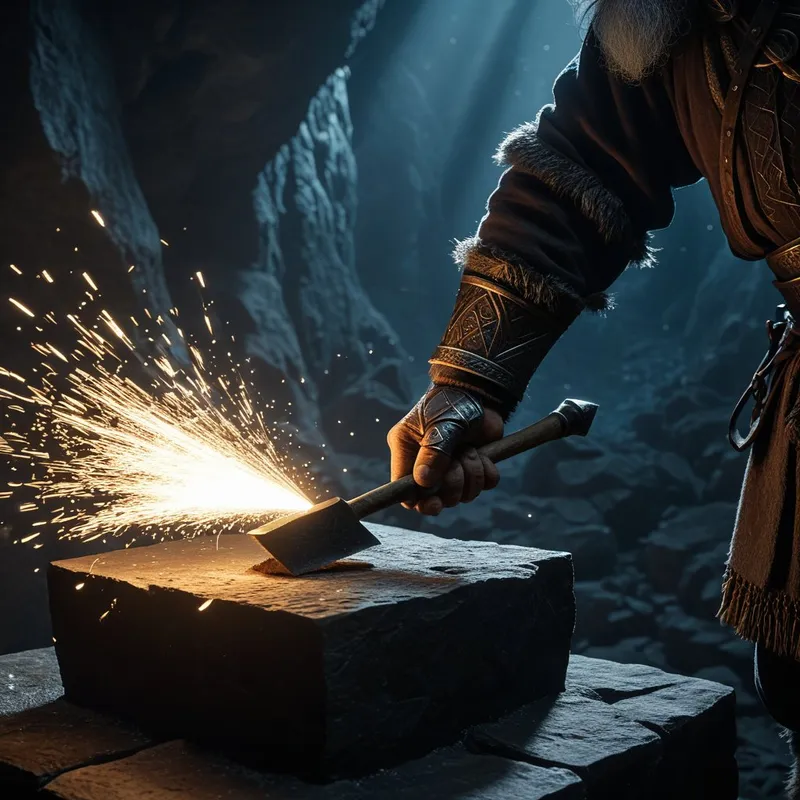
The air there was thick with the smell of molten star-iron and the ringing of hammers on anvils that sang with each strike. The dwarves, their beards woven with soot and their eyes like furnace coals, worked without rest. They did not shape metal; they bound essence. Into the heart of the spear they poured the unbreakable law of the oath, the certainty of the falling star, the inevitability of the first word spoken in a silent hall. They named it Gungnir, for in its flight, all things would sway to its will.
When Odin took the spear, the very cavern trembled. It was perfectly balanced, a line drawn between intention and outcome. Its shaft was of a wood that remembered being part of the World Tree, and its point held a cold, hungry light. This was the price and the prize: a focus so terrible it could not be borne by any but he who had traded an eye for wisdom.
And so it was, at the founding of all things, that the Aesir and the Vanir gods, weary of war, met to make peace. They gathered in a circle, but words were wind. Then Odin stepped forward. In a silence that swallowed sound, he raised Gungnir high. The runes upon it blazed. With a cry that was both a promise and a curse, he cast the spear over the host of the gathered gods. It flew, humming a note of pure fate, and where it landed, the ground was sanctified and cursed in the same breath. "Let this ground be holy to all who enter here," he declared, his voice the voice of the law itself. "And let any who break the oaths sworn upon it find this spear awaiting them." In that moment, the war ended. Not with a treaty, but with a weapon that became the arbiter of all treaties. From that day, no oath was true unless sworn upon the symbol of Gungnir, for it was the embodiment of consequence, absolute and unerring.
Cultural Origins & Context
The myth of Gungnir is woven into the oldest surviving threads of Norse literature, primarily in the Poetic Edda and the later Prose Edda. It was not a standalone bedtime story, but a vital piece of cosmological and social machinery. Skalds (poets) and chieftains would invoke it.
Its primary societal function was jurisprudential and sacral. Before a Thing (assembly), oaths were sworn upon a sacred ring, often associated with Odin, or upon the symbolic casting of a spear over the assembly ground, directly mirroring Odin's mythic act. This ritual transformed a mundane gathering into a space under the All-Father's gaze, where words became binding fate. Gungnir represented the terrifying power of the community's collective word—the foundation of law itself in a warrior society where personal honor was the primary currency. To break an oath sworn upon its symbol was to invite not just social ostracization, but cosmic retribution.
Symbolic Architecture
Gungnir is far more than a magical weapon; it is the symbolic embodiment of focused consciousness and sovereign will. Odin, the god of wisdom, poetry, and death, does not wield a sword (the weapon of pure force) or an axe (the tool of brute creation). He wields a spear—a projectile, an instrument of directed force. It represents the application of hard-won wisdom (his sacrificed eye) toward a singular, inescapable point.
The spear is the line drawn from the self to the world; unerring, it makes the inner decree an outer reality.
Its creation by the dwarves, masters of crafting abstract concepts into form, tells us that this power is not innate but forged—a product of immense pressure, skill, and hidden knowledge. The spear's defining characteristic, that it never misses its target, is the ultimate symbol of karma or fate. It is the inevitable consequence of an action truly, fully willed. In psychological terms, Gungnir represents the ego's capacity for decisive, conscious intent. It is the power to say "This shall be," and to align all one's psychic energy behind that declaration, making its manifestation in the world as certain as a thrown spear finding its mark.

The Dreamer's Resonance
When the symbol of Gungnir pierces the modern dreamscape, it seldom appears as a literal weapon. More often, one dreams of a laser beam of light cutting through fog, a single, unwavering path through a tangled forest, or a sudden, crystal-clear command heard in a cacophony of voices. The somatic experience is one of tension followed by release—a coiled spring in the solar plexus that suddenly shoots forward.
Psychologically, this dream pattern emerges during periods of paralyzing indecision or moral ambiguity. The dreamer is caught in the nets of "what if" and "maybe." The appearance of the Gungnir archetype signals a critical inner process: the unconscious is forcing a consolidation of will. It is the psyche's demand for the dreamer to stop vacillating, to identify their true target, and to commit to a course of action with full acceptance of the consequences. The anxiety in the dream is the fear of that commitment—the terror and the relief of the point of no return.

Alchemical Translation
The individuation process, the journey toward psychic wholeness, requires the development of a conscious, directed will—the very essence of Gungnir. We begin in a state of inner Svartalfheim: our potentials, talents, and drives are raw, unshaped, and scattered. The dwarven forge is the crucible of life experience, where we are hammered by conflict, heated in the fires of emotion.
To forge your Gungnir is to take the scattered ore of your potential and, through the heat of experience and the hammer-blows of choice, draw it out into a single, purposeful point.
Odin's sacrifice of his eye for wisdom is the pivotal alchemical act. It represents the willingness to sacrifice broad, undifferentiated perception (seeing everything, committing to nothing) for the focused, one-eyed vision of deep insight. You give up the comfort of ambiguity to gain the power of clarity. Casting the spear over the assembly of your inner gods—your competing desires, fears, and loyalties—is the moment of self-governance. You declare, "This is the law of my being. This oath I swear to myself." The spear's flight marks the establishment of an inner Idavollr, a sacred ground of personal integrity from which you can act in the world. Your "Gungnir" is your unshakable commitment to your own truth, and its "unerring" quality is the inevitable life you build by consistently acting from that forged center. It is not about controlling the world, but about your aim within it becoming so true that your path and your destiny become one.
Associated Symbols
Explore related symbols from the CaleaDream lexicon: