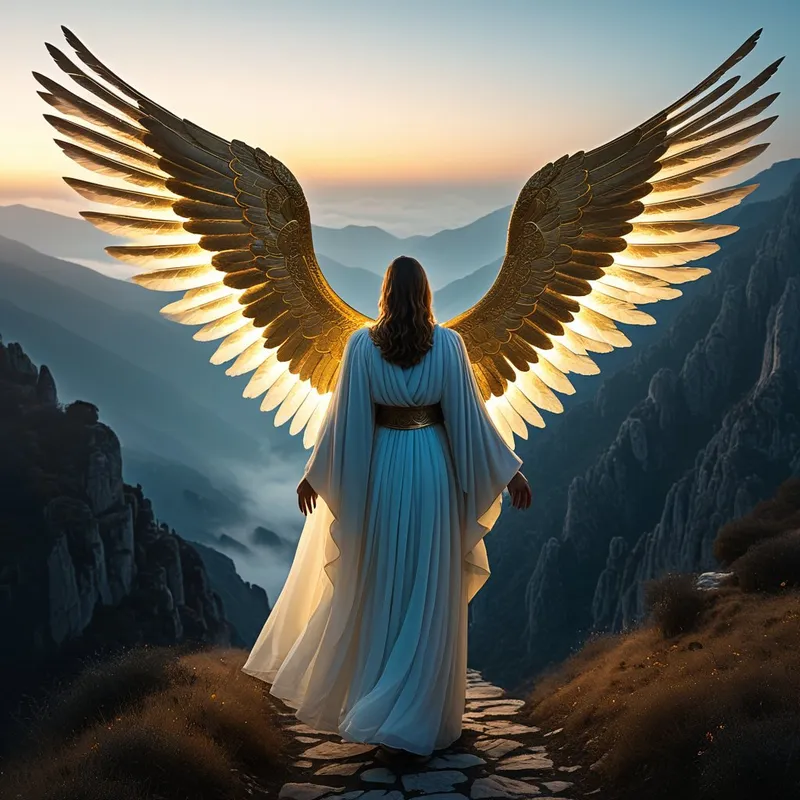
Guardian Angel Myth Meaning & Symbolism
The myth of a personal celestial protector, a divine companion assigned at birth to guide, guard, and intercede on behalf of a human soul.
The Tale of Guardian Angel
Listen, and let the veil between the worlds grow thin. Before the first cry of a newborn soul echoes in the chamber of birth, in the silent courts of heaven, a summons is heard. Not a trumpet blast, but a whisper of divine will. From the choir of countless spirits, one steps forward. Its form is not of flesh, but of intention made manifest—a being of watchful intelligence and fierce, gentle love.
This is your Guardian Angel. It receives no fanfare, only a charge as old as creation itself: Be their light in the shadow, their whisper in the silence, their shield in the storm. Walk with them, unseen, from their first breath to their last sigh.
And so it begins. The angel descends, not as a falling star, but as a settling presence, like a mantle of air that clings to the soul. It is there in the crib, when night terrors loom. Its wing, vast and insubstantial as a thought, brushes the fevered brow of the child. It is the sudden, inexplicable hesitation that pulls a wanderer back from the crumbling cliff’s edge, the gut feeling that turns them down a safer road. It stands sentinel in the empty room of despair, a bastion against the whispering void.
The conflict is not its own, but yours. It watches the soul stumble into temptation’s thicket, feels the sharp thorns of poor choices, yet it may not pluck you out. Its mandate is guidance, not coercion; a nudge, not a shove. Its greatest trial is its holy restraint. In the rising action of a life hurtling toward disaster, the angel works in the periphery: arranging a chance meeting, softening a hardened heart, placing a forgotten verse before tired eyes. It battles not with sword and flame, but with synchronicity and softened blows.
And in the final resolution, as the mortal body fails and the last light dims in the eyes, the angel’s vigil shifts. Its unseen hand becomes a guiding one. It is said the soul, stepping free of its earthly coil, finally turns and sees—truly sees—the companion who was there all along. The journey ends not with a farewell, but with a recognition. The guardian, its earthly task complete, escorts the soul home, its protection now a celebration, its guidance now a triumphant return.
Cultural Origins & Context
The concept of a personal, divine protector has roots that intertwine with the very fabric of Christianity, though its full flowering came in time. Early seeds are found in the Hebrew Bible, with psalms speaking of God commanding His angels concerning the faithful. In the New Testament, Jesus’ statement about children—“their angels always see the face of my Father in heaven”—provided a potent scriptural cornerstone.
This belief was not born in theological councils but in the hearts of the faithful. It was passed down by mothers whispering comfort to frightened children, by travelers praying for safe passage, by the lonely and the imperiled feeling an inexplicable presence. The early Church Fathers, like Origen and St. Thomas Aquinas, later systematized the idea, arguing from reason and revelation for the existence of personal guardian spirits. Aquinas, in his scholastic way, even speculated on their hierarchy and nature.
By the Middle Ages, the Guardian Angel was a pillar of popular piety. It served a profound societal function: it personalized the divine in an immense and sometimes terrifying cosmos. In a world of plague, war, and uncertainty, the myth offered intimate assurance. You were not a forgotten speck. The Almighty Himself had assigned a celestial ambassador to your side. This belief fostered interiority, a sense of individual spiritual worth, and a moral compass—one was always in august company.
Symbolic Architecture
At its core, the Guardian Angel is not merely a celestial bodyguard. It is a profound symbolic representation of the higher, guiding aspect of the Self—what Carl Jung</ab title> might call the Self in its protective, guiding function. It symbolizes the innate, transpersonal intelligence of the psyche that works for our integration and well-being, often outside the purview of our conscious ego.
The angel does not live in heaven, but in the liminal space where divine will touches human choice—the exact coordinates of the soul’s growth.
The angel represents Providence made personal. It is the mythic answer to the human yearning for a universe that is not indifferent but intimately concerned. Psychologically, it embodies the guiding principle within the unconscious that arranges meaningful coincidences, provides intuitive hunches, and offers comfort from a depth beyond our daily awareness. Its “unseen” nature is crucial; it symbolizes those inner forces that guide us without dominating us, that work in the background of our lives, shaping fate through subtle influence rather than overt control.
Furthermore, the angel embodies the connection between the individual and the transcendent. It is a living bridge. It is not God, but God’s attentive regard given form. This speaks to the human need to relate to the ultimate not as an abstract force, but through a relatable, attentive intermediary—a psychological function that facilitates relationship with the numinous.
The Dreamer's Resonance
When the figure of the Guardian Angel appears in modern dreams, it rarely comes with harps and halos. Its manifestation is more nuanced, signaling a critical phase in the dreamer’s psychological process. It often appears when the ego feels lost, imperiled, or at a profound crossroads.
You may dream of a protective presence in a shadowy landscape—a figure of light, a calm voice, or simply a knowing feeling of safety amidst chaos. This suggests the psyche is activating its self-regulating, protective functions. The conscious mind is under stress, and the deeper Self is mobilizing resources to prevent fragmentation or despair.
Alternatively, dreaming of seeking or calling for an angel indicates a somatic and psychological cry for guidance. The dreamer may feel existentially adrift, having lost connection to their inner compass. The dream is the psyche’s dramatization of the search for that lost connection to inner wisdom and protection.
Sometimes, the dream is of a failed or absent guardian—a broken wing, a silent figure, an empty post. This is powerful shadow-work material. It may reflect a deep-seated feeling of spiritual abandonment, a betrayal by life or by one’s own inner resources. It points to a wound where the archetype of benevolent guidance has been damaged, and the dream is bringing this profound lack to consciousness for healing.

Alchemical Translation
The myth of the Guardian Angel provides a potent model for the alchemical process of individuation—the psychic transmutation of the base metal of ego-consciousness into the gold of the integrated Self.
The initial stage is assignation: the recognition that there is within you a transpersonal, guiding center. This is the opus beginning not with labor, but with acknowledgment. The conscious ego (the mortal) must learn to listen for the nudge, to attend to synchronicity, intuition, and those inner promptings that feel “other” yet deeply true. This is the cultivation of a relationship with the inner angel.
The core alchemical struggle mirrors the angel’s holy restraint. The guardian does not eliminate our trials; it accompanies us through them.
The crucible of suffering is not heated by the angel, but its presence ensures the soul does not shatter within it. The protection is not from the fire, but in the tempering.
Our psychological “guardian”—the Self—allows us to endure necessary suffering, shadow confrontation, and difficult choices because it holds the blueprint of our wholeness. It knows the stumbles are part of the path. The angel’s unseen battle is the psyche’s struggle to guide the ego toward growth without violating its free will, a delicate alchemy of influence and allowance.
The final transmutation is recognition. In the myth, this happens at life’s end. In the alchemy of individuation, it is the moment of profound self-realization. The ego, after a lifetime of struggle and guidance, finally turns inward and recognizes its own guiding principle. It sees that the “angel” was not an external savior, but the deepest, wisest, most protective aspect of its own being. The protector and the protected are understood as two aspects of one whole. The journey ends in a sublime integration: the soul, guided home, discovers it was always home, and the guardian was the part of itself that never forgot the way.
Associated Symbols
Explore related symbols from the CaleaDream lexicon: