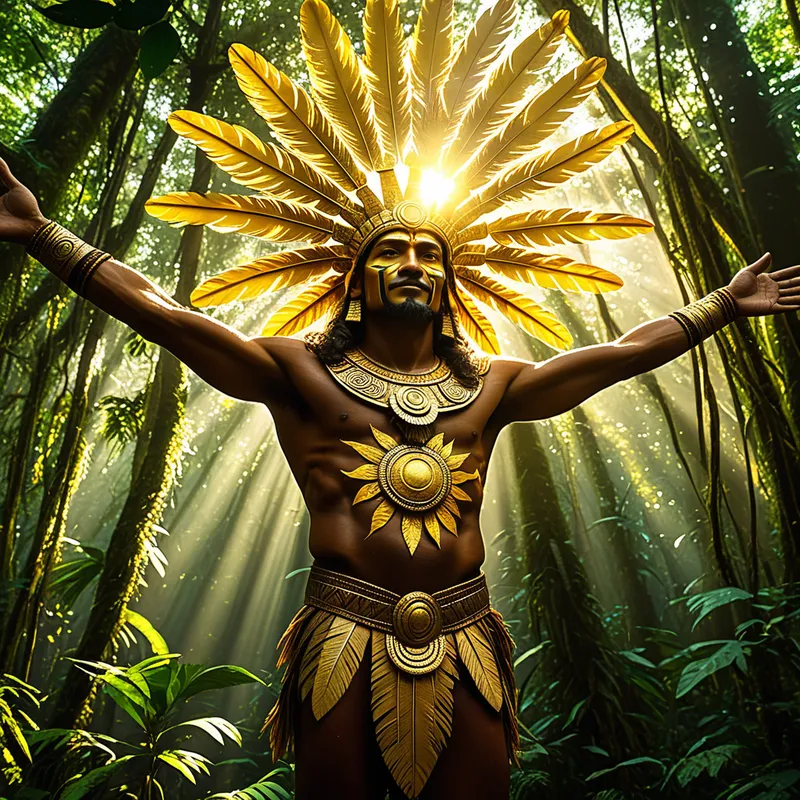
Guaracy Sun God Brazilian Myth Meaning & Symbolism
The myth of Guaracy tells of a celestial being whose sacrifice brings light to the primordial world, establishing the eternal cycle of day and night.
The Tale of Guaracy Sun God Brazilian
In the time before time, the world was a place of perpetual twilight. The great forest, the Ur-Wild, was a realm of deep, velvety shadows and cool, damp silence. Life stirred—the slither of the great anaconda, the whisper of leaves, the murmur of black waters—but it was a life half-formed, waiting in a dreamless sleep. There was no warmth, no color, only the endless, gentle gloom.
In this twilight lived the people, but they were not as we know them. They were shadows themselves, moving through the gloom, knowing only the shapes of things, never their true essence. Their world was cold, and their spirits were dim. They longed for something they could not name, a memory of a light they had never seen.
From the highest realm, Tupã, the great spirit Tupã looked down upon this somber world. His heart was moved by the silent longing of the shadow-people. He called forth his most radiant son, Guaracy. Guaracy was not a man; he was a being of pure, condensed potential, a living ember of celestial fire. “My son,” Tupã spoke, his voice the rumble of distant thunder, “the world below sleeps in darkness. It knows no morning, feels no warmth. It needs a heart of fire to wake it.”
Guaracy looked upon the twilight forest and felt its profound melancholy. He understood his father’s call. It was not a command, but a destiny. To bring light, he would have to become light. To bring warmth, he would have to become the source of all warmth. It was a journey of utter transformation, of ceasing to be a celestial visitor and becoming a fixed, burning center.
Guaracy descended. His arrival was not a crash, but a slow diffusion, like dye in water. At first, he walked among the shadow-people as a glowing stranger. Where he stepped, the moss glowed faintly; where he breathed, the air grew slightly warmer. The people were afraid, shrinking from this strange, painful brightness. They hid in the deepest thickets, for his light showed them their own forms clearly for the first time, and it was terrifying.
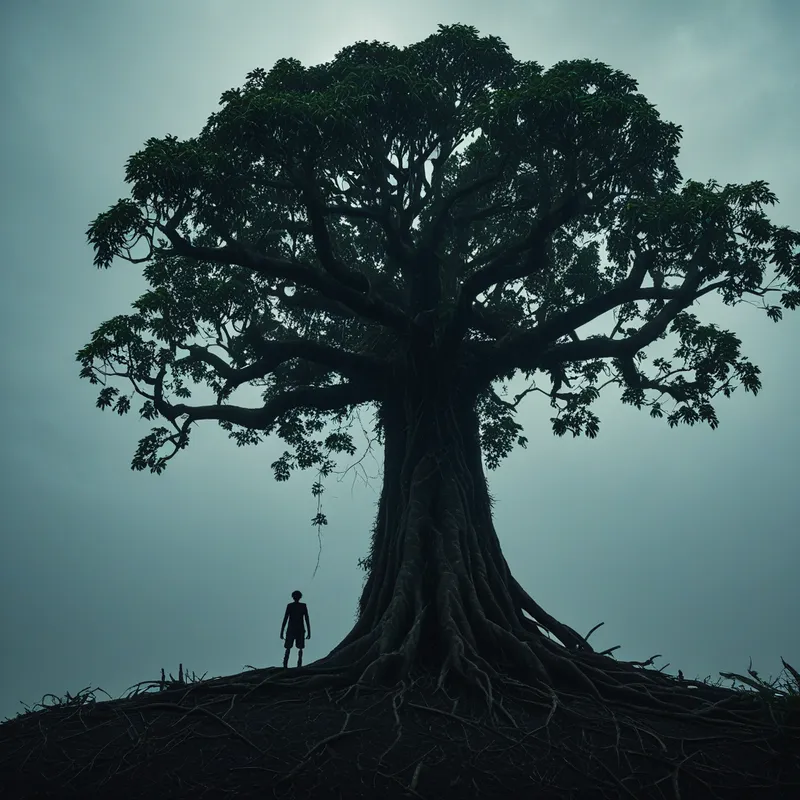
Seeing their fear, Guaracy’s resolve deepened. He could not simply walk among them. He had to become a part of the world’s very fabric. He journeyed to the center of the forest, to the oldest, tallest Sumaúma tree, whose roots drank from the underworld and whose branches brushed the lowest clouds. With a final look to the sky, a silent farewell to his father’s realm, Guaracy began to climb.
He climbed until the world below was a sea of dark green, and the twilight sky pressed close. Here, at the summit of the world, he stopped. He did not chant or pray. He simply opened himself. He let the celestial fire within him burn unchecked, no longer contained by the form of a son, but released as the essence of a star.
The explosion was silent and immense. A wave of pure, golden light erupted from the treetop, shattering the eternal twilight. It raced across the sky, painting it in hues of orange, pink, and blue. It poured down through the canopy, dappling the forest floor in a moving tapestry of light and shadow. The shadow-people cried out, covering their eyes. But as the initial shock faded, they lowered their hands.
They saw color. The impossible green of leaves, the vibrant flash of a bird’s wing, the rich brown of the earth. They felt warmth on their skin, a sensation so profound it brought tears to their eyes. They looked at each other and saw not vague shadows, but distinct faces, expressions of awe and joy. They were seen. They were known.
Guaracy was gone. In his place, a brilliant, burning disc now journeyed tirelessly across the dome of the sky. He had sacrificed his singular form to become the Sun. Each dawn, he is reborn in the east, climbing the sky to bathe the world in his life-giving gaze. Each dusk, he dies in the west, descending into the land of the ancestors, so that the world may rest and dream, before he is born again with the morning. The people learned to plant by his light, to hunt by his shadow, to live by his cycle. The twilight was broken forever, not by conquest, but by a gift of self-immolation.
Cultural Origins & Context
This myth originates from the Tupi-Guarani cosmovision, a profound spiritual and narrative system shared by numerous indigenous peoples across Brazil and the wider Amazon basin. It is not a singular, fixed text, but a living narrative passed down through generations of Pajés (shamans) and elders. The story was traditionally recounted during rituals, at the onset of communal hunts, or at times of seasonal transition, serving to root the community in the cosmic order.
Its primary function was etiological—explaining the origin of the sun and the cycle of day and night—but its depth goes far beyond simple explanation. It established the fundamental relationship between the celestial and the terrestrial, between sacrifice and sustenance. Guaracy’s act is the foundational contract of life: light and warmth are not free or automatic, but are born from a primordial, willing sacrifice. This myth encoded values of generosity, the necessity of transformation for the greater good, and the sacredness of the solar cycle that governs all life in the rainforest. The telling was an act of remembrance and gratitude, a way of aligning the human heartbeat with the pulse of the cosmos.
Symbolic Architecture
At its core, the myth of Guaracy is a master narrative of individuation through radical self-surrender. Guaracy begins as a contented celestial being, a “son” in a known order. The call from Tupã represents the summons of the Self, the pull toward a destiny that requires the dissolution of the current ego-state.
The hero’s journey is not out into the world, but into the core of one’s own being, where one must be consumed by one’s essential nature to be reborn as a conscious force in the world.
The perpetual Twilight is the psyche before consciousness—rich with potential but unrealized, a state of collective, shadowy existence. The people’s fear of Guaracy’s initial light mirrors our own resistance to consciousness; the first light of awareness is often painful, exposing what was comfortably hidden. Guaracy’s ultimate act—climbing the Sumaúma and dissolving into light—is the ultimate psychic sacrifice. The ego (his singular form) is voluntarily offered up to a greater principle (the archetypal Sun, the Self). He does not fight a monster; he becomes the source. His “death” is not an end, but a translation into a permanent, cycling archetypal force—the principle of consciousness itself, which must daily be renewed.
The Dreamer's Resonance
When this myth stirs in the modern unconscious, it often manifests in dreams of profound, necessary endings that are also beginnings. One might dream of a cherished house burning down, only for a magnificent garden to grow from its ashes. Or of diving into a dark, bottomless lake and discovering one can breathe underwater, becoming a source of light in the depths.
Somatically, this process can feel like a gathering heat in the chest—a pressure or warmth that feels both alarming and vital. Psychologically, it is the process of “coming into one’s own light,” which is paradoxically preceded by a feeling of being utterly consumed. The dreamer is going through a phase where an old identity, a way of being that feels safe but limited (the twilight), must be sacrificed for a more authentic, radiant, and world-illuminating expression of the Self. The fear present in the dream is the shadow-people’s fear: the terror of being truly seen, of wielding one’s own power and warmth.

Alchemical Translation
The alchemical process mirrored in Guaracy’s myth is the Rubedo, the Reddening, the final stage where the philosopher’s stone is achieved. It is not merely a gain, but a sublime transformation of base material into incorruptible gold through the agency of fire.
First, the Nigredo: the primordial twilight, the unconscious, undifferentiated state of the psyche (the massa confusa). Then, the Albedo: the initial call from Tupã, the emergence of a differentiating consciousness (Guaracy descending as a distinct being). The crucial, central operation is the Citrinitas turning into Rubedo—the yellowing becoming the reddening. This is Guaracy’s climb and immolation.
The alchemical fire is not an external flame, but the inner fire of one’s own essential nature. To create the gold of the integrated Self, one must have the courage to be fuel for that sacred fire.
For the modern individual, this translates to the moment when a talent, a calling, or a deep truth about oneself can no longer be held as a private possession or a hobby. It demands to be made central, to become the organizing principle of one’s life. This requires “climbing the world tree”—moving to the center of one’s existential reality—and allowing that inner truth to burn away the attachments to a former, smaller identity. The result is not grandiosity, but a consistent, reliable cycling of energy: the capacity to consciously “rise” and engage with the world (the day), and to consciously “set” and retreat into renewal (the night). One becomes, in a psychological sense, a sustainable source of one’s own light, a microcosm of the sun, in a perpetual cycle of sacrifice and rebirth.
Associated Symbols
Explore related symbols from the CaleaDream lexicon:
- Sun — The central symbol of the myth, representing the conscious Self, life-giving energy, cyclical renewal, and the radiant result of total psychic sacrifice.
- Sacrifice — The core action of the myth; the voluntary giving up of a limited form or identity for the creation of a greater, enduring good or principle.
- Light — The gift and the goal, symbolizing consciousness, awareness, clarity, and the revelation of true form that banishes the shadow of ignorance.
- Tree — The Sumaúma as the axis mundi, the connecting pillar between heaven, earth, and underworld; the site of transformation and the bridge between states of being.
- Shadow — The primordial state of unconsciousness and potential, but also the fear and resistance that first greets the emerging light of awareness.
- Journey — Guaracy’s descent and ascent, representing the inward and upward path of individuation, from celestial origin to worldly embodiment to cosmic principle.
- Death — Not as finality, but as the necessary transition point in a cycle; the sunset that guarantees the dawn, the dissolution of form that allows for a new mode of existence.
- Rebirth — The daily dawning of the sun, symbolizing the continuous renewal of consciousness and the promise that every ending contains the seed of a new beginning.
- Fire — The transformative agent, the inner celestial essence that consumes the old to create the new; the alchemical force of purification and revelation.
- Sky — The realm of Tupã and the domain through which the Sun travels, representing the vast container of consciousness, destiny, and cosmic order.
- God — Tupã as the originating source, the archetype of the primal father or creator whose will initiates the process of differentiation and consciousness.
- Hero — Guaracy as the archetypal figure who answers a cosmic call, faces the ultimate sacrifice, and through his act fundamentally alters the world for all.