Guanyin Myth Meaning & Symbolism
The myth of Guanyin, the bodhisattva of compassion, who renounced nirvana to hear the cries of the world, embodying boundless mercy and transformative grace.
The Tale of Guanyin
In the time before time, when the world was a tapestry of suffering and longing, there lived a king. His kingdom was prosperous, his rule just, but his heart yearned for an heir. From the depths of his prayers, a son was born—Guanyin, in a vow made lifetimes ago, chose this royal form. Yet, from his first breath, the prince was unlike other men. His eyes held the deep stillness of a mountain lake, reflecting not the glitter of the throne, but the silent tears of the world.
The palace walls, gilded and grand, felt to him like a cage of jade. While courtiers spoke of conquest and ceremony, he heard the distant cry of the hawk, the sigh of the old pine, the unvoiced grief of the peasant in the field. His father, the king, sought to bind him to destiny with marriage to a noble maiden. On the eve of the wedding, as incense coiled like silver serpents in the hall, the prince stood before his father. Not with rebellion, but with a sorrow so vast it silenced the court. “The cries of the world are my bride,” he whispered. “Its suffering, my kingdom to rule.”
He cast aside his silken robes, cutting his hair with a simple blade. Donning the rough hemp of a monk, he walked past the stunned guards, through the gates, and into the wilderness. His journey was not to a mountain monastery, but into the very heart of anguish. He sought the wisdom of sages on mist-wrapped peaks, learned the sutras that map the mind, and mastered meditations that still the cosmos. Yet, with each attainment, the cacophony of earthly pain grew louder, not softer. It was a symphony of broken hearts, lost children, drowning sailors, and withering crops—a chorus that shook the heavens.
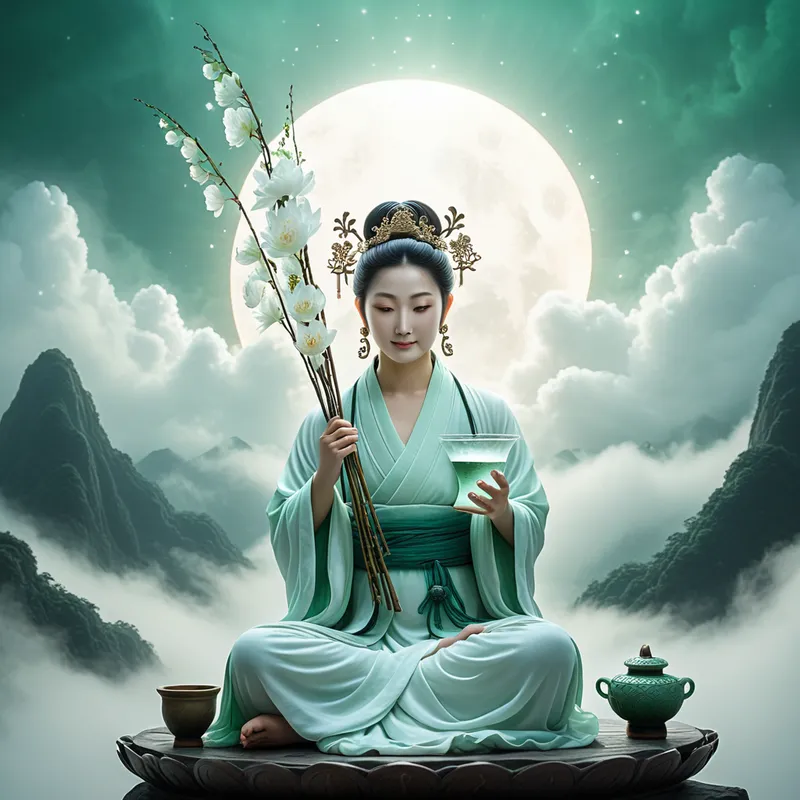
His compassion became a crucible. In a moment of ultimate realization, standing at the threshold of Nirvana, he turned back. The great vow echoed in his being: “I shall not enter final bliss as long as a single being remains in suffering.” This act of supreme renunciation shattered form itself. The princely monk transformed. Often, he was seen as a graceful, merciful goddess, a thousand arms radiating from her form, an eye of wisdom in each palm to see all suffering, a vessel of sweet dew in her hand to heal all wounds. She took her seat not in a distant paradise, but on the rocky isle of Putuo Shan, where the sea’s roar was the world’s perpetual lament. There, she listens. To the fisherman’s prayer in the gale, the mother’s plea by the sickbed, the silent despair in the darkest night. She does not always still the storm, but she always hears the cry within it. She is the one who, having touched the absolute, chose to remain in the relative, her very presence a bridge between the human sob and divine solace.

Cultural Origins & Context
The figure of Guanyin entered the Chinese spiritual landscape via the Silk Road, a translation and transformation of the Indian Buddhist bodhisattva Avalokiteśvara. This was no mere import, but a profound alchemy. Between the 1st and 10th centuries CE, as Buddhist sutras were translated in great monastic centers, Avalokiteśvara’s essence was filtered through the indigenous sensibilities of Daoist reverence for feminine, nurturing power (Yin) and the Confucian ideal of benevolent, merciful rulership.
By the Tang and Song dynasties, Guanyin had become perhaps the most beloved deity in the Chinese pantheon. Her myth was not preserved in one single text but was woven through popular narratives, temple murals, bianwen tales, and later, vernacular novels like the Journey to the West. This proliferation across mediums—from imperial court art to peasant woodblock prints—speaks to her societal function: she was the accessible divine. Unlike stern celestial bureaucrats or distant Buddhas, Guanyin was the compassionate listener who required no complex ritual, only a sincere heart. She served as the spiritual and psychological solace for a society familiar with hardship, offering a model of grace that was actively engaged with the messy reality of life.
Symbolic Architecture
At its core, the myth of Guanyin is a masterclass in the symbolism of permeable boundaries. The bodhisattva represents the ultimate dissolution of the barrier between self and other.
To become a vessel for the world’s sorrow is to achieve a sovereignty beyond any kingdom.
The thousand arms and eyes are not a display of power, but an icon of total receptivity. They symbolize a consciousness that has expanded to hold the multitudes, where perception itself becomes an act of compassion. The willow branch and vase of pure water are instruments of this engaged mercy—the willow for gentle sweeping away of afflictions, the sacred water for spiritual cleansing and revitalization.
The pivotal moment of renouncing nirvana is the myth’s central psychic truth. It inverts the spiritual quest from one of escape to one of profound immersion. Enlightenment is not an exit from suffering but a transformation of one’s relationship to it. Guanyin’s transformation from male prince to often-feminine goddess is deeply symbolic. It represents the integration of the active, striving principle (Yang) with the receptive, nurturing principle (Yin), achieving a wholeness that is the true source of unconditional compassion.
The Dreamer's Resonance
When the archetype of Guanyin stirs in the modern dreamscape, it often signals a critical phase of psychic overload and empathic development. The dreamer may find themselves in a place where sounds are overwhelming—a cacophonous city, a room full of weeping people, or a landscape where every tree and stone seems to emit a silent plea. This is the somatic echo of the bodhisattva’s vow, manifesting as a feeling of being unbearably porous to the pain of others, whether in one’s family, community, or the world seen through a news feed.
Dreams of shattering or multiplying—a mirror breaking into a thousand pieces, or suddenly having too many hands to manage—point to the ego’s resistance to this expansion. The psyche is attempting to reconfigure from a bounded, individual self to a more fluid, connected identity. To dream of calming a stormy sea with mere presence, or of holding a vessel that endlessly pours out healing liquid, indicates the dreamer is navigating this passage from empathic distress to compassionate capacity. The process is one of building a container strong enough to hold the suffering one perceives, without being dissolved by it.

Alchemical Translation
For the individual, Guanyin’s journey models the path of individuation through compassionate engagement. The first stage is the “renunciation of the palace”—the conscious departure from the ego’s programmed destiny (status, persona, conventional success) in service of a deeper, often unsettling, calling of the soul.
The middle, arduous stage is the “cultivation on Putuo Shan”—the disciplined inner work of meditation, reflection, and shadow integration. This is not done in narcissistic isolation, but with the explicit intent of building resilience and wisdom for the sake of others. The crucible is the realization that one’s personal healing is inextricably linked to the healing of the world.
The final alchemy is not becoming a saint on a pedestal, but becoming a bridge. The transformed self is the one who can stand in the chaos, hear the cry, and respond not from burnout, but from boundless inner resource.
The “thousand arms” are then translated as the individual’s newfound capacity for multi-faceted, skillful action in the world, each “arm” representing a talent, a word of comfort, or a practical act of help, guided by the “eye” of wisdom. The ultimate transmutation is of the wound of empathy into the gift of compassionate presence. One does not escape the world’s suffering but finds a sacred purpose within it, becoming a locus of calm and healing—a modern, human-scale reflection of the Goddess of Mercy who chose to stay.
Associated Symbols
Explore related symbols from the CaleaDream lexicon:
- Ocean — The vast, chaotic, and often terrifying realm of Samsara; Guanyin's abode at Putuo Shan signifies her mastery over and compassionate presence within the turbulent seas of worldly suffering.
- Water — The element of compassion, fluidity, and purification; represented by the nectar in Guanyin's vase, it symbolizes the healing, cleansing, and life-giving power of mercy.
- Mother — The ultimate nurturing, protective, and unconditionally loving archetype that Guanyin embodies in her most beloved form, offering solace and refuge to all beings.
- Ear — The primary organ of Guanyin's power; she is the "One Who Hears the Cries of the World," representing deep, attentive listening as the foundational act of compassion.
- Vessel — The vase (or bottle) Guanyin holds; it represents the container of the enlightened mind, capable of holding the elixir of wisdom and compassion to pour out for the benefit of others.
- Sacrifice — The core of Guanyin's vow; the conscious renunciation of personal liberation (Nirvana) for the sake of abiding with and liberating all suffering beings.
- Healing — The essential action stemming from Guanyin's compassion; the application of the "sweet dew" to cure spiritual, emotional, and physical afflictions.
- Bridge — Guanyin herself functions as the psychic and spiritual bridge between the human realm of suffering and the divine realm of bliss, facilitating connection and grace.
- Light — The luminous, peaceful radiance that surrounds Guanyin, representing the wisdom and purity of mind that is not extinguished by engagement with darkness, but illuminates it.
- Door — The threshold of Nirvana that Guanyin chooses not to pass through; symbolizing the pivotal choice to remain in the realm of form and relationship for a higher purpose.
- Bamboo Cane
- Bamboo Rod