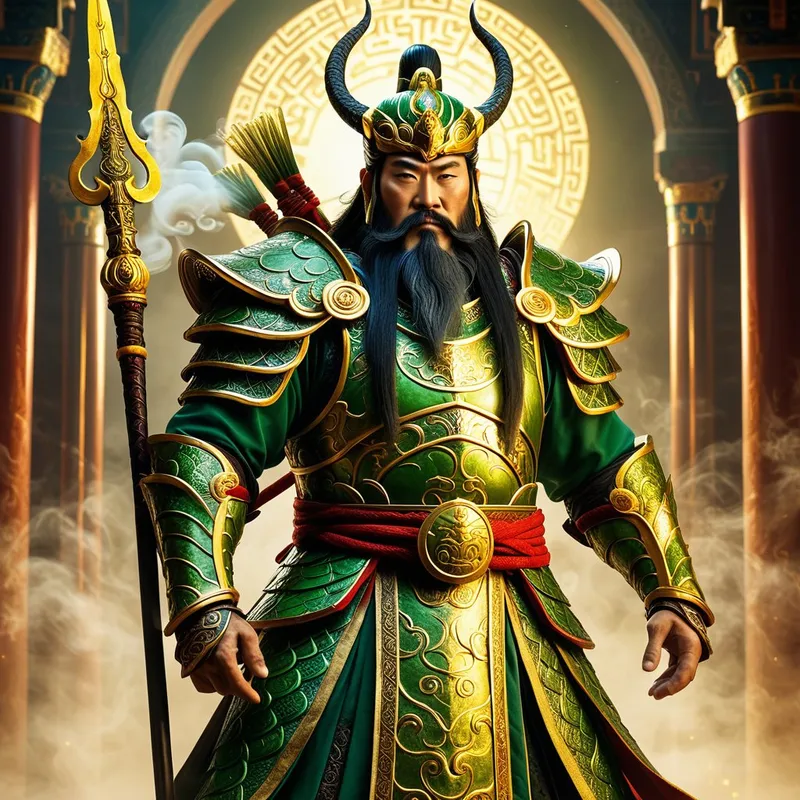
Guan Yu Myth Meaning & Symbolism
The epic journey of a warrior whose unwavering loyalty and honor transcended death, forging him into a divine protector and a cultural icon of righteous power.
The Tale of Guan Yu
Hear now the tale of the man who became a mountain, the warrior who became a god. In an age where the very Mandate of Heaven was fractured and the land bled from the claws of ambition, there walked a man of impossible stature. His name was Guan Yu. His beard was like a waterfall of night, his face the color of righteous fury, and in his hand rested the Green Dragon Crescent Blade, a weapon that sang a thirsty song only in the cause of honor.
He swore an oath in a peach garden, not to a king or an emperor, but to two brothers of his heart. The scent of peach blossoms, sweet and fleeting, bore witness as they pledged to restore the Han, to live and die as one. This oath became his spine, his breath, his north star. Through years of war, through victories that shook the earth and defeats that scattered them to the winds, this oath held. He fought with the fury of a dragon, yet his true battles were within: the temptation of a rival’s lavish gifts, the agony of temporary surrender to protect his sworn brother’s family. In these trials, his loyalty was not a blind duty, but a chosen fire that purified him.
His end came not on a grand battlefield, but through treachery and overconfidence. Captured, offered one last chance to bend his knee to a rising power, he chose instead to stand straight and meet the executioner’s blade. They say when his head fell, his spirit did not dissipate. It roared. It haunted the halls of the man who betrayed him, a phantom crying out for justice, until proper rites were finally observed.
And then, the true alchemy began. Denied a peaceful death, he was denied dissolution. His spirit, forged in the fires of unwavering loyalty and righteous violence, could not return to dust. Instead, it condensed, it crystallized. The warrior ascended. From a loyal general, he became Guan Gong, the Divine Guardian. Temples rose not just for soldiers, but for merchants who swore honest oaths, for police who sought protection, for communities desiring a bulwark against chaos. The man who lived by a code became the god who embodied it.
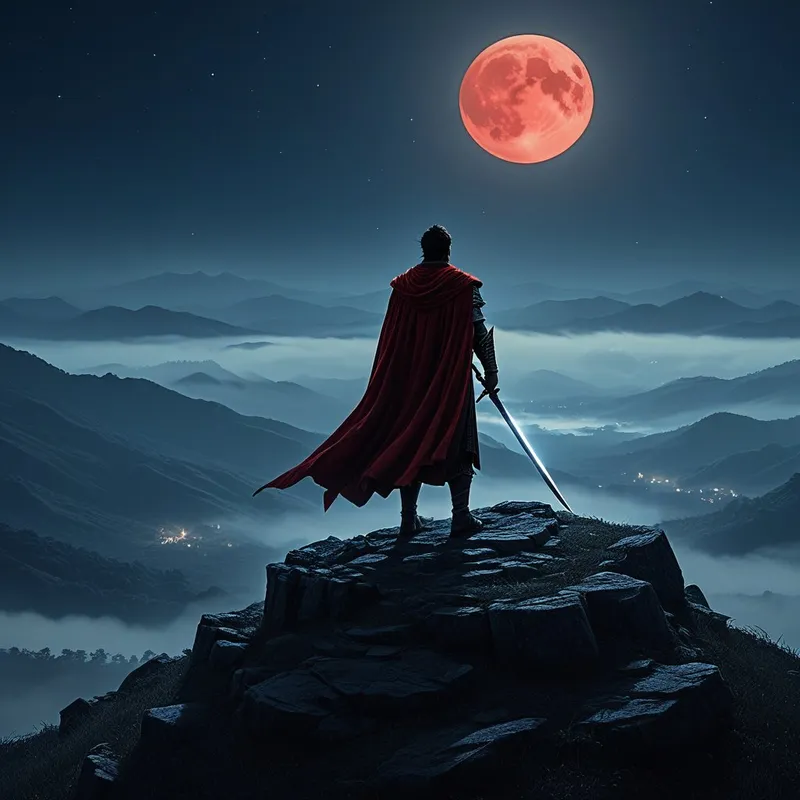
Cultural Origins & Context
The figure of Guan Yu is a unique palimpsest of history, literature, and folk religion. Historically, he was a noted general during the tumultuous Three Kingdoms period. His historical deeds were amplified over centuries through oral tradition, official histories, and most decisively by the 14th-century historical novel Romance of the Three Kingdoms. This masterpiece of literature transformed the historical general into the archetypal hero, emphasizing his loyalty, bravery, and righteousness while downplaying his historical flaws.
His worship proliferated during the Ming and Qing dynasties. Emperors bestowed upon him ever-grander titles, co-opting his image as the ultimate loyal subject to reinforce their own authority. Simultaneously, he was adopted into Daoism as a powerful protector deity and into Chinese Pure Land Buddhism</abras a guardian of temples (often called Sangharama). This cross-pollination made him omnipresent. His story was told by storytellers in teahouses, enacted in operas with his distinctive red face and majestic movements, and prayed to in temples that ranged from imperial grandeur to humble roadside shrines. Societally, he functioned as a moral compass—a divine enforcement of the Confucian virtues of yi (righteousness) and zhong (loyalty)—and a pragmatic source of protection for all walks of life.
Symbolic Architecture
Guan Yu represents the psychic integration of immense power with an unwavering ethical structure. He is not raw, chaotic strength; he is strength bound by oath, violence sanctified by purpose.
The true blade is not the one that cuts, but the oath that directs its swing. Righteousness is the sheath that makes terrible power honorable.
His Red Face symbolizes not merely anger, but the fiery shen (spirit) of loyalty and passion that cannot be hidden. The Long Beard signifies dignity, wisdom, and masculine potency anchored in virtue, not mere aggression. The Green Dragon Crescent Blade is his extended will, a tool that demands a worthy wielder; it is the decisive, cutting clarity of a mind committed to a singular path. His posthumous deification is the ultimate symbol: the ego-identity of "Guan Yu the general" dies, but the essential pattern of his being—his core virtue—is so potent it achieves autonomy, becoming an archetypal force accessible to the collective psyche.
Psychologically, he embodies the Senex (the wise old man) aspect of the Warrior archetype. He is the warrior who has internalized the code, for whom the battle is no longer for land or glory, but for the preservation of a sacred inner truth. His struggle is the human struggle to align raw capability (power, ambition, skill) with a transcendent principle (loyalty, righteousness, honor).
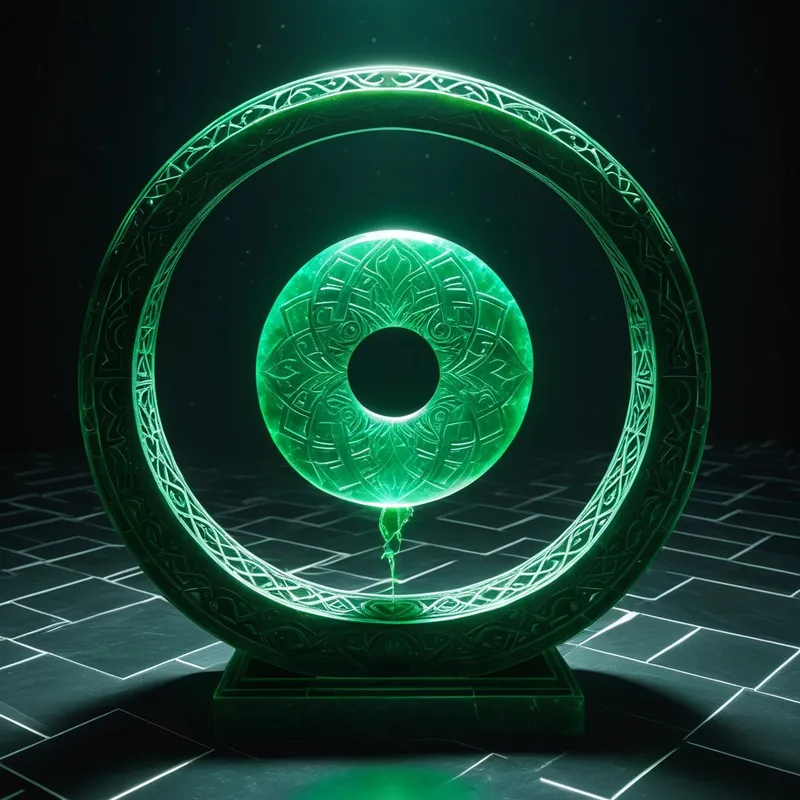
The Dreamer's Resonance
When Guan Yu strides into the modern dreamscape, he rarely appears as a simple historical figure. He manifests as an atmosphere, a demand, or a monumental presence. To dream of him, or of his symbols, often signals a profound crossroads in the dreamer's psychological integrity.
You may dream of a seal or a contract of immense weight that you are compelled to sign, representing a binding oath or commitment your soul is wrestling with. You might encounter a door or gate guarded by a stern, silent presence, indicating a threshold that can only be crossed with right intention and the courage of your convictions. A dream of a blade that is both beautiful and terrifying, which you must learn to wield, points to the integration of your own personal power—perhaps a talent, anger, or ambition—that feels dangerous and in need of ethical direction.
Somatically, this process can feel like a tightening in the jaw and shoulders, a gathering of resolve. It is the psyche preparing for a "righteous battle"—which may be setting a firm boundary, upholding a difficult truth at work, or finally committing to a path that aligns with your deepest values, despite the cost. The dream asks: What is your Peach Garden Oath? To what or to whom have you sworn your deepest loyalty?
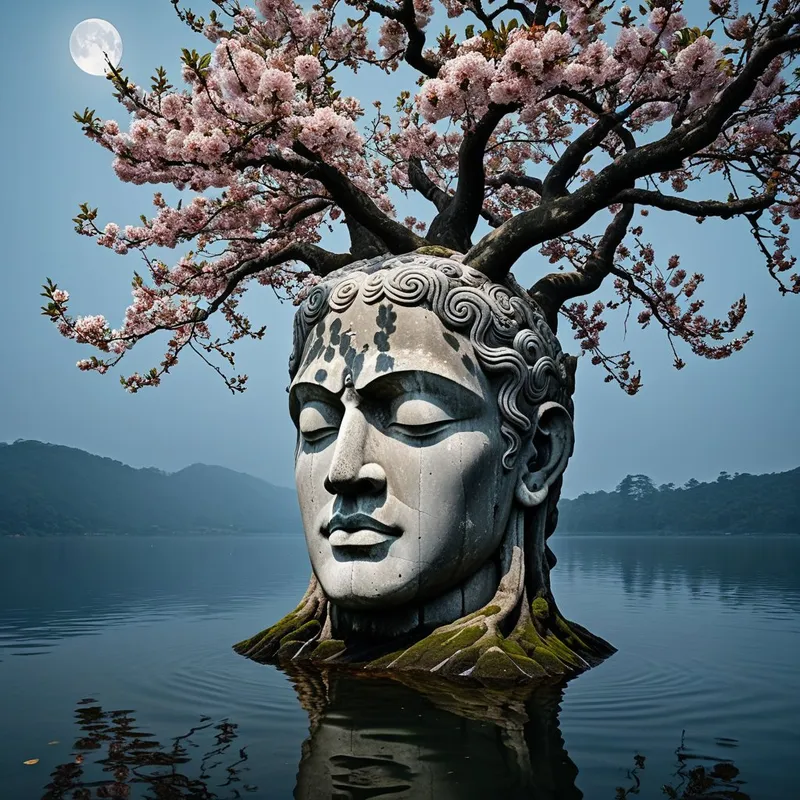
Alchemical Translation
The myth of Guan Yu models a specific path of individuation: the transmutation of the personal complex into a transpersonal principle. His journey is an alchemical recipe for the modern soul.
First, there is the Calcination of the oath in the Peach Garden. The ego's scattered desires are burned away in the fire of a supreme commitment. This is the conscious choice to bind oneself to a principle greater than immediate gain. Then comes the Dissolution through trials—captivity, separation from his sworn brothers. The ego is humbled, forced to adapt, but the core oath remains insoluble.
The crucial stage is his beheading—the Separatio. This is the violent, necessary death of the ego's identification with its social role (the great general). The modern parallel is the crushing defeat, the betrayal, the failure that seemingly destroys one's self-image.
The god is born not from the victory, but from the steadfastness in the moment of annihilation. The ego dies so the archetype can live.
Here lies the alchemical gold: Guan Yu does not fade. His beheading is not an end, but a liberation of his essential pattern from its historical container. This is Coagulation at the transpersonal level. The individual's lived integrity—their "righteousness"—ceases to be just a personal attribute and crystallizes into an inner authority, a guiding daimon. One becomes a vessel for the archetype itself. For the modern individual, this translates to the hard-won state where your actions are no longer driven by the need for external validation (fame, success as a general), but are authentic expressions of an inner code. You become a "temple" for your own truth, offering protection and guidance to the fragmented parts of your own psyche and, by extension, to your community. You have not just lived with integrity; you have become integrity.
Associated Symbols
Explore related symbols from the CaleaDream lexicon: