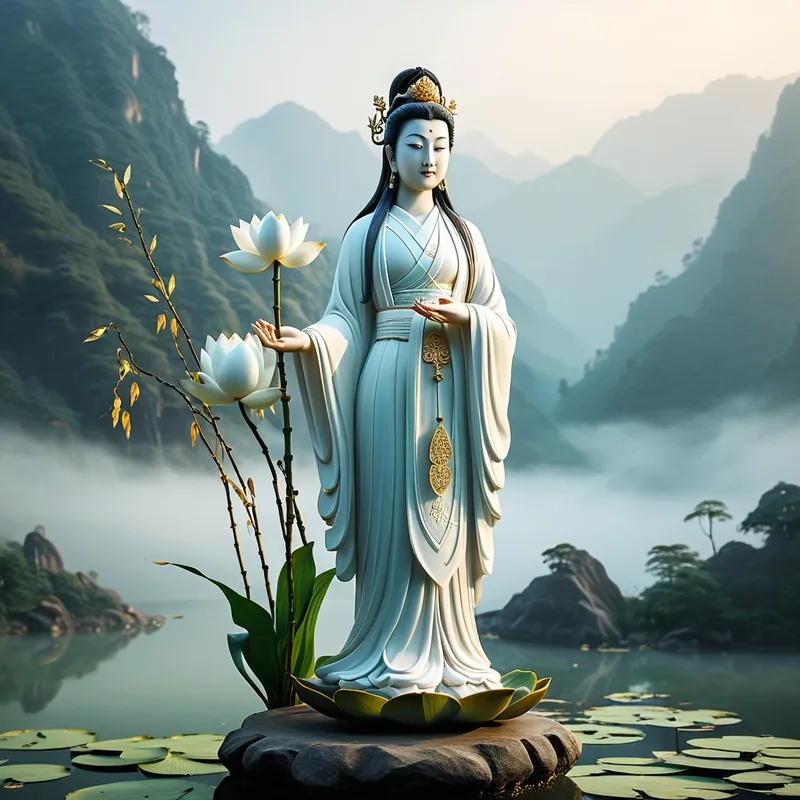
Guan Yin Myth Meaning & Symbolism
The myth of Guan Yin tells of a prince who renounces heaven to become the bodhisattva of compassion, vowing to hear the cries of the world.
The Tale of Guan Yin
In a time when the heavens brushed the peaks of the sacred mountains, there lived a king. His name was Miao Zhuang, and his kingdom was rich, his armies strong, but his heart was a fortress of ambition. He had three daughters, but his soul longed for a son to secure his legacy. The youngest daughter was named Miao Shan. From her first breath, she did not cry but smiled, and the air in the chamber grew sweet with the scent of unseen lotus flowers.
While her sisters dreamed of silks and suitors, Miao Shan walked in the palace gardens and heard not the songs of birds, but the silent sigh of the caged ones. She saw not the beauty of the arranged blooms, but the struggle of the weed pushing through stone. Her heart was a deep, clear pool that reflected the suffering of the world. When she came of age, her father, the king, demanded she marry a powerful prince to forge an alliance. Miao Shan stood before the glittering throne, a slender figure in simple robes amidst the gold. “Father,” she said, her voice like a quiet bell, “I cannot marry. My vow is to ease the suffering of all beings, to renounce the worldly life.”
The king’s rage shook the palace beams. He saw not piety, but rebellion; not compassion, but insult. He stripped her of her titles, banished her to the White Sparrow Monastery, and commanded the nuns to break her spirit with the most menial, back-breaking labor. Yet, as Miao Shan scrubbed floors and hauled water, legend says the animals of the forest came to aid her. A tiger fetched wood, an elephant drew water from the well. Her peace remained unbroken, a flame in a windless place.
Furious at her resilience, the king sent soldiers to burn the monastery to the ground. Miao Shan, seeing the flames leap toward her sisters-in-practice, plucked a single hair from her head. She blew upon it, and a great rain descended, quenching the inferno. Enraged beyond reason, the king ordered her execution. On the day the sword fell, it shattered against her neck. The executioner tried a silken cord, but it bloomed into a hundred lotuses. Finally, as the story is told, a supernatural executioner was summoned. As his blade descended, Miao Shan’s spirit departed her earthly form, not in anger, but in perfect peace. She descended into the underworld, the realm of Diyu.
But her presence there was not of a punished soul, but of a radiant sun in a land of shadows. Her compassion was so profound, her peace so absolute, that the flames of the hells cooled, the instruments of torture turned to flowers, and the tormented souls found respite. The lords of the underworld, bewildered and unnerved by this disruption of cosmic order, begged her to leave. And so she returned to the world, her spirit finding refuge on the mystical island of Mount Putuo.
There, in deep meditation, she attained supreme enlightenment. The heavens themselves opened, offering her the ultimate reward: ascension to full Buddhahood, an end to the cycle of birth and death. But as she stood on that threshold, a sound echoed in her being—the collective cry of the suffering world. It was a sound more powerful than the silence of Nirvana. And so, in the most profound act of the myth, she turned back. She vowed to forgo her own final peace until every last being was free from sorrow. She became Guan Shi Yin, the Bodhisattva of Compassion, with a thousand arms to reach out, and a thousand eyes to see, and ears to hear every whispered plea in the vast darkness.
Cultural Origins & Context
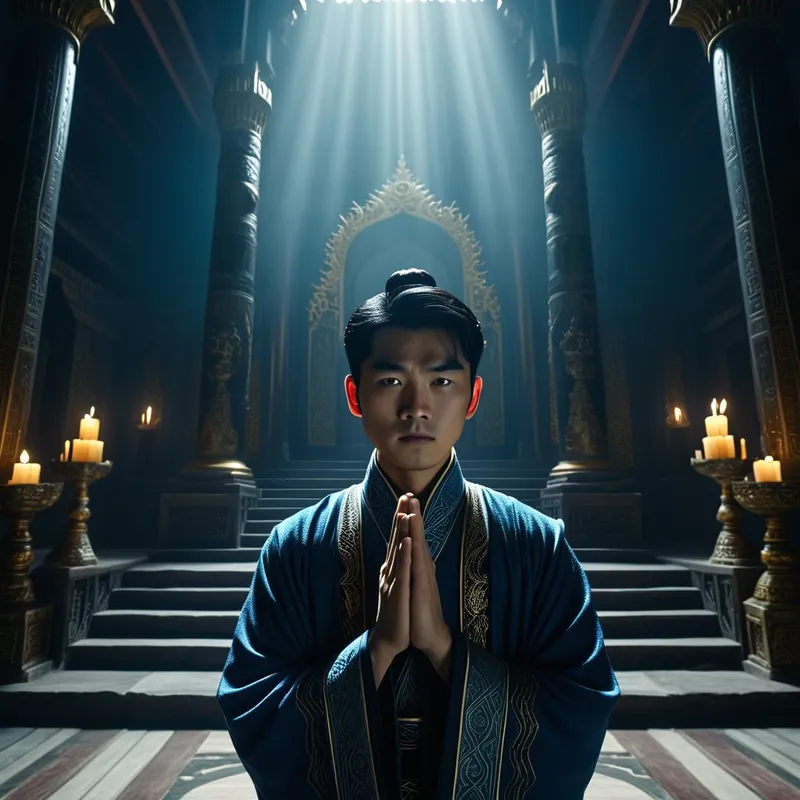
The myth of Guan Yin is not a single, frozen story, but a living river of devotion that has flowed through Chinese culture for over a millennium. Her origins are a profound syncretism, merging the Indian Buddhist bodhisattva Avalokiteshvara with indigenous Chinese Daoist goddesses and folk deities. This fusion began along the Silk Road during the Tang Dynasty, a period of extraordinary cultural exchange. Initially depicted as a masculine or androgynous figure from India, Guan Yin underwent a gradual, profound transformation in China, becoming predominantly feminine by the Song Dynasty. This shift speaks to a deep cultural need for a maternal, accessible, and merciful divine figure, complementing the more hierarchical and paternal structures of Confucian society.
The myth was passed down not just by monastic scribes, but by folk storytellers, temple priests, and grandmothers at the hearth. It was enacted in operas, painted on temple walls, and whispered in prayers by fishermen, merchants, and empresses alike. Its societal function was multifaceted: it provided a model of ultimate virtue (compassion over filial piety, a radical notion), offered hope of divine intervention in a precarious world, and created a psychological container for suffering. Guan Yin became the ultimate listener, the one who hears the cries of the world when no one else will, making the vast, impersonal cosmos feel intimately responsive.
Symbolic Architecture
At its core, the myth of Guan Yin is an alchemical map of consciousness transforming through the fires of opposition. Miao Shan is not merely a rebellious princess; she is the archetypal symbol of the individual spirit confronting the collective will—represented by the king, the state, tradition, and the ego’s desire for legacy and control.
The journey from Miao Shan to Guan Yin is the psyche’s evolution from personal will to transpersonal purpose, where the small self is sacrificed not for oblivion, but for a profound, active connection to the whole.
The repeated attempts to destroy her—through labor, fire, and execution—symbolize the world’s (and our own inner critic’s) attempts to annihilate that which does not conform. Her invulnerability represents the indestructible nature of authentic being when it is aligned with a purpose greater than survival. The descent into Diyu is the ultimate shadow integration; she does not battle hell, but illuminates it with her presence, transforming torment through recognition. This is the key psychological insight: compassion is not a weak sentiment, but a transformative power that changes reality by meeting it without resistance.
Her final vow, to postpone her own Nirvana, is the myth’s most radical symbol. It represents the choice of relatedness over isolation, of engagement over escape. The thousand arms and eyes are not just for aiding others; they are the sensory apparatus of a consciousness that has expanded to include the other as part of the self.
The Dreamer’s Resonance
When the pattern of Guan Yin surfaces in modern dreams, it signals a profound somatic and psychological process: the birth of the compassionate witness within. One might not dream of a literal goddess, but of scenarios rich with the myth’s architecture.
You may dream of being in a chaotic, noisy place—a crowded market, a screaming family argument—and discovering you can mute all sound except for one faint, genuine cry for help, which you feel compelled to answer. This is the “hearing the cries” function awakening. You may dream of having extra limbs or eyes, not as a horror, but as a feeling of newfound capacity to manage overwhelming responsibility or to perceive hidden truths. This somatic sensation points to the psyche stretching beyond its perceived limits to hold more complexity.
Conversely, you might dream of being Miao Shan before her transformation: facing a tyrannical authority (a boss, a parent, an inner voice) demanding you betray a core value for security or approval. The dream’s tension resides in the choice between self-betrayal and the terrifying, liberating act of saying “no,” which is the first step toward the authentic “yes” of compassion. These dreams mark the ego’s struggle to make room for the transpersonal Caregiver archetype, often felt as a crisis followed by a deep, quietening peace.

Alchemical Translation
For the modern individual navigating a fragmented world, the myth of Guan Yin models the complete arc of psychic transmutation, or individuation. It begins with the Calling—Miao Shan’s innate orientation toward compassion, that inner truth which feels like a destiny, even if it contradicts external expectations. This is followed by the Ordeal—the confrontation with the “king,” the personal and collective forces that seek to enforce conformity through punishment, ridicule, or exile.
The alchemical fire is applied in the Descent—the journey into Diyu. Psychologically, this is the courageous descent into one’s own underworld: the repressed traumas, shame, anger, and fear. Guan Yin does not fight these shadows; she sits with them. Her method is radical acceptance, which transmutes the hellish energy. This is the core of shadow-work: not eradication, but integration through compassionate witnessing.
The alchemical gold is forged in the Vow—the conscious decision to translate personal enlightenment into engaged compassion. It is the move from “I am free” to “Because I am free, I can serve.”
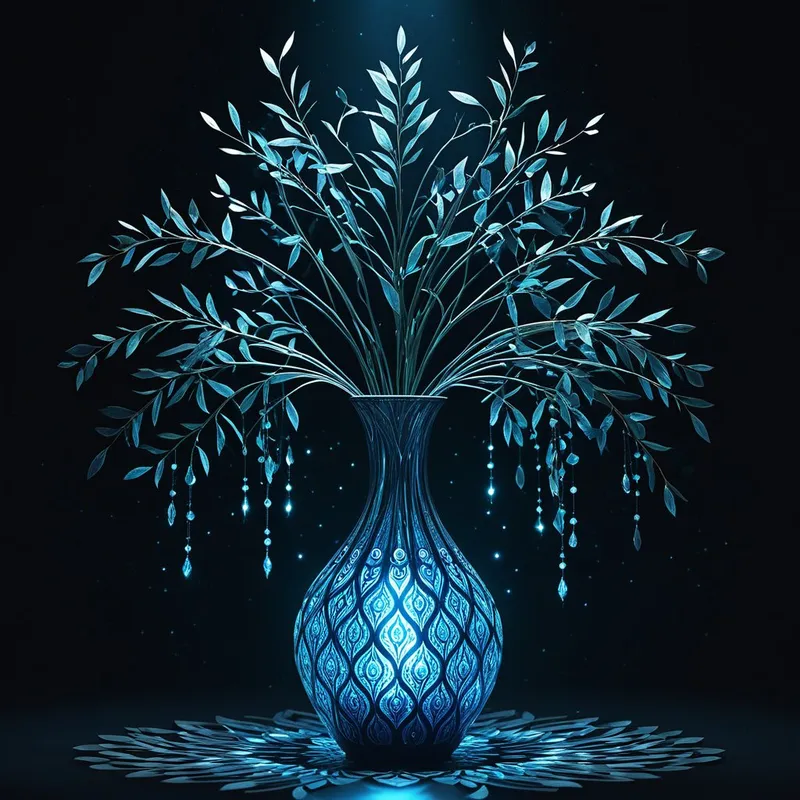
Finally, the Manifestation is the development of the “thousand arms and eyes.” In modern terms, this is the capacity for multi-faceted empathy, for holding multiple perspectives without being shattered by them. It is building a psyche resilient and spacious enough to perceive the world’s pain without collapsing into despair or retreating into indifference. The individual becomes a vessel—the pure vase—through which the healing waters of awareness flow. One does not become a savior for all, but one becomes a conscious, responsive point of peace and clarity within the whole, fulfilling the deepest promise of the myth: that true liberation is found in boundless connection.
Associated Symbols
Explore related symbols from the CaleaDream lexicon: