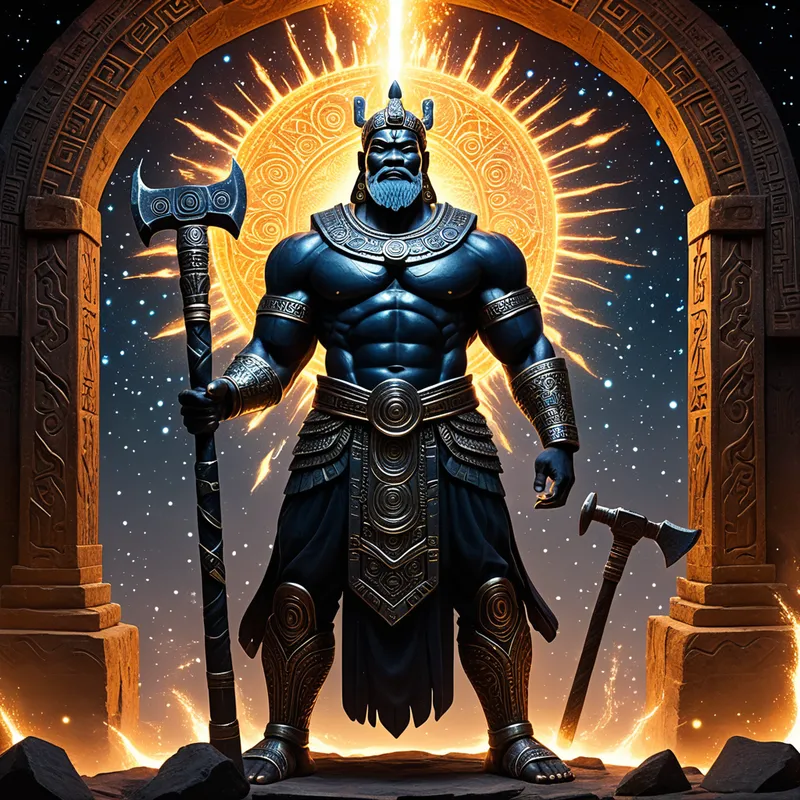
Gu God of Iron West African Myth Meaning & Symbolism
The myth of Gu, the divine blacksmith of the Fon people, who forged tools, weapons, and civilization from the primal elements of earth and fire.
The Tale of Gu God of Iron West African
Listen. In the time before time, when the world was soft clay and whispered potential, the great Mawu-Lisa shaped the cosmos. They breathed life into the mountains and filled the hollows with seas. But the world was silent, and the beings upon it were vulnerable, naked to the whims of chaos.
Then came a sound—a deep, resonant clang that echoed from the heart of the earth. It was not thunder, for thunder was still learning its voice. This was the sound of intention striking form. From the forge of creation itself stepped Gu. His body was not flesh, but the sheen of ore under a first rain; his muscles were cables of raw, earth-born metal. In his hand, he did not carry a weapon, but a hammer that was both question and answer.
Mawu-Lisa saw him and knew a piece of their own creative fire had taken solid form. "What will you do?" they asked, their voice the rustle of forests and the crackle of stars.
Gu looked at his empty hands, then at the raw world. He saw the people struggling with brittle wood and soft stone. He saw the animals they could not hunt, the earth they could not break, the homes they could not build. He did not speak with words, for his language was action. He knelt and plunged his hands into the soil, drawing forth dark, sleeping veins of iron. He breathed upon them, and his breath was the first true fire—not the wild fire of lightning, but a focused, obedient flame.
The clang-clang-clang began its eternal song. Under the fall of his hammer, the shapeless ore wept sparks and became form. First, the daba, its curved blade a promise of future harvests. Then, the arrowhead, sharp as a thought of justice. Then, the knife, the axe, the spear. With each creation, the world changed. The forest gave way to fields. Fear of the night gave way to the guarded fire. The formless struggle of life gained edges, angles, purpose.
But Gu was not finished. He saw that tools alone could create chaos as easily as order. A spear could feed a village or destroy it. So, from the same iron, he forged the first manilla, a circle of metal that was wealth, covenant, and bond. He forged the chains that would bind prisoners instead of slaying them, and the bells that would call communities to council. He shaped the very hinges of the first door, marking the sacred boundary between the wild and the home.
His final creation was for Mawu-Lisa themselves. From the core of a fallen star, he forged a crown of intricate, unbreakable iron vines. When he presented it, the cosmos shivered. He had not just made things; he had made possibility. He had given the raw dream of creation the hard, necessary bones to stand upon. The god of iron stood silent at his anvil, the rhythmic clang now the steady heartbeat of a world waking up to its own power.
Cultural Origins & Context
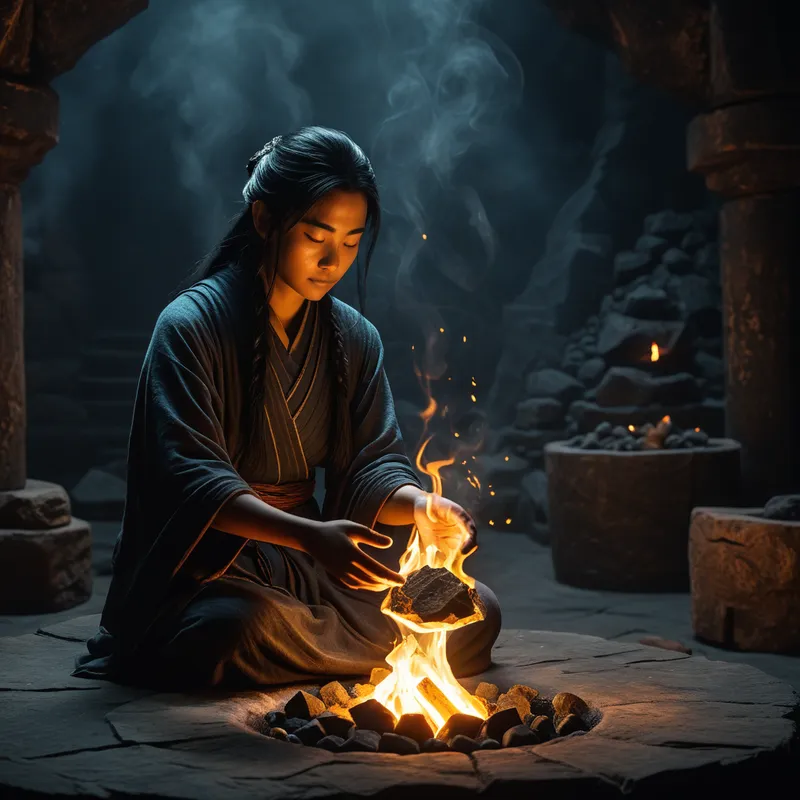
The myth of Gu originates with the Fon people of Dahomey (modern-day Benin). He is a central vodun within a complex and sophisticated pantheon. Unlike myths preserved solely in oral epic, Gu's presence was tangible, immediate, and vital. His priests were the blacksmiths, and his temples were the forges that sat at the literal and symbolic center of villages.
The myth was not merely told; it was performed daily in the ringing of hammers and the roar of bellows. It was passed down from master smith to apprentice alongside technical secrets of tempering and alloy. Societally, Gu’s function was profound. He was the divine rationale for technology, transforming the Fon from a people subject to nature into a people who could negotiate with it, shape it, and defend themselves. He legitimized the smith's craft as a sacred, cosmically ordained duty. In the powerful Kingdom of Dahomey, this translated directly into military and economic strength—Gu was the patron of the famed Dahomean army and the artisan class that underpinned its power.
Symbolic Architecture
Gu is the archetypal principle of the Creator who works not with thoughts or words, but with resistant, earthly material. He represents the moment when potential must confront limitation to become real.
The ore is the unformed Self; the hammer is the force of will; the forge is the transformative crucible of experience. Without the heat and the blow, the Self remains a hidden vein in the dark earth.
Iron itself is the key symbol. It is of the earth (Earth), yet it must be taken by force (mining). It is chaotic in its raw state, yet it holds the potential for both life-giving order (the hoe) and destructive chaos (the sword). Gu’s mastery signifies the human imperative to take this ambiguous, powerful substance of reality and consciously shape it toward purposeful ends. He is the god who civilizes the raw materials of existence, imposing Order through skilled, sacred labor.
The myth also beautifully encapsulates the duality of technology. Gu forges both the tool and the weapon, the currency and the chain. He does not create a utopia; he creates the means for complexity, with all its attendant moral choices. He gives humanity agency, and with it, responsibility.
The Dreamer's Resonance
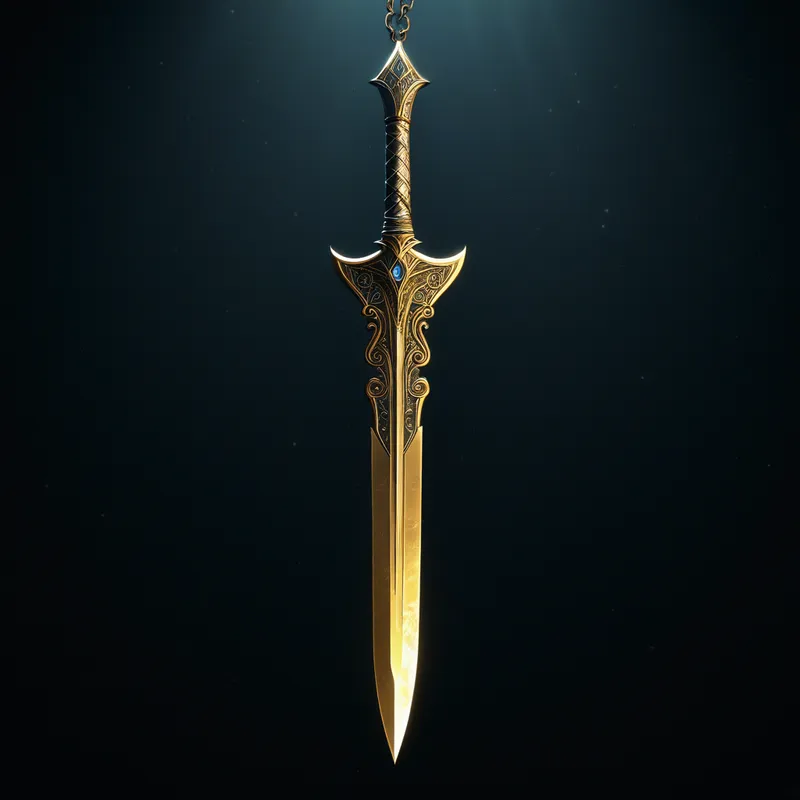
To dream in the pattern of Gu is to dream of the forge. One might dream of standing before an anvil with a urgent task but no hammer, or of holding white-hot metal that must be shaped before it cools. These are dreams of potent, pressurized potential seeking form.
Somatically, this can feel like a gathering tension in the arms and hands, a clenched jaw, or a heat in the core—the body preparing for a act of profound making or decisive action. Psychologically, the dreamer is in the crucible of a Transformation. The "raw ore" could be a talent, a grief, a rage, or a love that feels too vast and unmanageable in its current state. The dream is the psyche's signal that this material is now ripe for working. It is time to apply the heat of focused attention and the hammer blows of conscious choice to shape it into something functional, something that can be integrated into the architecture of one's life. Resistance to this process may manifest as dreams of broken tools or cold forges.
Alchemical Translation
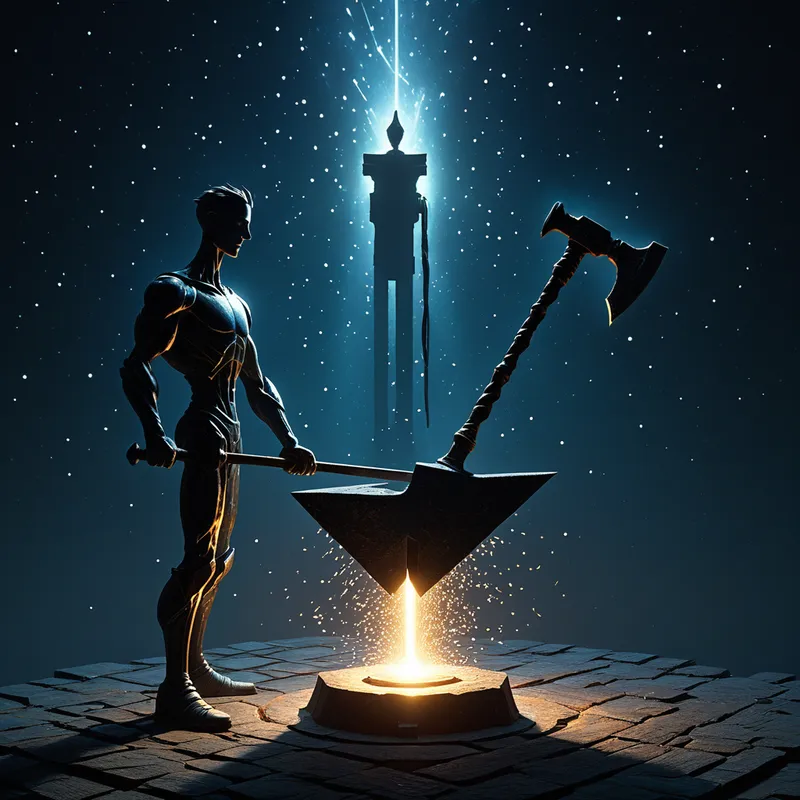
The journey of Gu is the alchemy of individuation in its most grounded form. It maps the process of psychic transmutation where base, unconscious contents (the raw ore of instinct, trauma, desire) are brought into the fiery light of consciousness (the forge) and hammered into usable forms (the adapted personality, the creative product, the conscious attitude).
Individuation is not about becoming spiritually disembodied. It is about becoming a skilled smith of your own soul, forging a unique and functional identity from the primal elements you were given.
The first stage is Nigredo: the descent into the earth to find your ore—confronting your shadow, your history, your raw drives. The second is Albedo: the heating in the forge—the purification through introspection, suffering, or analysis that renders the material malleable. The third is Rubedo: the hammer strikes—the acts of will, commitment, and repeated effort that shape this molten potential into a specific form—a new career, a healed relationship, a work of art, a hard-won integrity.
Gu, as the divine blacksmith, is the internal archetype that guides this entire operation. He represents the part of the psyche that says, "This difficult thing within you is not a flaw to be discarded; it is the very material from which your strength will be forged. Now, pick up your hammer. Light your fire. Begin the work."
Associated Symbols
Explore related symbols from the CaleaDream lexicon:
- Iron — The core substance of the myth, representing raw potential, strength, the necessity of work, and the dual capacity for creation and destruction that must be mastered.
- Fire — The transformative agent in the forge, symbolizing the purifying and shaping power of intense emotion, will, and conscious focus required to change one's nature.
- Earth — The source of the iron ore, representing the raw, unconscious, instinctual material of the Self that must be excavated and worked upon.
- Tool — The product of Gu's labor, signifying the extension of human will and the practical means to shape one's environment and destiny.
- Weapon — The shadow aspect of the tool, representing the necessary force for defense, the capacity for aggression, and the moral burden of power.
- Forge — The sacred, liminal space of transformation where raw material meets conscious skill, analogous to the therapeutic container or the focused creative process.
- Hammer — The active, applying force of will and decisive action that gives form to intention, striking the blows that shape reality.
- Anvil — The stable, enduring base of the Self that must withstand the blows of transformation, representing resilience, tradition, and the unyielding ground of being.
- Order — The ultimate goal of Gu's work, the imposition of functional structure and civilization upon the raw chaos of undifferentiated nature and instinct.
- Creator — The archetype embodied by Gu, the drive to bring new, tangible forms into existence through a marriage of vision, skill, and labor.
- Transformation — The central process of the myth, the alchemical journey from hidden potential to manifest, functional reality.