
Groundhog as Weather Prophet Myth Meaning & Symbolism
A myth of deep earth wisdom, where a humble creature holds the secret of winter's end and spring's return, teaching patience and inner knowing.
The Tale of Groundhog as Weather Prophet
Listen. The world is locked in the iron grip of Grandmother Winter. The breath of the north wind is a blade, and the sky is a lid of grey stone. The people huddle close to their fires, their stories growing thin, their eyes turning inward. The land sleeps a death-like sleep, and the memory of green things, of singing birds, is a fading dream.
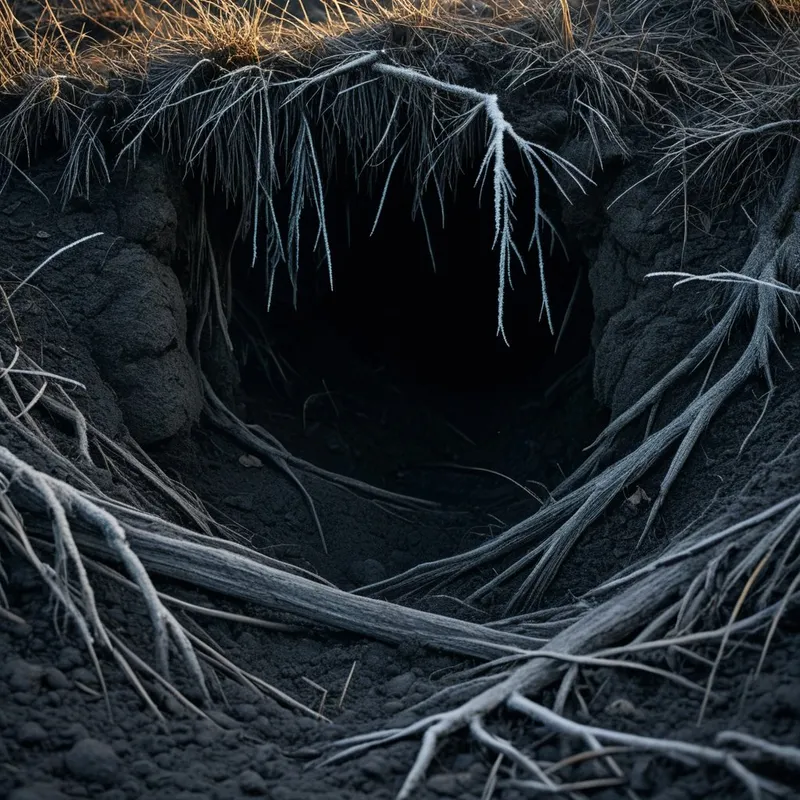
In this time of deep silence, all eyes turn not to the great chiefs or the soaring eagles, but downward, to the humble door in the earth. For there, in a chamber woven from roots and lined with the softness of forgotten grasses, sleeps The One Who Knows the Bottom of the Sky. It is not a beast of claw and fury, but a creature of profound stillness, of earth-knowing. Its heartbeat is a slow drum that matches the pulse of the land itself.
On a morning when the cold is so sharp it rings like crystal, a change whispers through the frozen air. A sliver of gold, thin as a knife’s edge, cuts the eastern horizon. The people gather, their breath pluming white in the stillness. They do not speak. They watch the mound of earth, the dark mouth of the burrow.
Within the earth, the sleeper stirs. It feels the shift, not in the air above, but in the deep bones of the world. The frost has reached its deepest tooth, and now, somewhere far below, a great turning begins. The creature rises, moving through the tunnel not with haste, but with a solemn, ancient purpose. It is both messenger and message.
It approaches the threshold, the line between the underworld of roots and stone and the overworld of wind and light. Here, it pauses. The conflict is not one of battle, but of perception. To step out is to speak. Will it see its own shadow, cast long and sharp by the tentative sun? That shadow is the ghost of winter clinging on, a promise of six more weeks of inwardness. Or will the sky be a blanket of cloud, the light diffuse and shadowless, a sign that the cold’s spirit is broken and the thaw will come swift?
The creature emerges. The world holds its breath. It sniffs the air, tasting the metallic tang of frost and the distant, ghostly promise of damp soil. It looks, not with the eyes of fear, but with the deep-seeing of one who has listened to the earth’s dreams all winter long. In that moment of looking, the fate of the season is not decided, but revealed. The creature bears witness to a truth already written in the secret language of sap and stone. It then returns to its chamber, its duty complete, carrying the knowledge back into the heart of the world. The people watch it descend, and in its silent action, they receive their answer. They turn their faces, either to settle deeper into the wisdom of waiting, or to begin listening for the first, faint drip of the great melt.
Cultural Origins & Context
This myth finds its roots among several Algonquian nations, including the Lenape, Ojibwe, and others for whom the groundhog (or woodchuck) was a respected clan animal and a keen observer of the natural world. It was never a solitary superstition, but a thread woven into a vast tapestry of ecological knowledge and cosmological understanding. The story was passed down not as a weather forecast, but as a sacred observation, a way of marking time that was intimately tied to the land's rhythms.
Elders and storytellers would share this tale as winter deepened, embedding it within a larger body of knowledge about animal behavior, plant cycles, and celestial movements. Its societal function was profound: it taught patience, acute observation, and humility. It positioned humanity not as the master of nature, but as a participant in a dialogue with it. The groundhog was the intermediary, a creature whose life was so bound to the earth's cycles that it became a reliable sign-reader. This myth reinforced a worldview where every creature, no matter how humble, held a piece of the world's wisdom, and paying attention to them was a spiritual and practical necessity.
Symbolic Architecture
At its core, the myth is a masterclass in the symbolism of liminality—the sacred space of the threshold. The groundhog is the ultimate liminal entity, dwelling between the underworld (its burrow, the unconscious, the past, winter) and the overworld (the surface, consciousness, the future, spring). Its emergence is a ritual act of divination, a consulting of the oracle that is the self-in-relation-to-the-world.
The shadow it may or may not see is not a meteorological trick of the light, but the projected shape of our own inner winter—the unresolved, the dormant, the aspects of self that require more time in the dark before they can be integrated.
The burrow symbolizes the womb of the unconscious, the place of incubation and deep knowing. The act of returning, regardless of the prophecy, is crucial. It signifies that wisdom is not for hoarding in the light, but must be returned to the depths to nourish the roots of being. The groundhog does not conquer the weather; it translates the language of the earth. It represents the somatic intelligence we have often lost—the gut feeling, the intuitive hit, the deep knowing that comes from being still and listening to the rhythms within and without.

The Dreamer's Resonance
When this myth pattern surfaces in modern dreams, it often signals a critical point of inner transition. Dreaming of being the groundhog, or of watching it emerge, speaks to a psyche on the cusp of a significant revelation or decision. The somatic process is one of "felt sense"—a bodily anticipation, a tightening in the chest or gut that precedes conscious understanding.
The dream may manifest as standing before a doorway, peering into a hole, or watching an animal behave portentously. The emotional weather of the dream is key: is there anxiety (the fear of a long shadow/wait), or hopeful relief (a shadowless emergence)? This dream asks the dreamer: What season is your soul in? What knowledge have you been incubating in your personal underworld? Are you ready to bring it to light, or does it need more time in the fertile dark? The dream underscores that the answer is not manufactured, but discovered through a brave act of looking at one's own situation with clear, unattached eyes.
Alchemical Translation
The alchemical process modeled here is the opus contra naturam—the work against (or through) nature—which in psychological terms is the journey of individuation. The base material is the "lead" of unconscious hibernation, the long winter of the soul where we are identified with our struggles or our latency.
The groundhog’s journey from nigredo (the blackness of the burrow) to the threshold is the stage of albedo. It is the emergence of a purified awareness, capable of perceiving its own shadow without being consumed by it.
The act of looking for the shadow is the crucial coniunctio, the confrontation between the conscious self (the emerging creature) and its shadow (the projected shape on the ground). If the shadow is seen, the process returns to nigredo for a necessary, extended purification—a psychic "six more weeks of winter" where deeper integration must occur. If no shadow is seen, it signifies a successful integration; the light of consciousness and the substance of the shadow have been united, allowing a swift transition to citrinitas and eventually rubedo, the full blossoming of the Self.
For the modern individual, the myth teaches that true knowing comes from within the "earth" of one's own body and unconscious. Our prophetic power lies not in frantic seeking, but in cultivating the groundhog’s qualities: the courage to enter the dark, the patience to wait for the right moment, the stillness to listen to inner tides, and the humility to accept the message received, whether it calls for patient incubation or courageous emergence. We are all both the watcher and the creature, awaiting the sign of our own becoming.
Associated Symbols
Explore related symbols from the CaleaDream lexicon: