Grotti Myth Meaning & Symbolism
A magical millstone, Grotti grinds out endless gold and peace, but its misuse unleashes a sea of salt and a curse of unceasing labor.
The Tale of Grotti
Hear now the song of the stone that sings, the wheel that weeps, the grindstone of fate. In the days when kings walked with the weight of the world upon their brows, there lived a king named Fróði, son of Friðleifr. His was a reign of peace so profound, so still, it was called Fróðafriðr. No man raised a sword against another; no axe bit into a neighbor’s timber. Yet, in the heart of this stillness, a hunger grew—not for war, but for more. More wealth, more security, more proof of the gods’ favor.
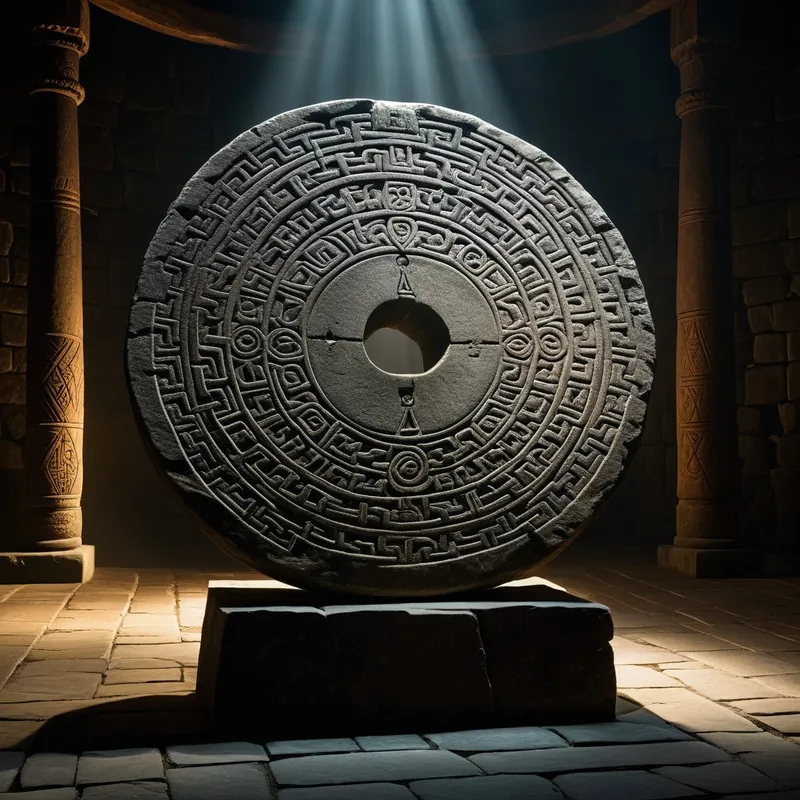
Fróði possessed a treasure beyond compare: the millstone Grotti. This was no common quern. Forged in the primeval times by the cunning dvergr, it could grind whatever its master commanded. But Grotti was heavy, so monstrously heavy that no man, nor even a host of men, could turn its cold, rune-scarred stone. Only beings of ancient, giant strength could move it.
The king sought such strength and found it in two captive giantesses, Fenja and Menja. Their arms were like knotted oak, their spirits as vast and untamed as the Ginnungagap. Fróði brought them to the stone. “Grind,” he commanded. “Grind gold, and peace, and all good things for Fróði.”
And so, the giantesses bent their backs. The great stone groaned to life, a deep, rhythmic thunder that shook the very foundations of the hall. From between the grinding stones poured a river of bright gold, rings and nuggets clattering in a ceaseless stream. It ground out prosperity, it ground out the peace itself, making Fróði’s reign legendary. But the king, his eyes gleaming with the reflected gold, gave his slaves no rest. “Grind on,” he said. “The sun still shines; you may still grind for Fróði.”
Exhaustion became their world. The song of the stone became a dirge. Their powerful limbs ached, their breath came in ragged clouds in the cold air. No respite, no mercy, only the endless, crushing circle. Then, in the deep watch of a night that felt as eternal as their toil, a change stirred in the giantesses’ hearts. The song of their labor twisted into a song of prophecy and wrath. As they pushed, they began to chant, their voices weaving with the stone’s groan.
They sang of their own noble lineage, of kings and battles. They sang of Fróði’s greed, a peace bought with bondage. And they sang a new command into the stone’s hungry maw. “No more gold, Grotti. No more peace for the unworthy. Grind instead an end to this false tranquility. Grind salt. Grind vengeance.”
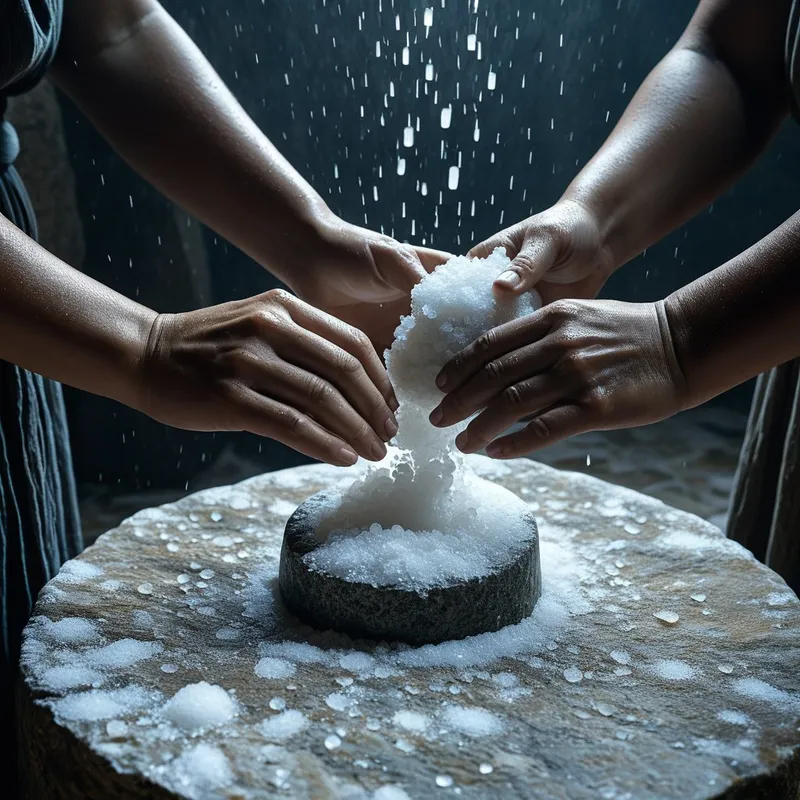
The nature of the grind shifted. The golden stream ceased. Now, from the heart of Grotti, poured a relentless, grating flood of white sea-salt. It piled high in the hall, a bitter, useless mountain. Still, Fróði, blind in his avarice, did not command them to stop. “Grind on,” he muttered, not understanding the alchemy of rage he had unleashed.
The giantesses ground on, their chant now a curse. They ground until the salt burst the walls of the king’s hall. They ground until it filled his ships at the dock. They ground until the very sea around Denmark grew salty and barren from the endless, magical outflow. And in grinding this curse, they ground the doom of Fróði himself, for an end to peace is an invitation to the sword. The Fróðafriðr shattered like glass. The millstone fell silent, its terrible work done, but its lesson etched into the very taste of the sea.
Cultural Origins & Context
The myth of Grotti is preserved primarily in two Old Norse poems: the Grottasöngr (The Song of Grotti) and referenced in Snorri Sturluson’s Skáldskaparmál (The Language of Poetry). It is a myth deeply rooted in the legendary history of the Danish Skjöldung dynasty, blending the cosmic with the political. Unlike the myths of the Æsir which explain the structure of the cosmos, Grotti’s tale is a skáldsaga—a poet’s saga—that uses the supernatural to explore very human themes of power, labor, and consequence.
It was likely told in halls not just as entertainment, but as a profound cautionary tale. In a culture that valued strength, wealth, and good fortune, the story of Fróði served as a critical check. It warned that even the greatest peace and prosperity (Fróðafriðr) is fragile if built on a foundation of exploitation and unending appetite. The image of the captive giantesses—forces of nature personified—being driven beyond their limits would resonate in a society familiar with slavery, conquest, and the precarious balance between a ruler and the sources of his wealth. The myth gave a cosmic voice to the enslaved and a divine consequence to the tyrant.
Symbolic Architecture
At its core, Grotti is the archetypal symbol of the Creative Engine. It represents the primordial capacity to generate reality from raw potential. It is the Yggdrasil of industry, the Mjölnir of production. Its function is neutral; its output is determined by the consciousness—or unconsciousness—of the one who commands it.
The millstone does not judge what it grinds; it only answers the will, spoken or unspoken, of the one who turns the wheel.
Fróði represents the Ego in possession of a great power. His initial command—“grind gold and peace”—is not inherently evil. It is the desire for security, abundance, and order. But the Ego, isolated and fearful, fails to recognize the living intelligence within the engine it commands (the giantesses as instinct and deep psyche) and the necessity of rhythm, rest, and respect. His command becomes a compulsion: “grind on.” This is the psyche’s state of identification with a single function—relentless production, endless thinking, constant doing—without integration.
Fenja and Menja are the archetypal Völur (seeresses) of the unconscious. They are the deep, instinctual, and often bound forces of nature within us. Initially subservient to the ego’s narrow demand, they contain within them ancestral wisdom, memory, and ultimately, the power of revolution. Their shift from silent labor to prophetic song is the moment the unconscious ceases to be a servant and becomes an oracle of truth, delivering a necessary, if destructive, correction.
The salt is the brilliant symbol of the unintended consequence, the shadow of creation. Gold is condensed light, value, currency. Salt is preservation, but also bitterness, sterility, and the essential, unglamorous mineral of life. To grind salt is to produce the necessary corrosion that ends a stagnant condition. It is the psychic truth that floods in when the fantasy of endless, easy gold collapses.
The Dreamer's Resonance
When the motif of Grotti appears in modern dreams, it signals a profound somatic and psychological process: the experience of being the instrument of a grinding compulsion. The dreamer may find themselves operating a vast, meaningless machine, or performing a repetitive task that feels eternal and exhausting. There is often a deep bodily sensation of ache, strain, and inescapable momentum.
This is the psyche’s depiction of a life lived on autopilot, where the individual feels like a captive giantess turning the wheel of their own existence—for a paycheck, for status, for a peace that feels hollow. The “song” in this state is an internal lament, a monotony of thought that hasn’t yet found its prophetic, liberating voice. The dream is a mirror showing the cost of ignoring the body’s and spirit’s need for rhythm, meaning, and rest. The feeling of grinding salt—of producing something that feels corrosive, bitter, or useless—reflects a growing awareness that one’s labors are not nourishing the soul, but perhaps poisoning the inner landscape.
Alchemical Translation
The myth of Grotti models the critical alchemical stage of mortificatio and separatio—the death of an old state and the separation of valuable elements from dross—as a prerequisite for true individuation. Fróði’s initial state is one of identification with a blessed, peaceful persona (the King of Peace). His possession of Grotti symbolizes the ego’s appropriation of a creative or life-giving power. The first stage of transmutation is the binding of the giants: the ego attempts to harness the vast, wild powers of the unconscious (instinct, emotion, deep creativity) for its own narrow purposes.
The crisis comes with the endless grind. This is the symptom of a one-sided psyche, where a single function dominates without renewal. The ego, fearing loss, commands “more,” not understanding it is commanding its own demise. The turning point is the prophetic song of the giantesses. This is the eruption of the unconscious into consciousness, not as a blind rage, but as a voice carrying ancestral truth and a new, fateful intention.
The curse is the cure in disguise. The salt that destroys the kingdom is the antiseptic that cleanses the wound of illusion.
Finally, the grinding of salt is the alchemical operation itself. It is the conscious, if painful, engagement with the shadow side of one’s endeavors. The peace (persona) must be dissolved in the salt sea of truth. The gold (the valued identity) must cease to be produced so that a more essential, if less glittering, substance can emerge. This process floods the old structures, rendering them uninhabitable. The “death” of Fróði’s peace is not a failure, but the necessary end of an immature state of being.
For the modern individual, Grotti calls us to ask: What engine am I turning without cease? What song is my labor singing—is it a hum of numbness, or a chant of deep truth? And what must I, from a place of empowered consciousness, command the millstone to grind now? Not for an insatiable ego, but for the salvation of the entire kingdom of the self. We must learn to be not the Fróði who exploits, but the wise ruler who listens to the song of the stone and knows when to let the wheel rest, and when to transform the nature of the grind itself.
Associated Symbols
Explore related symbols from the CaleaDream lexicon: