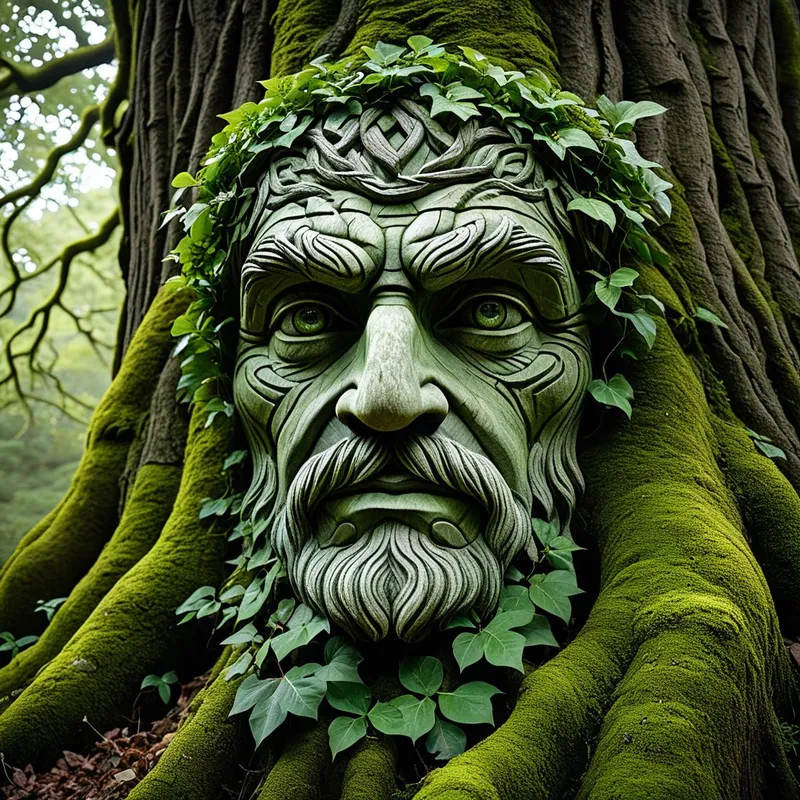
Green Man Myth Meaning & Symbolism
The Green Man is the ancient face in the foliage, a spirit of the wildwood embodying nature's relentless cycle of death, decay, and vibrant regeneration.
The Tale of Green Man
Listen. The wind in the high branches is not just wind. It is a breath, drawn from the damp earth, exhaled through a million leaves. In the deep places, where the sunlight falls in shattered coins upon the moss, the forest holds its secrets close. But one secret will not stay hidden. It watches from the bark of the oldest oak, from the tangled embrace of the honeysuckle, from the silent pool fringed with fern.
He has no single name that the tongue can easily shape. He is the genius loci of the wildwood itself. In the time of bright blossoms, when the hawthorn froths white, you might glimpse him as a shadow just beyond the clearing, a rustle that is more than a beast. His hair is the hanging ivy, his beard the cascading moss. His eyes are the dark, still water caught in a hollow stone.
His tale is not one of battles with spear and shield, but of a slower, more profound conflict—the struggle between life and the seeming death that nourishes it. The people of the tribes knew this struggle in their bones. They saw it when the summer’s glory was consumed by the autumn fires, when the land fell into the grey sleep of winter. They feared this sleep was a true death. And so, in their fear, they would sometimes turn from the wood, build their fences higher, tell tales of the dark and swallowing wild.
But the Green Man does not rage. He waits. He lets the frost crisp his leaves, lets the axe bite into his trees. He falls into the mulch and the loam, into decay so complete it becomes potential itself. This is the heart of the mystery. In the deepest part of winter, when the world is held fast, a stirring begins not in the sky, but in the roots. A silent, irresistible pressure. It is the pressure of a story that must be told.
From the split bark, from the fallen log teeming with unseen life, from the very wound, a new greenness surges. It is fiercer, brighter, more abundant than before. It bursts forth not in spite of the decay, but because of it. The face reappears, not as a memory, but renewed—young shoots curling from weathered stone, flowers blooming from a mouth of rotten wood. He is the breath in the wind again, the whisper in the leaves, the undeniable truth: what falls is not lost, but transformed. The forest has breathed out, and breathed in, and is alive once more. The cycle is complete, and in its completion, it begins anew.
Cultural Origins & Context
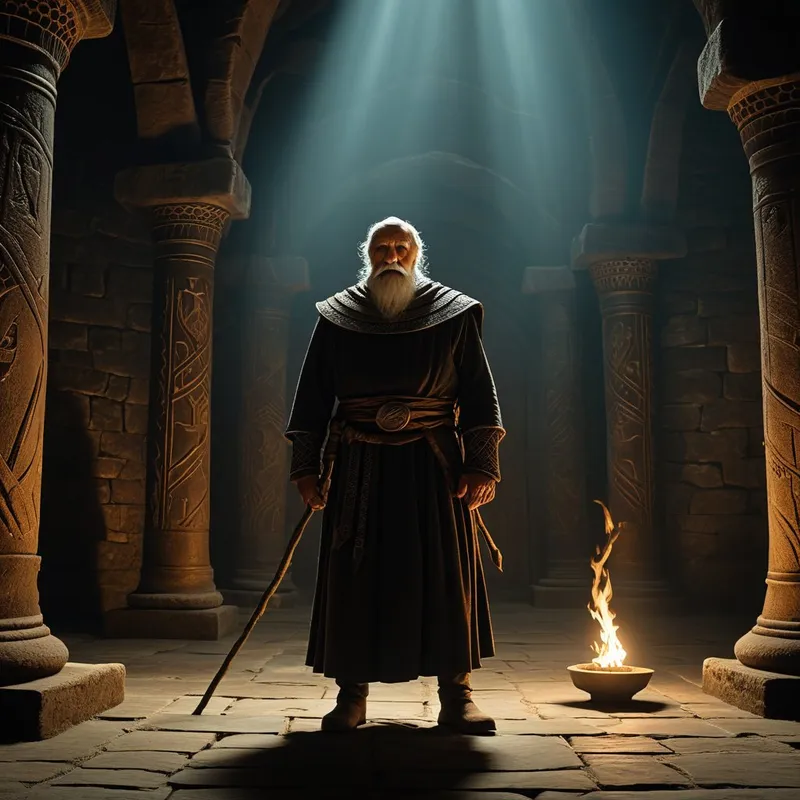
The figure we now call the Green Man is a puzzle passed down not in manuscripts, but in stone and story-fragments. The Celts, a tapestry of Iron Age tribes across Europe, left no written myths of their own. Theirs was an oral tradition, a living stream of knowledge carried by the Druids and bards. These stories were not mere entertainment; they were the sacred map of the world, encoding laws, history, and the proper relationship between the people, their ancestors, and the numinous land.
While the specific narrative of the leaf-faced god is lost to time, his essence permeated the Celtic worldview. Deities like Cernunnos, the stag-antlered lord of animals, and the myriad spirits of spring and vegetation, speak to this deep reverence for the cyclical, regenerative power of nature. The Green Man, as a later folkloric crystallization of this principle, likely emerged from seasonal rituals and the observation of the agricultural year. His face, carved later on Christian church misericords and bosses, is a stubborn pagan memory, a testament to a belief so fundamental it could not be fully erased. It was the folk-soul’s way of remembering: the sacred is not only in the heaven above, but in the leafing branch and the decaying log.
Symbolic Architecture
The Green Man is not a god of the untamed wilderness opposed to humanity, but the spirit of the process that sustains all life. He is the archetypal embodiment of the life-death-rebirth cycle, stripped of sentimentality. His symbolism is an intricate architecture built on three pillars: the face, the foliage, and the cycle.
The face in the leaf is the Self emerging from the chaos of the unconscious, order born of nature's own wild logic.
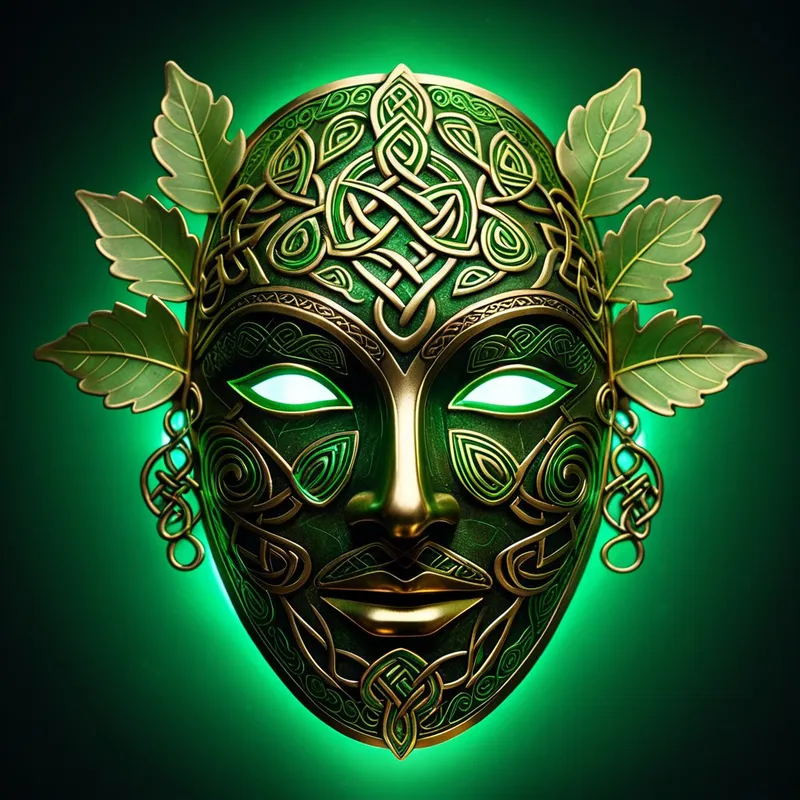
The face signifies consciousness, identity, and presence emerging from the formless. It tells us that the generative force of nature is not blind, but possesses a kind of knowing, an ancient intelligence. The foliage—oak, ivy, hawthorn, vine—represents the proliferating, connecting, and often chaotic vitality of life itself. It is the raw, untamed biomass of existence, of thought, of instinct. The union of the two, the humanoid form sprouting from the vegetable world, symbolizes the inseparable bond between human consciousness and the biological, instinctual ground from which it springs.
Most critically, he represents the cycle. He is not eternally young. He is shown in all stages: budding, flourishing, fruiting, decaying, and re-sprouting. This makes him a profound symbol of time itself—not linear time, but cyclical, recursive time, where the end is always a new beginning.
The Dreamer's Resonance
When the Green Man stirs in the modern dreamscape, he rarely appears as a literal foliate head. His visitation is more subtle, more somatic. To dream of him is to dream the process he represents.
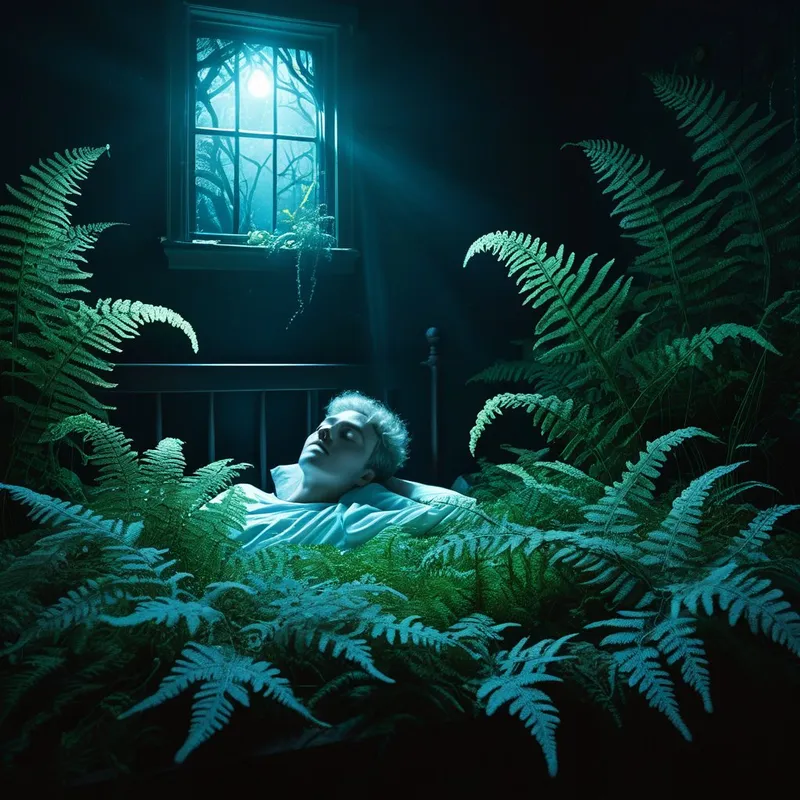
You may dream of a house where vines are breaking through the plaster, or of a forgotten room thick with healthy, encroaching mold. You may find your own hands are root-like, or that you are breathing underwater in a forest. These are dreams of psychic overgrowth, where the instinctual, vegetative layers of the psyche are actively reclaiming territory that has been too rigidly ordered, too sterile, or too consciously controlled. It can feel unsettling, even invasive.
This resonance signals a critical phase of integration. The conscious ego, perhaps identified solely with its modern, technological, or highly structured self, is being confronted by the older, biological, and wild substrate of its own being. The Green Man in dreams is the somatic truth of transformation: it is not a clean, intellectual decision, but a messy, organic process that involves a degree of dissolution. The dream-ego is being invited—or compelled—to compost parts of its identity to make way for a more authentic, grounded form of life.
Alchemical Translation
In the alchemical vessel of the soul, the work of the Green Man is the Nigredo and the Citrinitas made one continuous process. His myth models the path of individuation not as a heroic ascent to a distant peak, but as a deepening rooting into one’s own nature.
To become whole, one must first consent to become soil.
The initial conflict—the fear of the wild, the decay, the loss of form—mirrors the ego’s resistance to the unconscious. We build walls, deny our shadow, fear the loss of control. The alchemical translation begins with the sacrifice of the old form. This is the winter of the psyche, the necessary decay of outworn attitudes, personas, and self-concepts that have served their purpose but now block new growth. It feels like a death.
The Green Man’s triumph is his reappearance from this very decay. This is the regeneration from the substance of the self. The new consciousness that emerges is not imported; it is synthesized from the broken-down materials of the old, now fertilized by the acceptance of the shadow and the instinctual world. The leaves sprouting from the mouth symbolize a new speech, a truth-telling born of this organic process. The wisdom in the eyes is the Self’s knowledge that death and life are partners in a single, endless dance of becoming.
For the modern individual, the Green Man’s path asks: What in you needs to fall to the ground and decompose? What rigid structure must be softened by the moss of patience and the rains of feeling? Only through that dissolution can the deep, resilient, and authentically wild green shoot of your own true nature find the force to break through.
Associated Symbols
Explore related symbols from the CaleaDream lexicon: