Green Knight Myth Meaning & Symbolism
A mysterious, verdant warrior challenges a knight's honor, sending him on a year-long quest to face a fatal blow and the raw truth of nature.
The Tale of Green Knight
Hear now a tale from the high-towered halls of Camelot, when the fire roared and the wine flowed like a red river. It was the time of the New Year’s feast, a time for boasting and laughter, for the clatter of plates and the shine of gold. King Arthur himself sat at the head of the table, a beacon of order and chivalry in the heart of winter.
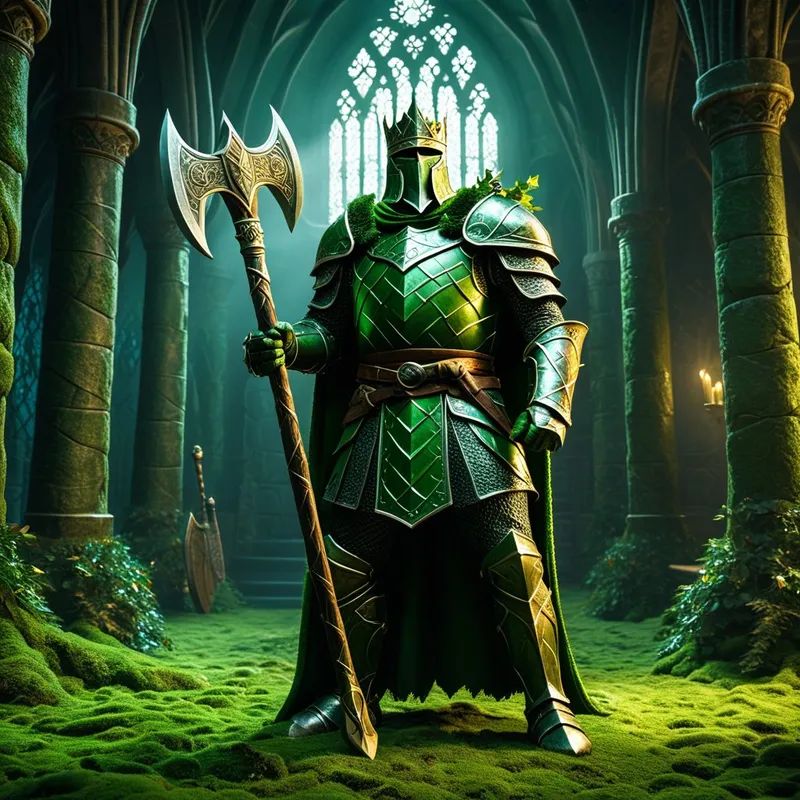
Then came the sound. Not of song, but of hoofbeats like thunder rolling into the hall. The great doors did not open—they were sundered by the presence that entered. A horse, tall as a war-tower, and upon it a rider the likes of which had never been seen. His skin was the deep, mossy green of a forest at dusk. His armor, green as emerald. His beard, a great bush of green, fell like a cascade of ivy. In one hand, a holly bough, token of peace in the dead of winter. In the other, a Danish axe, its edge gleaming with a cold, hungry light.
Silence, thick and cold, fell upon the court. This was the Green Knight. His voice boomed, not with malice, but with the implacable force of a river carving stone. He proposed a game. A Christmas game. Let any knight of renown strike him one blow with this mighty axe. But in a year and a day, that knight must seek him out at the Green Chapel and receive a blow in return.
The court was frozen. The challenge hung in the air, a test of their very essence. Then, to preserve the honor of his king and his fellowship, Sir Gawain stood. He took the axe, its weight a promise of doom. The Green Knight dismounted, knelt, bared his green neck. With a single, swift stroke, Gawain struck. The head, green as summer leaves, tumbled across the floor. The court gasped, then began to murmur in relief. The game was over.
But the body did not fall. It stood, walked calmly to its head, and lifted it by the hair. The eyes opened. The lips moved. “Remember your promise, Gawain. Seek me at the Green Chapel when the year turns. I am the Knight of the Green Chapel.” Then, mounting his steed, the head still held aloft, he rode from the hall, leaving behind the scent of damp earth and the chill of a truth unspoken.
The seasons turned. Summer’s glory faded to autumn’s gold, then to winter’s bitter grip. Gawain, bound by his word, set out. His journey was a descent from the world of courtly tapestries into the raw, teeth-bared world of nature. He fought wolves and trolls, slept in ice and rock, a solitary figure against the vast, indifferent white. At last, near the year’s end, he found a castle, a bastion of warmth and hospitality ruled by a lord and his beautiful, cunning lady. For three days, as the lord hunted, the lady tested Gawain’s courtesy, offering gifts and kisses. Gawain, ever polite, accepted only kisses, which he duly passed to the lord in their nightly exchange-of-winnings game. But on the third day, the lady offered a green silk girdle, enchanted, she said, to protect his life. Fear for the coming axe-stroke pierced his heart. He accepted it, and hid it from the lord, breaking the terms of their game.
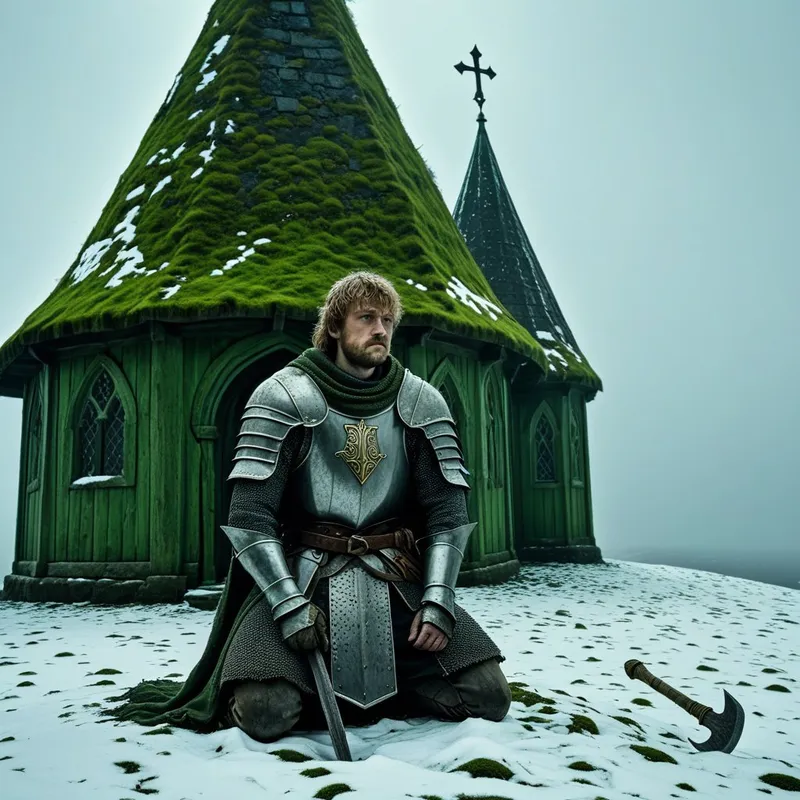
The final morning, Gawain came to the Green Chapel. It was no chapel of stone, but a mossy, grass-covered barrow, an ancient, sleeping mound. From within came the sound of a blade being sharpened. The Green Knight emerged, whole and terrible, axe in hand. Gawain knelt, bared his neck. The axe swung once, twice, stopping just short, testing his nerve. On the third swing, it bit—but only nicking Gawain’s skin, drawing a single drop of blood.
Then the Knight laughed, not with cruelty, but with the deep rumble of understanding. He revealed himself: he was the lord of the castle, transformed. The entire year-long ordeal was a test crafted by Morgan le Fay. The nick was for Gawain’s one small failing: hiding the girdle out of a very human fear of death. Gawain, shamed, flinched at his own imperfection. But the Green Knight absolved him, calling him the most blameless knight of all, for his flaw was not malice, but love of life. Gawain returned to Camelot, wearing the green girdle not as a trophy, but as a badge of humility, a reminder of the wild, testing truth that lives beyond the castle walls.
Cultural Origins & Context
The tale survives in a single, magnificent manuscript from the late 14th century, a poem known as Sir Gawain and the Green Knight. It is a product of the rich, complex Arthurian tradition that flourished in the high to late Middle Ages, blending chivalric romance with older, deeper currents. The anonymous poet, likely from the Northwest Midlands of England, wrote in a robust, alliterative style that echoes Old English verse, grounding the courtly tale in a more ancient, earthy linguistic soil.
The myth functioned as more than entertainment. In an age of strict chivalric ideology, it served as a sophisticated pressure test for that very code. It asked the courtly audience: Can perfect courtesy survive a confrontation with the utterly non-courtly—with raw nature, with unblinking mortality, with cunning sexuality? It was told in halls not unlike Camelot’s, a mesmerizing story that both affirmed the knightly ideal and subtly questioned its sustainability in a world ruled by older, greener laws.
Symbolic Architecture
The Green Knight is no conventional villain. He is an archetypal force, an emissary from a realm where human rules dissolve.
He is the incarnation of the Shadow of Camelot itself—not evil, but everything the ordered, civilized court has excluded: the untamed wild, the cycle of decay and regeneration, the blunt fact of mortality that even the mightiest king must face.
His color is the first and deepest symbol. Green is the color of life, of viridian spring, but also of mold, of rot, of the life that feeds on death. He holds holly (evergreen, persistent life) and an axe (the instrument of cutting, of death). He is the paradox of nature itself: endlessly creative, utterly destructive, and completely indifferent to human notions of fairness.
His beheading game is the ultimate confrontation with consequence. In the insulated world of the court, a boast or a strike can be a game. The Green Knight introduces a law of absolute reciprocity, a cosmic echo that returns your action to you, transformed. The journey Gawain undertakes is the necessary pilgrimage from the conscious persona (the perfect knight) to the site of the unconscious (the grassy barrow chapel) to integrate this law.
The green girdle is the symbol of the complex, compromised self. It represents the instinct to survive, which can lead us to small betrayals of our own ideals. Its acceptance marks Gawain’s transition from a figure of pure, abstract virtue to a fully human being, flawed yet authentic.
The Dreamer's Resonance
When this myth stirs in the modern psyche, it often manifests in dreams of profound testing. You may dream of a looming, silent natural figure—a tree that watches, a mountain that judges. You may dream of preparing for a dreaded appointment or facing an inevitable reckoning, your heart pounding with a mix of terror and solemn duty.
Somnatically, this is the process of the psyche preparing to honor a commitment made to itself, often at a level deeper than conscious awareness. It is the anxiety before a necessary confrontation with a part of the self you have “beheaded”—ignored, dismissed, or tried to cut off (a talent, an emotion, a truth). The dream is the Green Knight’s reminder: the year and a day are up. The journey to the Green Chapel—a place that feels both deeply familiar and utterly alien—must begin. The psychological process is one of moving from a state of sheltered, perhaps arrogant, self-concept (“I am perfectly honorable/strong/successful”) into the raw wilderness of your own unresolved complexities.
Alchemical Translation
The alchemy of the Green Knight myth is the transmutation of brittle, idealized consciousness into a resilient, embodied selfhood. The individuation journey it models is not about achieving perfection, but about achieving wholeness through acknowledged imperfection.
The quest begins with the nigredo, the blackening: the shocking intrusion of the Green Knight shatters the golden glow of Camelot. Gawain’s comfortable identity is dissolved. His journey through the winter wasteland is the albedo, the whitening—a stripping away of all courtly pretensions, a purification by solitude and hardship.
The castle interlude represents a crucial, often misunderstood stage: the citrinitas or yellowing. Here, the tested psyche encounters the temptations of the soul—not crude evils, but sophisticated tests of integrity (the lady’s advances) and the allure of magical solutions to avoid pain (the girdle). Failing perfectly here is essential. It introduces the necessary impurity, the copper into the gold, that makes the final product strong rather than fragile.
Kneeling at the Green Chapel is the final stage, the rubedo or reddening. He offers his neck—his conscious will—to the axe of truth. The expected death blow becomes a life-giving wound, a mere nick that draws the symbolic blood of acknowledgment. The Green Knight, the terrifying Other, is revealed as a part of the self (the lord of the castle). The integration is complete. The green girdle, once a token of fear and deceit, is reclaimed as the badge of the integrated self. It is no longer a magical protector from life, but a humble reminder of one’s humanity within life’s great, green, and relentless cycle. The knight returns not to a state of naive innocence, but to a conscious fellowship, carrying the wisdom of the wild within the hall.
Associated Symbols
Explore related symbols from the CaleaDream lexicon: