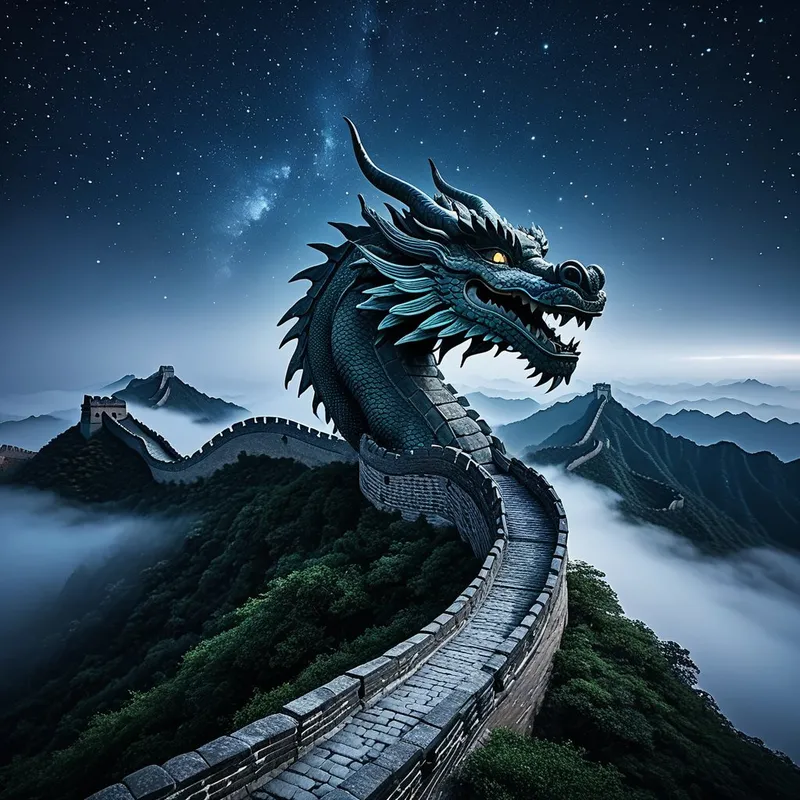
Great Wall Myth Meaning & Symbolism
A myth of collective will, where a nation's grief and hope are transmuted into an eternal stone dragon, a boundary against chaos and a testament to unity.
The Tale of Great Wall
Listen, and hear the story not of mortar and rock, but of breath and bone. In the days when the earth was young and the northern winds carried not just cold, but the howls of raiders and the whispers of chaos, the heart of the land was fractured. The people of the Middle Kingdom lived in the shadow of a great fear, their villages like scattered seeds, vulnerable to the storm.
From this fear, a resolve was born, not in one heart, but in ten thousand. The Emperor, the Son of Heaven, decreed that a barrier must rise, a spine of stone along the dragon’s back of the northern mountains. But this was no mere decree of a ruler; it was the cry of a people made manifest. And so, they came. Farmers left their plows in the furrows. Scholars set aside their brushes. Mothers kissed their children and turned their faces to the north. They became a river of humanity flowing to the high, barren places.
The work was the work of giants, yet done by human hands. They hauled mountains, stone by stone. Their songs were the rhythm of the hammer, their laments the sigh of the chisel. The seasons wheeled above them—scorching sun that baked the clay, bitter winds that stole the warmth from their fingers, rains that turned the paths to rivers of mud. Many who came never returned to the green valleys. Their bodies, spent, were laid to rest within the very fabric of the rising wall. It is said that for every li of its length, a hundred souls sleep in the earth beneath it.
One tale whispers of a young wife, Meng Jiangnu, whose husband was taken for the wall. She journeyed for years to bring him winter clothes, only to learn he had perished and been entombed within the stones. Her grief was so vast, so pure, that when she found the stretch where he lay, she wept for three days and three nights. Her tears, hot as magma and bitter as the sea, struck the wall. And the wall, that implacable thing of stone, could not bear the weight of a human heart unmade. With a sound like a mountain sighing, a great section crumbled, revealing the bones of the lost within.
The wall grew, not as a building grows, but as a living thing grows—slow, inevitable, consuming and being consumed. It linked fortress to fortress, peak to peak, until one day, the workers at the eastern sea clasped hands with the workers from the western deserts. The great serpent of stone was complete. It lay across the land, a scar and a suture, a dividing line between the cultivated order of the fields and the wild uncertainty of the steppes. It did not speak, but its silence held the memory of every song sung upon it, every life given to it. It became the Dragon’s Spine, a testament written not in ink, but in sacrifice and collective will, standing guard under the eternal watch of the heavens.
Cultural Origins & Context
The myth of the Great Wall is not a single, codified story from a classic text like the Shan Hai Jing, but a vast, living folklore that grew from the historical reality of its construction. For over two millennia, various dynasties—most famously the Qin and Ming—engaged in monumental projects to fortify the northern frontier. The myth emerged from the ground up, from the songs of conscripted laborers, the laments of their families, and the awe of later generations who beheld the structure snaking across impossible terrain.
It was passed down through oral tradition, in local operas, folktales, and poems. The story of Meng Jiangnu is one of the most enduring threads, a poignant counter-narrative to the imperial glory. This myth complex served multiple societal functions: it explained the Wall’s terrifying scale and human cost, it provided a vessel for collective grief and memory, and it ultimately transformed a military edifice into a national symbol of resilience, perseverance, and the defining power of cultural boundary. It taught that what defines a people is not just the land within, but the shared effort to protect it.
Symbolic Architecture
Psychologically, the Great Wall is one of humanity’s most potent symbols of the Psychic Boundary. It represents the necessary, often painful, process of delineating the self from the non-self.
The wall is not built to keep the world out, but to define what is in. It is the shape of identity, forged in sacrifice.
Its stones symbolize the accumulated experiences, traumas, and lessons that form our character. Some stones are laid consciously (our values, decisions), while others—like the lost laborers entombed within—represent unconscious complexes, forgotten pains, and inherited burdens that nonetheless form the foundation of who we are. The Wall’s primary symbolic function is protection, but a profound one. It protects the tender, cultivated "middle kingdom" of the conscious ego—our sense of order, values, and culture—from the invasive "northern barbarians" of the unconscious: formless chaos, unintegrated instincts, and overwhelming psychic content.
Yet, the myth wisely shows the boundary’s duality. It is both a protector and a prison. It can create safety but also isolation. The grief of Meng Jiangnu, which breaches the Wall, symbolizes the inevitable return of the repressed. No psychic boundary is absolute; the pain of the soul will always find a way through, demanding recognition and integration.
The Dreamer's Resonance
When the Great Wall appears in a modern dream, it signals a critical phase of boundary work within the psyche. The dreamer is likely grappling with questions of integrity, defense, and isolation.
To dream of building a wall, stone by arduous stone, reflects a conscious effort to fortify the ego. This may be necessary after a period of invasion—emotional burnout, a violation of trust, or a loss of self. The somatic feeling is often of exhaustion coupled with determination, a weary strengthening. Dreaming of standing upon the Wall, looking out over vast landscapes, suggests a achieved perspective, a hard-won ability to observe one’s inner and outer worlds from a place of relative security.
Conversely, to dream of a crumbling or breached Wall, as in Meng Jiangnu’s story, indicates a psychic upheaval. Repressed grief, rage, or desire is breaking through the defenses. This can feel terrifying—a loss of control—but is often a necessary crisis for healing. The dreamer’s shadow is demanding entry. To dream of being trapped on the wrong side of the Wall, in the desolate north, speaks to a feeling of being exiled from one’s own center, alienated from one’s values or community, lost in the wilderness of the unconscious.

Alchemical Translation
The myth models the alchemical process of Nigredo and Albedo on a collective and individual scale. The initial stage is the confrontation with the prima materia—the raw, chaotic threat (the northern invasions, our own inner chaos). The decision to build is the ego’s commitment to the work of consciousness.
Individuation is the labor of building a wall around a sanctuary you have not yet seen, trusting that the work itself will reveal what is worth protecting.
The grueling labor, the sacrifice, and the embedding of pain (the lost laborers) represent the Nigredo, the blackening, the necessary suffering and confrontation with the shadow that precedes transformation. Each stone laid is a conscious act, a small integration.
The completion of the Wall is not the final goal, but a stable stage of Albedo. A defined, functioning consciousness has been achieved. But the myth’s deeper alchemy is in the breach. Meng Jiangnu’s tears represent the Aqua Divina—the healing, dissolving power of acknowledged emotion. Her grief, when fully felt, does not destroy the Wall but reveals its hidden contents (the bones of the lost). This is the integration. The Wall remains, but it is now conscious of what it contains; the boundary is wiser, more permeable to truth.
For the modern individual, the process is the same. We must build our necessary defenses and ego structures through effort and often pain. But the journey toward wholeness requires us, at the right time, to let our deepest, most authentic feelings touch those hardened defenses. Not to obliterate the self, but to reveal the forgotten parts buried within our own architecture, allowing for a more compassionate, complete, and resilient identity to stand guard over our being.
Associated Symbols
Explore related symbols from the CaleaDream lexicon: