Great Plains Myth Meaning & Symbolism
A myth of the land's creation, where the People emerge from the earth and learn to live in sacred reciprocity with the Buffalo and the vast, whispering plains.
The Tale of the Great Plains
In the time before time, when the world was only a thought in the mind of the Wakan Tanka, there was a great, dark, and silent flatness. It was not land, nor water, nor sky, but a dreaming potential. From the deep places below, the Oyate stirred. They were not yet people, but spirits of the soil, yearning for form and breath.
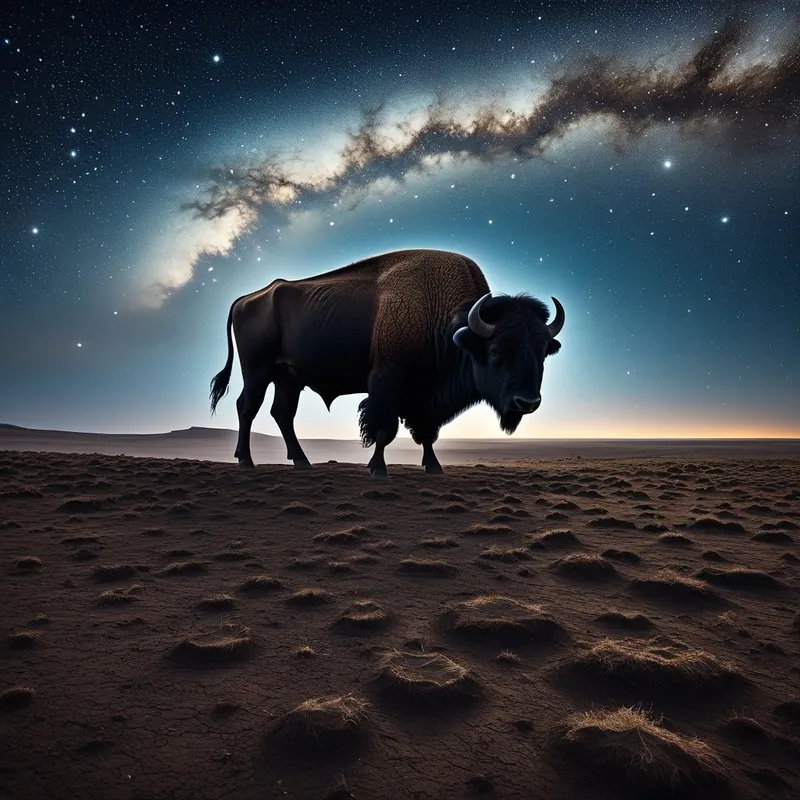
Then came a sound—a low, resonant rumble that was not thunder, but a heartbeat. It grew from the four directions, shaking the very fabric of the dark flatness. From the star-strewn east emerged a great and mighty presence: Tatanka. His form was of rolling hills and dark, fertile earth, his eyes pools of ancient water, his breath the warm wind. Where his hooves touched the dreaming flatness, the ground firmed and cracked, and from the cracks sprang not plants, but whispers—the whispers of grass.
Tatanka lowered his great head and blew his life-wind across the expanse. The whispers took root, becoming a sea of green that rippled to the horizon, the Mitakuye Oyasin made visible. The grass fed the soil, and the soil held the rain. Yet, the land was silent but for the wind.
Now the People pushed upwards, their bodies forming from the very clay Tatanka had trod. They stood, blinking in the new light, on two legs, but their spirits were still tethered to the earth below. They were hungry, and they were cold. They saw Tatanka, the source of the grass, and felt awe and need. One among them, a woman whose hair was the color of dry grass, stepped forward. She had no weapon, only empty, open hands.
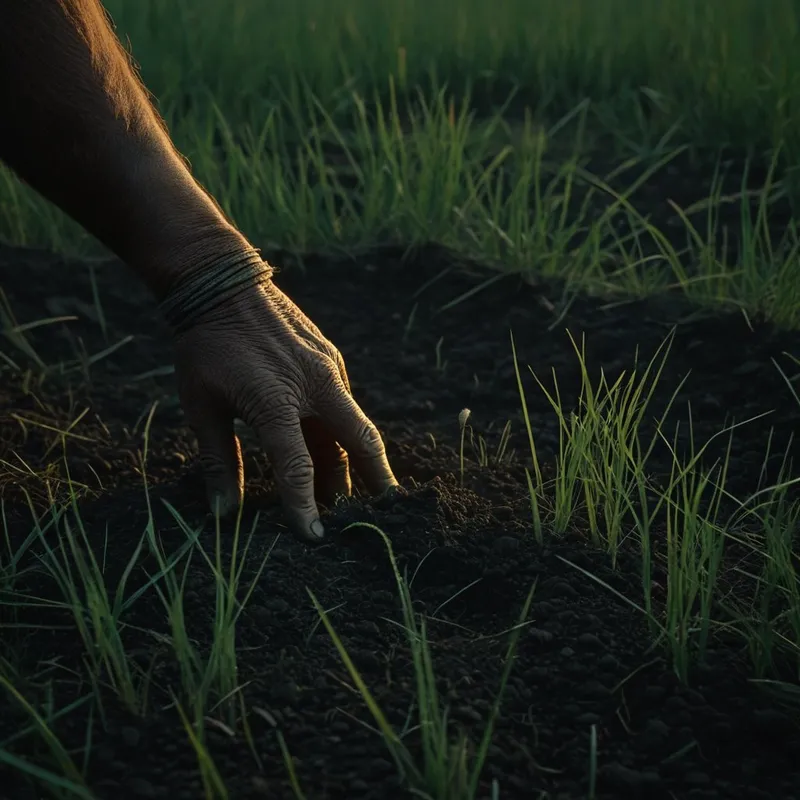
She knelt before the great being, not in submission, but in recognition. She placed her palms on the ground where the first grass grew. Tatanka watched, his breath steady. Then, he knelt before her. He bowed his head, and from the space between his horns, from the very center of his being, there fell not blood, but a gift. A single, perfect hide, which settled upon the woman’s shoulders, warm as sunlight. And then, from his side, a bounty of his own flesh, transformed into a herd that covered the plains, a moving, breathing extension of his spirit.
The woman understood. She took a piece of the sacred flesh, and with reverence, she buried it beside a stream. From that offering, the first tipsin and canpa grew. She held seeds in her hand, and the wind, Tatanka’s breath, took them to scatter across the world. The covenant was sealed. The People would honor Tatanka by using every part of his gift, by caring for the grass that was his breath, and by offering songs and prayers of gratitude. The land was no longer a flatness, but a living, giving relation—the Great Plains.
Cultural Origins & Context
This narrative is not a single story, but a tapestry woven from the oral traditions of numerous Plains nations, including the Lakota, Cheyenne, Blackfoot, and Pawnee. It was never written down in a canonical text, but lived and breathed in the Inipi (sweat lodge), in the stories told by elders during long winter nights, and in the very rituals of the hunt. The storyteller was not an entertainer but a knowledge-keeper, often an elder or holy person, whose telling was a sacred act of remembrance and instruction.
Its societal function was foundational. It was the original user’s manual for human existence on the plains. It encoded ecological wisdom—the understanding of the bison’s central role in the ecosystem, the importance of prairie grasses, the seasonal cycles. More profoundly, it established the sacred law of reciprocity. The myth taught that life is not a right, but a gift sustained by a continuous cycle of taking and giving back, of prayer and practical care. It framed the entire landscape not as a resource, but as a family.
Symbolic Architecture
At its heart, the myth is a blueprint for a conscious relationship with the Anima Mundi, the world-soul. Tatanka is not merely an animal, but the archetypal Provider. He represents the totality of the ecosystem’s generative power—the self-sustaining, abundant life force of nature itself.
The true hero of the myth is not the conqueror, but the one who kneels in recognition, whose empty hands become the vessel for a sacred covenant.
The emergence of the People from the earth symbolizes the fundamental truth of our physicality: we are not on the land, we are of the land. Our bodies are literally the dust of that plain. The woman’s act of burial—returning the gift to the soil—is the critical symbolic turn. It transforms consumption into communion, and need into a responsible partnership. The Great Plains themselves become a symbol of the psyche: a vast, open, sometimes harsh inner landscape where the foundational relationship between the ego (the People) and the nourishing, powerful Self (Tatanka and the land) is negotiated.

The Dreamer's Resonance
When this myth stirs in modern dreams, it often manifests as profound yearnings or unsettling visions. One might dream of endless, empty fields feeling both free and desolately lonely—a somatic signal of a psyche disconnected from its inner source of nourishment, experiencing a spiritual famine amidst material plenty.
Dreams of encountering a bison—whether peaceful, charging, or dying—point directly to the dreamer’s relationship with their own inner sustenance and power. A charging bison may symbolize a neglected inner resource or instinct (the Provider archetype) turning aggressive, demanding attention. To dream of planting something in barren earth and watching it grow into something unexpected is the psyche rehearsing the act of sacred reciprocity, learning to trust that giving will lead to receiving in a transformed way. These dreams ask: What in your life are you only taking from? Where have you forgotten to offer gratitude or to give back?

Alchemical Translation
The alchemical process modeled here is the transmutation of consumption into communion. For the modern individual, lost in a culture of extraction and endless taking, the myth outlines the path of psychic individuation through the cultivation of sacred reciprocity.
The first stage is the emergence: recognizing our own barren inner flatness, our feeling of being spiritually ungrounded. The second is the confrontation: facing the majestic, powerful source of life within us (the Self, our innate creativity, vitality, or intuition)—a force that can feel overwhelmingly other. The critical, transformative third stage is the kneeling: the conscious act of humility and openness. This is the sacrifice of the arrogant ego that believes it is self-made.
Individuation is not about becoming self-sufficient, but about becoming responsibly interdependent—with the depths of one’s own soul and with the world.
The final stage is the burial of the gift: taking what we have received—insight, love, talent, resources—and consciously, ritualistically, planting it back into the soil of our community, our work, or our inner development. We do not hoard the meat; we share the feast and sow the seeds. This completes the circuit of the sacred. The psyche that learns this no longer lives on the plains as a beggar or an exploiter, but as a relative in a living, breathing network of mutual care. The Great Plains within becomes a fertile, sustainable ecology of the soul.
Associated Symbols
Explore related symbols from the CaleaDream lexicon: