
Great Blue Heron Myth Meaning & Symbolism
A myth of the solitary heron whose profound stillness and patience reveals the hidden depths of the world, teaching the wisdom of waiting and seeing.
The Tale of Great Blue Heron
In the time before memory, when the world was still soft and singing with its first songs, there was a people who lived by the water’s edge. They were quick and clever, their hands swift with spear and net, their laughter sharp on the wind. Yet, for all their speed, a shadow grew in their bellies—a hunger that swiftness could not fill. The fish grew wary, the game scarce, and the people’s hearts grew heavy with the fear of emptiness.
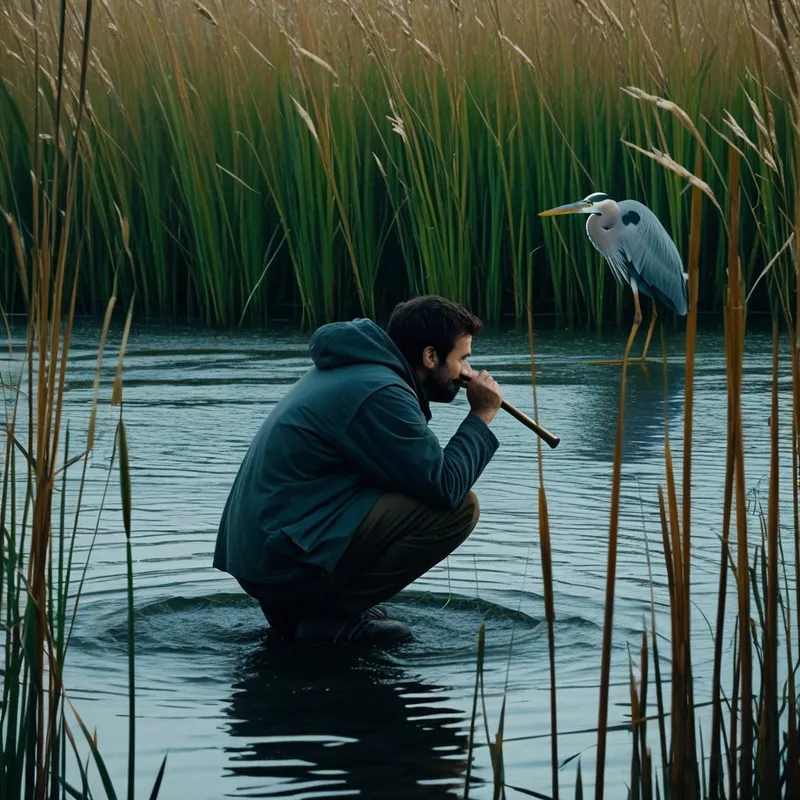
Among them was a young man named Listens-to-Water. While others thrashed through the shallows, he would often pause, his spirit troubled by the noise. One evening, as the sun bled into the western marshes, he stole away from the campfires. He walked until the sounds of his people faded, replaced by the deep, wet silence of the lagoon. And there he saw it.
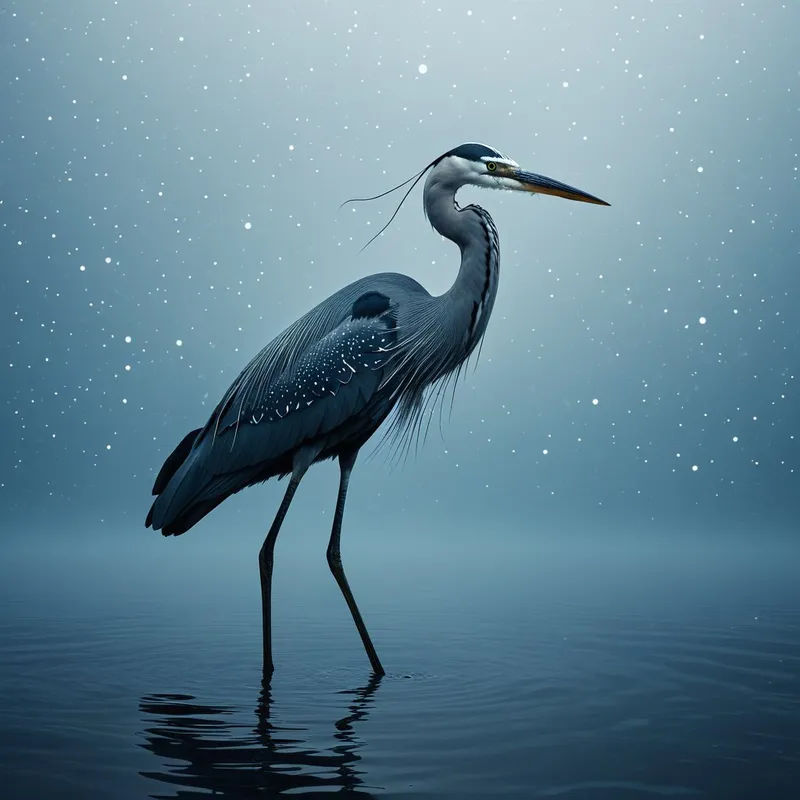
It was a creature of grey-blue smoke and sharp angles, a living statue poised on legs like slender spears. The Great Blue Heron stood in the still water, its gaze fixed on the depths. Listens-to-Water held his breath, expecting the sudden dash, the explosive strike. But it did not come. The heron did not move. It became part of the water, part of the air, a node of absolute patience in the flowing world. Minutes stretched. A dragonfly landed on its crest. The water mirrored the first stars.
Then, with a motion so fluid and swift it seemed less an action and more a change in the fabric of reality itself, the heron’s head descended. Its beak pierced the water without a splash and emerged, a silver fish flashing in the dusk. The heron swallowed, gave a low, guttural croak that seemed to hold the satisfaction of the world itself, and resumed its watchful pose.
For days and nights, Listens-to-Water remained. He forgot his hunger, his fear. He watched the heron teach him without words. He saw it stand through rain, through wind, its focus unbroken. He saw how its stillness was not emptiness, but a profound fullness—a gathering of awareness so complete that the world revealed its secrets. The heron saw the subtle ripple of a fin under lily pads, the slight shadow of a frog in the reeds, the minute vibrations in the water that spoke of life hidden below.
When Listens-to-Water finally returned to his people, he was gaunt but his eyes held a new light. He did not speak of his journey. Instead, he walked to the water’s edge, and stood. He stood as the heron stood. At first, his people mocked his idleness. But as the suns passed, they noticed a change. The animals did not flee from his profound quiet. The fish seemed to swim into his waiting net. He had learned that true power lies not in the chase, but in the depth of the wait; not in the clamor of action, but in the silence that sees everything.
Cultural Origins & Context
The figure of the Great Blue Heron appears in the oral traditions of numerous Native American nations, particularly those whose lives are intimately tied to wetlands, rivers, and coasts, such as the Coast Salish, Iroquois (Haudenosaunee), and various Southeastern tribes. It is not a single, monolithic myth but a pervasive archetypal presence woven into teaching stories, clan histories, and personal medicine narratives.
These stories were not mere entertainment; they were functional maps of the ecosystem and the human psyche. Elders would tell heron stories to teach children the virtues of patience, observation, and self-reliance. For hunters and fishermen, the heron was a master teacher, embodying the perfect technique that comes from alignment with natural law, not from force. The myth was passed down in the quiet moments—by the fire, in the canoe, during the long watches of the night—ensuring that the wisdom of stillness was remembered in a world that demanded constant motion. It served as a cultural counterbalance, a reminder that wisdom and sustenance come to those who can be profoundly present.
Symbolic Architecture
The Great Blue Heron is an embodiment of the psychic principle of compensation. In a world valuing action, it symbolizes the supreme power of inaction. In a world of noise, it is the essence of receptive silence.
The heron does not seek its prey; it becomes the space where the prey reveals itself. This is the alchemy of attention.
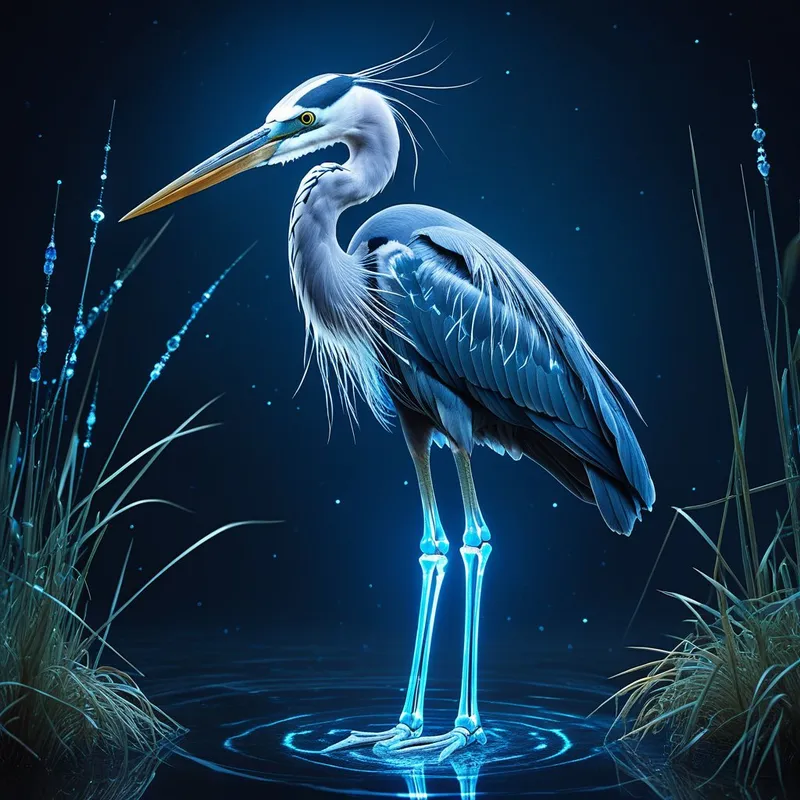
Its long, stilt-like legs connect it to both the depths (the watery unconscious) and the heights (the air of spirit and consciousness), making it a mediator between realms. Its sharp, spear-like beak represents the precision that can only emerge from prolonged focus—the single, decisive action born of infinite patience. The heron’s solitary nature speaks to the necessity of withdrawing from the collective frenzy to cultivate one’s own unique vision and rhythm. Psychologically, it represents the Sage archetype in its purest, most non-verbal form. It is the part of the psyche that knows how to wait, watch, and understand the patterns beneath the surface chaos before acting.
The Dreamer's Resonance
When the Great Blue Heron appears in a modern dream, it is often a profound somatic signal. The dreamer may be experiencing a period of frantic striving, feeling scattered, or forcing outcomes in their waking life. The heron arrives as an emissary from the deeper self, calling for a radical pause.
The dream imagery is telling: a heron standing motionless in a chaotic urban landscape; watching a heron from a distance, feeling a pull towards its calm; or becoming the heron, feeling the strange, powerful tension of coiled potential in one’s own body. This is not a call to passive resignation, but to active receptivity. The psyche is initiating a process of re-collection—pulling one’s scattered energy and attention back into a single, potent point of awareness. The somatic feeling upon waking is often one of deep calm mixed with a sharp, quiet alertness. The heron dream signals that the time for blind action is over; the time for deep seeing has begun.
Alchemical Translation
The myth of the Great Blue Heron models the crucial, often overlooked first stage of psychic transmutation: the nigredo of consciousness. Before the gold can be made, the base material must be dissolved in the solvent of patient observation.
For the modern individual hurtling through life, the "heron process" begins with a conscious, often difficult, decision to stop. To stand still in the marsh of one’s own life—with its murky emotions, hidden fears (the fish in the deep), and floating distractions (the lily pads). This stillness is an act of supreme courage, for it means facing the anxiety that we must constantly do to have value.
Individuation often begins not with a quest, but with a cessation. The heron teaches that the self is not found in seeking, but in the quality of attention we bring to where we already stand.
By practicing the heron’s stance, we allow the contents of our personal and collective unconscious to surface into awareness. We see the patterns of our behavior, the true sources of our hunger, the hidden opportunities we were too busy to notice. The heron’s final, fluid strike is the symbol of the transformative action that arises spontaneously from this gathered awareness. It is not a forced decision, but an inevitable expression of a new understanding. Thus, the myth guides us from the poverty of frantic seeking to the wealth of profound seeing, completing the alchemical cycle where true action is born from the marriage of infinite patience and perfect timing.
Associated Symbols
Explore related symbols from the CaleaDream lexicon: