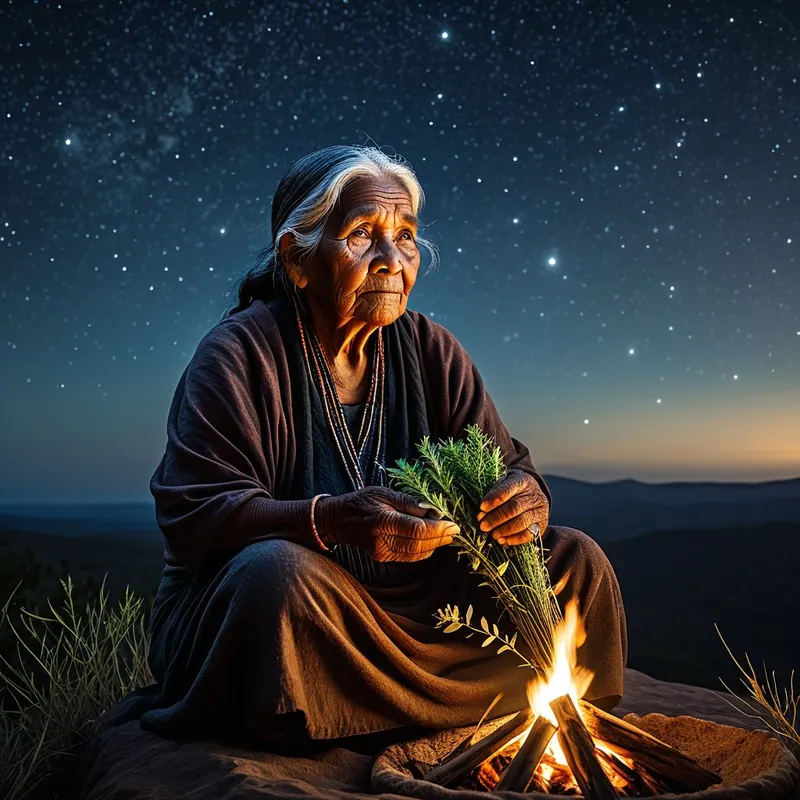
Grandmother Sage Myth Meaning & Symbolism
An ancient, wise grandmother figure emerges from the earth to teach humanity healing, wisdom, and the sacred connection to all living things.
The Tale of Grandmother Sage
Listen. Before the rivers learned their paths and the mountains settled into their long slumber, when the world was young and raw with possibility, the people knew only hunger. Not for food—the land was generous—but for understanding. They walked upon the earth but did not know her song. They breathed the air but did not hear its stories. A great forgetting had settled upon them, a fog separating their hearts from the heartbeat of the world.
Then came the great drying. The rains hid. The streams whispered away to nothing. A brittle silence fell, and with it, a sickness of spirit. The people’s prayers seemed to fall like stones at their feet. In their despair, they gathered what little moisture remained and poured it onto the driest, most cracked patch of earth they could find, a place of pure need, as an offering of their last hope.
For three days and three nights, they kept vigil. On the fourth dawn, as the sun stretched its first pale fingers across the barren ground, the earth itself began to stir. Not with violence, but with a slow, deliberate sigh. The parched soil parted like a curtain, and from the depths emerged a figure.
She was old, older than the oldest stone. Her skin was the color and texture of sun-baked clay, etched with lines that held the maps of forgotten rivers and the tracks of ancient storms. Her hair was silver as moonlight on spider silk, woven with dried leaves and prairie grass. She did not stand, but sat upon the earth that had borne her, her gnarled hands resting in her lap. She was Grandmother.
She said nothing at first. She simply looked at the people with eyes that held the patience of deep roots and the clarity of a mountain spring. Then, she reached beside her, where a small, grey-green plant grew instantly from the dust. She plucked a leaf, crushed it between her thumb and forefinger, and held it to her nose. She gestured for the people to come close.
One by one, they inhaled the scent—pungent, clean, clearing the fog from their minds. As the aroma filled them, Grandmother began to speak. Her voice was the sound of wind through canyon walls, of water over stone. She did not give them rules. She told them stories. Stories of each plant, each creature, each stone and stream. She taught them which leaves could mend a fever, which roots could strengthen the heart, which prayers of gratitude made the corn grow tall. She showed them how to listen to the dream-song of the land, how to see the spirit in the fire, and how to use the smoke of the sacred grey-green plant—the sage—to carry their intentions to the sky and cleanse their homes and hearts.
She taught them that to heal the body, one must first speak to the spirit; to fill the belly, one must first thank the earth. When her teachings were complete, and the people’s eyes shone with new understanding, Grandmother Sage smiled, a crack appearing in the clay of her face like a spring finding its way to the surface. “Remember,” she whispered, her voice now the rustle of leaves. “I am not gone. When you need to remember, when you need to cleanse, when you need wisdom… call my name. Use my gift. I am in the plant. I am in the smoke. I am in the knowing in your bones.”
With that, her form settled back into the earth, leaving behind a thriving patch of fragrant silver-green sage. The people, no longer hungry, knew what to do. The great drying ended, not with a storm, but with a gentle, remembering rain.

Cultural Origins & Context
The figure of Grandmother Sage is not the property of a single nation, but a powerful, recurring pattern in the oral traditions of many Indigenous peoples across North America, particularly among Plains, Southwestern, and Great Basin cultures. She is a mythic personification of the first medicine, the primordial teacher of healing and balance.
These stories were never written down in sacred texts but were breathed into being around winter fires, in summer lodges, and during ceremonial gatherings. They were told by elders, the living repositories of wisdom, to children and community members not as mere entertainment, but as the primary technology for transmitting ecological knowledge, ethical frameworks, and spiritual identity. The myth served a critical societal function: it encoded the sacred origin of herbal medicine (smudging with sage being a widespread practice for spiritual purification), established the protocol for respectful relationship with the plant world, and rooted the role of the healer—often embodied by grandmothers and wise women—in divine precedent. It taught that wisdom and healing are not abstract concepts, but emerge directly from the land itself, gifted through relationship.
Symbolic Architecture
At its core, the myth is a profound map of psychic integration. Grandmother Sage does not arrive as a conquering deity, but emerges from the cracked, thirsty earth in response to sincere human need. She symbolizes the deep, instinctual wisdom of the unconscious—the anima in her most developed, transcendent form—that surfaces when the conscious mind (the people) is parched, sick, and disconnected from its source.
The cure for spiritual drought is not more water, but the memory of where the water comes from.
The sage plant itself is the perfect symbol: a hardy, aromatic shrub that thrives in arid conditions. It represents resilience, purification, and the clear, sharp truth that grows in times of austerity. The act of burning it, creating smoke, is alchemical: transforming the solid (leaf) into the ethereal (smoke), carrying prayers from the material to the spiritual realm. Grandmother Sage is thus the archetype of the Crone as life-giver, the one who holds the knowledge of death (the dried plant, the burnt offering) as an essential part of the cycle of healing and renewal. Her return to the earth signifies that this wisdom is not external to us; it is immanent, woven into the very fabric of the world we inhabit.

The Dreamer's Resonance
When this myth stirs in the modern dreamscape, it often manifests not as a literal grandmother, but as an atmosphere, a scent, or a specific landscape. To dream of a vast, arid plain where a single, fragrant bush grows might signal a psyche feeling spiritually barren, craving cleansing and clarity. A dream of finding a hidden spring or a root cellar filled with drying herbs points to the dreamer tapping into neglected inner resources, their own ancestral or instinctual knowledge.
Somatically, the dreamer may report a sensation of clearing, a literal feeling of congestion lifting, or a profound sense of grounding—feet feeling rooted to the earth. Psychologically, this myth activates during life phases of “drying out”: burnout, intellectual or creative stagnation, or a feeling of ethical or spiritual contamination. The dream is an invitation from the deep Self to stop seeking external solutions and to instead make an offering of one’s vulnerability to the inner ground of being, to initiate a personal “smudging” ritual to clear psychic clutter and remember one’s foundational truths.

Alchemical Translation
The journey modeled by the myth is the quintessential path of individuation through reconnection with the primordial source. The “great drying” represents the inevitable crisis of the modern ego: hyper-rational, disconnected from nature and instinct, leading to sickness of spirit. The people’s offering is the crucial first step of surrendering the ego’s control—pouring their last water, their last hope, onto the dry earth of the unconscious.
The transmutation begins not when the answer appears, but when the question is offered with absolute humility.
Grandmother Sage’s emergence is the spontaneous eruption of the Self, the organizing, healing center of the psyche. Her teachings are not complex doctrines, but the reactivation of innate knowing—the “remembering” of how to listen, how to relate, how to heal. For the modern individual, the alchemical work is to create the conditions for this emergence: to acknowledge one’s spiritual thirst, to make a sincere offering of attention to the inner world (through meditation, nature immersion, dream work), and to patiently learn the “stories” of one’s own soul.
Finally, Grandmother’s return to the earth translates to the ultimate goal of this psychic transmutation: the wisdom does not remain a transcendent, external figure to be worshipped. It is fully integrated. The sage plant left behind is the symbol of the new, sustainable practice—a daily ritual of cleansing, grounding, and mindful connection that becomes part of the individual’s lived reality. The psyche is no longer arid; it is seeded with resilient, fragrant wisdom, capable of thriving in any season. The individual becomes, in their own way, a vessel for Grandmother’s timeless breath.
Associated Symbols
Explore related symbols from the CaleaDream lexicon: