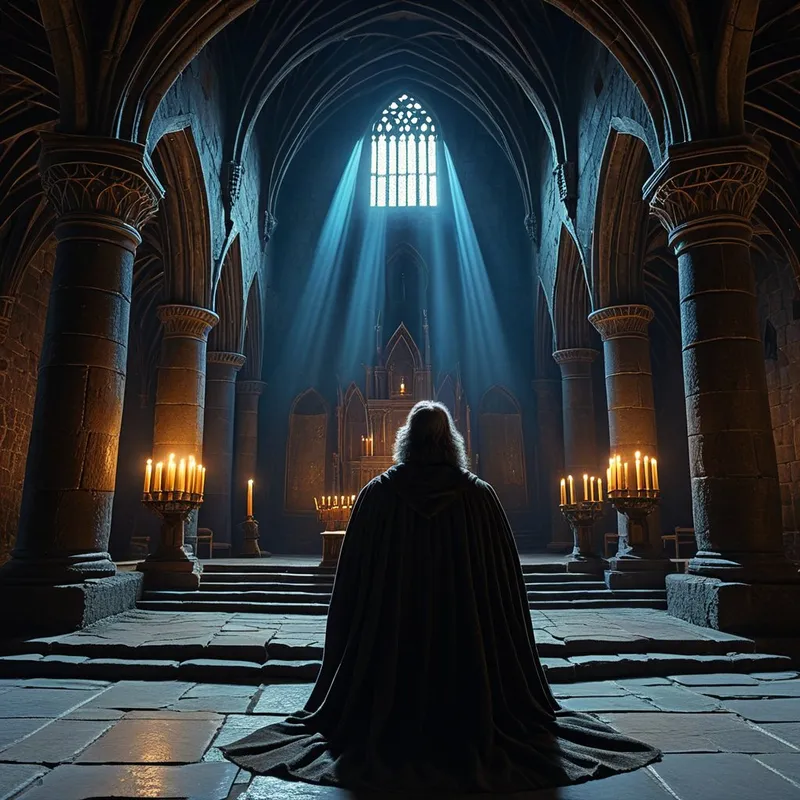
Grail Quest Myth Meaning & Symbolism
A sacred vessel's absence blights the land. Only the purest knight, asking the right question, can heal the wounded king and restore life's vital flow.
The Tale of Grail Quest
Listen, and hear of a time when the world grew thin. In the golden age of Arthur, a shadow fell upon the land of Carbonek. The streams ran brackish, the crops withered in the field, and a profound lassitude settled upon the people. The cause was a wound that would not heal—a grievous injury to the thigh of the land’s sovereign, the Fisher King. He could do naught but recline by the waters, fishing in a river that yielded little, presiding over a castle that was a tomb of living stone.
Into this blighted realm came knights, the flower of Camelot’s Round Table, drawn by a vision. They had seen it in a beam of celestial light during a feast: the Holy Grail, veiled in samite, radiating a peace that pierced the soul. One by one, they swore the Quest. They forsook the comfort of the hall for the peril of the wild wood, each taking a path alone.
Among them was a youth, Sir Percival, pure of heart but untutored in the world’s deeper sorrows. After years of wandering, of battling tangible foes and the creeping despair of silence, he stumbled upon a boat that bore him to a strange shore. As dusk purpled the sky, he found a castle that seemed to rise from the mist itself. Within, in a hall of echoing silence and fading tapestries, sat the wounded King upon a litter. A feast was laid, yet it tasted of ash. The air was thick with unspoken pain.
Then, a miracle. A door opened. A maiden processed in solemn silence, bearing in her hands a spear from whose tip a single drop of blood fell, and behind her, another, who carried the Grail itself. It was not of gold or silver, but of a substance that held and multiplied light, and from it poured a fragrance that spoke of paradise. It passed before each knight, filling their cup with food and wine of their deepest desire. Percival watched, his heart swelling with awe. But he remembered a hermit’s teaching: on the Quest, one must not speak idly. So, he sealed his lips. He did not ask, “Whom does the Grail serve?” or “What ails thee, Lord?”
The vision faded. The next morning, he awoke on the bare hillside, the castle vanished as if a dream. The opportunity was lost. The land remained cursed, the King unhealed, because the knight, in his rigid piety, failed to ask the compassionate question. The Quest, for him, had failed. Only later would he learn that the true task was not to seize, but to serve; not to win glory, but to heal a wound through the simple, courageous act of asking.

Cultural Origins & Context
The Grail myth is a late and profound flowering of the Arthurian cycle, emerging in the 12th and 13th centuries from the pens of poets like Chrétien de Troyes and Wolfram von Eschenbach. It is a cultural palimpsest. Beneath its Christian veneer—the Grail as the cup of the Last Supper—beats the older, Celtic heart of a cauldron of plenty and a bleeding lance, symbols of sovereignty and the land’s vitality. The wounded king is a figure from the very earth.
Told in courtly romances, it served a dual function. For the aristocracy, it spiritualized the chivalric code, turning prowess inward toward a pilgrimage of the soul. For a society, it modeled a crisis of meaning: what happens when the center—the king, the faith, the vital principle—is injured and cannot heal itself? The myth was a narrative vessel for exploring the relationship between individual conscience, compassionate action, and the health of the collective whole.
Symbolic Architecture
The Grail Quest is not an adventure story but a symbolic blueprint for psychological integration. Every element is an aspect of the self.
The Fisher King represents the wounded masculine principle, the ruling consciousness that is injured—often in its capacity for feeling, relatedness, or vitality (the thigh wound). He is the ego that has become passive, ruling a stagnant inner kingdom.
The Grail is the symbol of the transcendent function, the potential for wholeness that exists within the psyche but remains veiled, accessible only in moments of numinous vision.
The Wasteland is the resultant state of the psyche when this core wound is ignored: a life of repetitive action, emotional dryness, and a loss of meaning. The knights who fail are those aspects of ourselves that seek the goal through force, pride, or blind adherence to rule, like Percival’s initial silence.
The crucial, failed question—“Whom does the Grail serve?”—is the pivot. It symbolizes the shift from ego-centric seeking (“I must find the Grail for my glory”) to a stance of service and relatedness. It is the question that acknowledges the other, that seeks to understand suffering rather than conquer a prize.

The Dreamer's Resonance
When this myth stirs in modern dreams, it signals a profound crossroads in the dreamer’s process of individuation. Dreaming of a futile search through a labyrinthine landscape mirrors the feeling of being spiritually or creatively barren—in a personal wasteland. To dream of a magnificent, unreachable castle that vanishes upon approach speaks to glimpsing one’s potential for wholeness, only to have it recede due to fear or a failure of nerve.
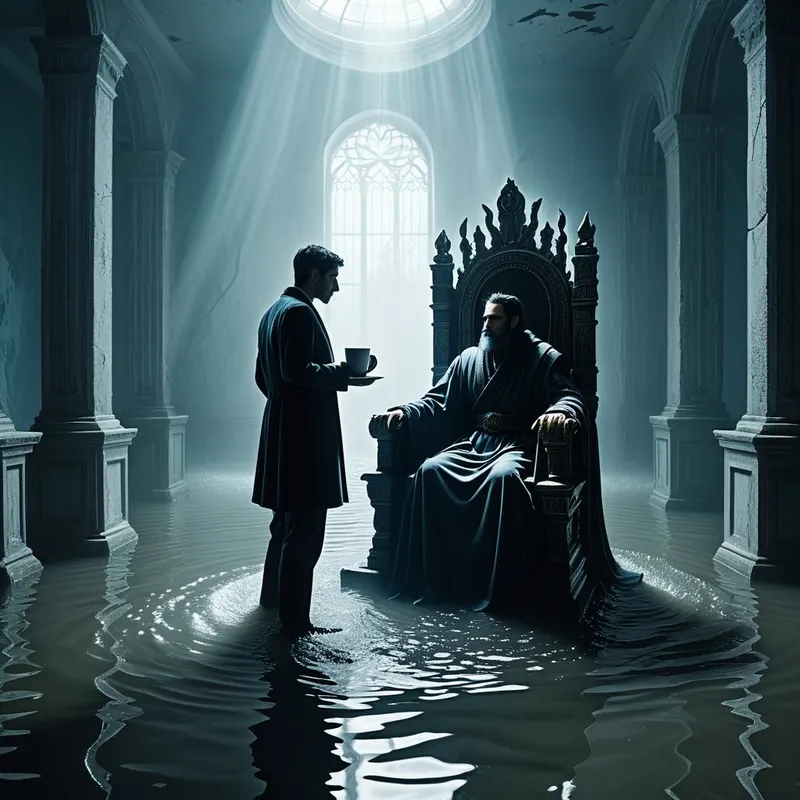
The most potent dream image is encountering a wounded or sickly authority figure—a boss, a parent, a leader—in a decaying environment. This is the psyche presenting the Fisher King complex. The dreamer is being shown the part of their own ruling principle that is injured and causing inner blight. The somatic feeling is often one of heavy frustration, paralysis, or choking sadness. The psychological process underway is the unconscious pressing for an engagement with this wound, demanding not an analysis, but a compassionate question directed inward: “What ails you? What do you need to heal?”
Alchemical Translation
The alchemy of the Grail Quest is the transmutation of the seeker into the servant, and the integration of the wound into a source of wisdom. The process begins with the nigredo: the recognition of the Wasteland, the dark night of the soul where one’s old modes of being (the knightly quest for external validation) turn to ash.
The vision of the Grail in the castle is the albedo, a moment of lunar illumination, a pure glimpse of the Self. But this white stage is incomplete without the rubedo, the red work of integration. This is embodied by Percival’s long, humbling journey after his failure—his education in empathy, his confrontation with his own shadow. He must integrate the feminine wisdom of the hermit and the Grail Maiden.
The ultimate alchemical act is not the finding, but the asking. The healing question is the philosopher's stone that transforms the leaden wound into golden wisdom, restoring the circular flow between king and land, consciousness and the unconscious.
For the modern individual, the Quest maps the path from a life of fragmented seeking to one of grounded service to one’s own deepest truth. The healed Fisher King is the ego that has made peace with its imperfection and now rules in dialogue with the Grail—the Self. The land restored is a life where action flows from meaning, and vitality is renewed from within. The Grail, then, is never truly found; it appears when the heart is finally oriented to ask, and to serve.
Associated Symbols
Explore related symbols from the CaleaDream lexicon: