
Grail Knights Myth Meaning & Symbolism
A sacred quest for a divine vessel that heals a wounded king and land, undertaken by knights who must prove their spiritual purity and ask a single, crucial question.
The Tale of Grail Knights
Listen, and hear a tale not of conquest by the sword, but of a quest for the soul. In the twilight of Arthur's golden reign, a shadow fell upon the land of Logres. The seasons sickened; spring forgot to bloom, and rivers ran thin and grey. At the heart of this blight lay the Grail Castle, hidden in a valley of perpetual mist, accessible only to the pure of heart and the fate-touched.
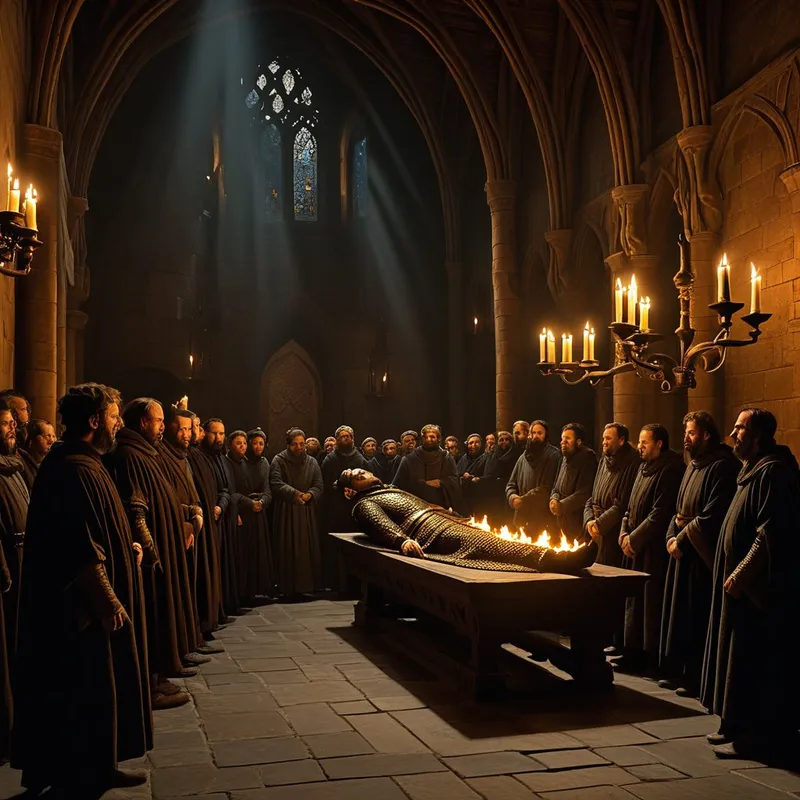
Within its silent halls languished the Fisher King, a ruler struck by a grievous wound that would not heal—a wound in his thigh, the seat of his vitality. His kingdom mirrored his agony: a wasteland. His only solace was a mysterious, sacred ritual. Each evening, as the king lay suffering, a solemn procession would pass through the hall. A youth carried a white lance from whose tip a single drop of blood perpetually fell. Another bore candelabra. Then came a maiden, holding aloft a vessel of such radiant beauty and sorrow that it stole the breath from all who beheld it. This was the San Graal, the Holy Grail. It floated on a light of its own, filling the hall with the scent of spices and the sound of a distant choir. It carried a single wafer, sustenance for the dying king, yet it could not cure him.
The knights of the Round Table, hearing whispers of this wonder, swore a solemn vow: to seek the Grail, to behold its mystery, and by finding it, heal the king and the land. Thus began the Great Quest. They rode out from Camelot, not as a company, but as solitary pilgrims, each entering the forest at the point that seemed darkest to him.
The quest was a crucible. Galahad, the perfect knight, son of Lancelot, sailed away on a ghostly ship to a mystical city, his destiny separate and celestial. Percival, the innocent fool, stumbled upon the Grail Castle itself. He witnessed the haunting procession, saw the bleeding lance and the glowing vessel. His heart swelled with awe, but his tongue was locked by courtly training. He feared to speak out of turn, to ask an impertinent question. In the morning, he awoke on bare ground, the castle vanished, and the opportunity lost. His failure deepened the waste. Bors chose compassion over glory, saving a maiden over claiming a prize, and thus proved his worth.
But it is Percival’s story that holds the key. After years of wandering and repentance, guided by a holy hermit, he found the hidden path once more. Again, he sat in the silent hall with the suffering Fisher King. Again, the procession passed. This time, pierced by compassion and a wisdom born of failure, Percival found his voice. He asked the question that was the only medicine: “Whom does the Grail serve?”
In that moment, the spell was broken. The king wept with relief. “You have asked,” he said, “and now I may be healed.” The wound closed. The rains fell upon the parched earth. The Grail, its purpose fulfilled for that king, vanished from mortal sight. The quest was over, the knights scattered or gone, and Arthur’s court, bereft of its best, turned toward its own tragic sunset. The Grail was not a trophy to be won, but a mystery to be approached with a heart capable of one, perfect, compassionate question.
Cultural Origins & Context
The myth of the Grail Knights is the pinnacle of the Arthurian literary tradition, coalescing in the 12th and 13th centuries. It is a uniquely Western fusion of Celtic mythic cauldrons of plenty, Christian relic lore (specifically the Cup of the Last Supper), and the chivalric romance ethos of the High Middle Ages. The primary tellers were court poets like Chrétien de Troyes (who left the story unfinished, a wound in itself), Wolfram von Eschenbach, and the anonymous authors of the vast Vulgate Cycle.
Its societal function was multifaceted. For the knightly class, it spiritualized their violent vocation, transforming the ideal from martial prowess to spiritual purity and caritas (selfless love). For the aristocracy, it reinforced the concept of the ruler’s health being symbiotically tied to the land’s fertility—the “Fisher King” is a sovereign whose impotence creates a wasteland. The myth was passed down in lavish manuscripts, read aloud in courts, serving as both entertainment and profound religious allegory, a mirror held up to a society navigating the tension between earthly power and divine grace.
Symbolic Architecture
The Grail Quest is not an external adventure but an internal map of the soul's journey toward integration. Each element is a psychic component.
The Wounded Fisher King represents the ailing ruling principle of the psyche—the dominant consciousness or ego that is injured, sterile, and cut off from its source of life and meaning. His wound, often in the thigh (the generative area), signifies a spiritual or creative impotence.
The Wasteland is the resultant state of the inner world: a life of repetitive dryness, depression, and alienation, where nothing grows or inspires.
The Grail is the symbol of the transcendent function, the uniting symbol that emerges from the depths of the unconscious to heal the rift between the conscious and unconscious mind.
The Grail itself is the ultimate symbol of wholeness (teleios). It is the Lapis Philosophorum of the Western psyche—a vessel containing the divine, the nourishing, and the transformative. It is not God, but the vessel that can contain the experience of the divine, the Self.
The Failed Question of Percival is the tragedy of the unconscious psyche. It represents the ego’s hesitation, its adherence to empty convention (“do not speak first”), its failure of nerve and empathy. It is the moment we sense a deep truth but silence it for fear of social transgression or the vulnerability of genuine engagement.
The Healing Question—“Whom does the Grail serve?”—is the alchemical key. It shifts the focus from possession (“I want the Grail”) to service and relationship. It acknowledges a power greater than the ego. The answer, implied in the healing, is that the Grail serves the Grail King—it serves the deep, central Self, not the petty wants of the ego. The question itself is an act of compassion, an outward turn that paradoxically heals the inward wound.

The Dreamer's Resonance
When this myth stirs in modern dreams, it signals a profound crisis of meaning and a call to a spiritual or psychological quest. Dreaming of a wounded figure in authority (a boss, a parent, a leader) who is secretly suffering mirrors the Fisher King. The dreamer may feel their own life is a wasteland—a repetitive job, a sterile relationship, a creative block.
Dreams of searching for a lost, radiant object in a labyrinthine castle or a tangled forest are classic Grail motifs. The somatic experience is often one of aching longing mixed with frustration. More crucially, dreaming of missing a crucial opportunity, staying silent when one should speak, or being unable to ask a vital question is the direct imprint of Percival’s failure. The psyche is rehearsing the old pattern of repression and fear. The healing comes when the dreamer, in the dream or upon waking, realizes the question that needs to be asked—often a simple, terrifyingly honest one about need, purpose, or love.

Alchemical Translation
The Grail Quest models the individuation process with stark clarity. The knight leaves the collective order of the Round Table (the persona, the adapted social self) and enters the forest at the darkest point (the descent into the unconscious, the nigredo).
The encounters with hermits, maidens, and temptresses are encounters with archetypal figures of the unconscious—the Senex, the Anima, the shadow. Percival’s initial failure is a necessary mortificatio, a humbling death of the naive ego. His subsequent guidance and repentance represent the slow, painful work of analysis and introspection (albedo).
The quest’s goal is not to acquire the Grail, but to become a vessel worthy of it—to transform the lead of the egoistic personality into the gold of the Self.
The climax at the Grail Castle is the coniunctio, the sacred marriage. The asking of the question is the ego’s final, surrendered act of alignment with the Self. It is not an assertion of will, but an act of service. The healing of the King and Land (rubedo) symbolizes the integration of the unconscious into consciousness, resulting in a renewed, fertile, and purposeful psychic life. The Grail then vanishes because its work is done; it is not a permanent possession but a transformative experience. The modern individual’s “Grail” is not a physical object, but that state of integrated being where one’s life force is restored, and one acts not from lack, but from a sense of sacred service to one’s own deepest truth. The knight returns not to Camelot, which is doomed, but to a world made new by the answered question.
Associated Symbols
Explore related symbols from the CaleaDream lexicon: