Grail Myth Meaning & Symbolism
A wounded king's land lies barren until a pure knight quests for the sacred vessel, a journey of spiritual healing and profound self-discovery.
The Tale of Grail
Listen, and hear the tale of the wasteland.
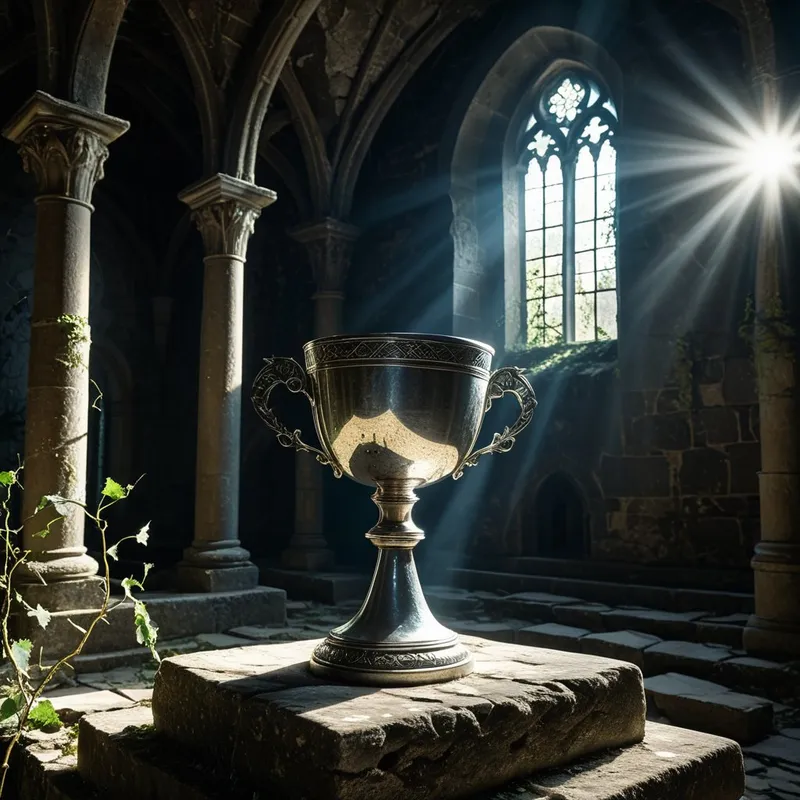
Once, in the hidden heart of the world, there was a kingdom called Logres. Its king was a man named Pelles, or sometimes Amfortas. He was a guardian, charged with protecting the most sacred of relics: the Sangreal. This was no mere cup, but the very vessel that had caught the last, sacred drops from the side of the crucified Christ. It blazed with a light that was not of sun or moon, a presence that was both a promise and a judgment.
But a shadow fell. The king, in his pride or his passion, was wounded—a grievous blow to the thigh that would not close. Some say it was the Dolorous Stroke from a sacred lance; others whisper of a failure of the heart. From that wound, which festered and wept, a sickness spread. The king could not die, yet he could not live. He could only fish in the river near his castle, Corbenic, a pallid ghost of a ruler. And as he languished, so too did his land. The rivers ran thin and bitter. The fields, once golden, hardened into cracked clay. The trees bore no fruit, and the very air grew heavy with a silent grief. This was the Wasteland, a kingdom mirroring the agony of its sovereign.
The cry went out, woven into the dreams of knights and the songs of minstrels. Only a question, posed by a knight of perfect purity and compassion, could break the curse. Many came, the proud and the brave. They witnessed the Grail Procession in the castle hall—a maiden bearing the glowing Grail, another with the silver platter, a squire with the lance that dripped blood onto the floor. They saw the mystery unveiled before them, but their tongues were tied by awe or by the shadows in their own souls. They asked nothing. And each morning, they awoke on the barren moor, the castle vanished, the quest failed.
Until one came who was different. Not the strongest, nor the most glorious, but perhaps the most empty. His name was Galahad, or in older tellings, the fool Perceval. He arrived, weary from a labyrinth of trials, having faced beasts without and demons within. In that ghostly hall, he witnessed the same silent parade of wonders. He saw the king’s torment, the land’s thirst. But where others saw a spectacle, he felt a resonance—a pang of empathy that pierced his heart. He did not ask about the marvels themselves. His voice, cracked with dust and compassion, formed the simple, healing question: “Whom does the Grail serve?”
And with those words, the stone of the world sighed. The king’s wound closed at last. The lance ceased its weeping. A sound like distant thunder was the earth drinking deep, forgotten springs. Green shoots pierced the castle flagstones. The Wasteland bloomed. The Grail, its purpose fulfilled, ascended from mortal sight, leaving behind a fragrance of rain on dry soil and the profound silence of a prayer answered.
Cultural Origins & Context
The Grail myth is a shimmering tapestry woven from many threads. Its deepest roots are not in official Church doctrine, but in the fertile soil of Celtic cauldrons of plenty, Otherworld vessels, and the yearning of medieval Christendom for a tangible connection to the divine. It crystallized in the 12th and 13th centuries, primarily through the romances of writers like Chrétien de Troyes, Wolfram von Eschenbach, and in the vast Vulgate Cycle.
Told in courtly halls and monastic scriptoria, the story served multiple functions. It was a sublime piece of chivalric literature, elevating the knight’s quest from mere adventure to a spiritual pilgrimage. It was also a vessel for esoteric Christian mysticism, exploring themes of divine grace, unworthiness, and direct communion. Societally, it reflected a crisis of authority and spirit—the longing for a healing force to mend a world felt to be fractured by sin, political strife, and distance from God. The Grail was the ultimate relic, but its quest was an internal map for the aristocratic soul.
Symbolic Architecture
The myth’s power lies in its perfect symbolic architecture, a blueprint of the psyche’s journey toward integration.
The Wounded King and his Wasteland are not two tragedies, but one. They represent the state of a life ruled by a unhealed, dominant complex—a core psychological or spiritual injury that drains vitality from the entire personality. The king is the ruling consciousness, paralyzed. The land is the embodied self, the realm of potential, now barren.
The Grail does not heal the wound; it is the question that allows the wound to heal itself.
The Grail itself is the ultimate symbol of the Self. It is the container of the divine, the source of life (blood), and the goal of the quest. It is not a trophy to be owned, but a mystery to be served. Its appearance in the procession is the psyche offering a vision of wholeness to the conscious mind.
The Questing Knight is the ego, the part of us that must undertake the difficult, often bewildering journey of consciousness. His purity (Galahad) or his naive sincerity (Perceval) is not moral perfection, but an orientation of the heart—a capacity for empathy over conquest.
The Healing Question—“Whom does the Grail serve?”—is the pivotal moment of metanoia. It shifts the focus from “How can I possess this power?” to “What does this wholeness ask of me? How can I align with it?” It is the question that breaks the narcissistic spell of the wound.

The Dreamer's Resonance
When this myth stirs in the modern dreamer, it rarely appears as castles and chalices. Its pattern is felt somatically and symbolically. You may dream of a house where one room is perpetually flooded or cold, and fixing it somehow restores the entire building. You may dream of a neglected, dying plant that miraculously revives when you finally remember to water it with a specific, hard-to-find liquid. The dream ego is often tasked with delivering a message it doesn’t understand, or finding an object in a labyrinthine office or subway system.
Psychologically, this signals a process where a long-ignored core complex—a deep shame, a frozen grief, a foundational betrayal—is demanding attention. The “wasteland” is the feeling of stagnation, depression, or creative barrenness in waking life. The dream is presenting the possibility of healing, but it requires the dreamer to move beyond mere observation (the failed knights who watch silently) to an engaged, compassionate inquiry into the source of their own suffering. The anxiety in the dream is the ego confronting the terrifying responsibility of its own healing.

Alchemical Translation
The Grail quest is the alchemical Magnum Opus rendered as narrative. It models the process of individuation with stark clarity.
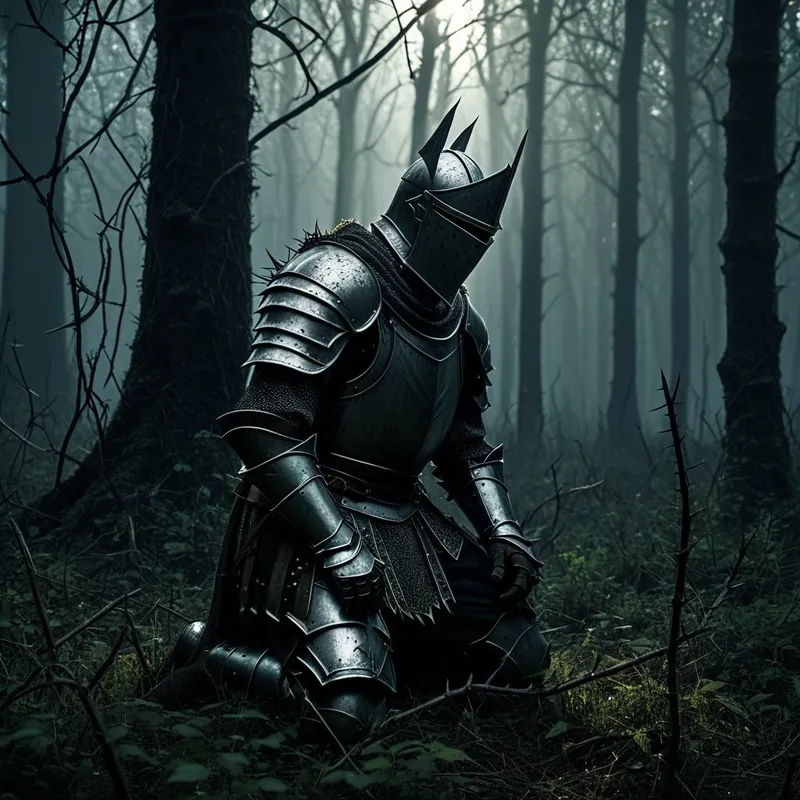
The first stage, nigredo (the blackening), is the Wasteland itself—the recognition of despair, fragmentation, and the rule of a morbid complex. The knight’s arduous journey through forests and battles is the albedo (the whitening), the arduous work of confronting shadows, refining intentions, and purifying the ego’s motives from glory to service.
The Grail Castle is the citrinitas (the yellowing), the sublime and fleeting encounter with the image of wholeness. It is a vision, not yet integration. The critical, transformative fire is the question. This is the rubedo (the reddening), the coagulation of spirit and matter, where insight becomes embodied action.
The quest ends not with possessing the Grail, but with becoming a vessel capable of containing its meaning.
The healing of the king and land symbolizes the final stage: the ego’s alignment with the Self. The ruling consciousness is healed by submitting to a higher order of meaning. The personal “land”—one’s relationships, work, creativity—flowers not as a goal, but as a natural consequence of that inner alignment. The Grail vanishes because its purpose is complete; it has been internalized. The seeker does not find the Grail; they become, in their healed and humble humanity, a Grail-bearer for the world. The vessel is no longer out there, but in here, a capacity to hold the paradoxical mix of suffering and divinity that is the human condition.
Associated Symbols
Explore related symbols from the CaleaDream lexicon: