Golgotha Myth Meaning & Symbolism
The story of a divine sacrifice on a skull-shaped hill, where death is unmade and the world is redeemed through an ultimate act of love.
The Tale of Golgotha
Hear now the tale of the Skull Place, of the day the world held its breath and the veil was torn.
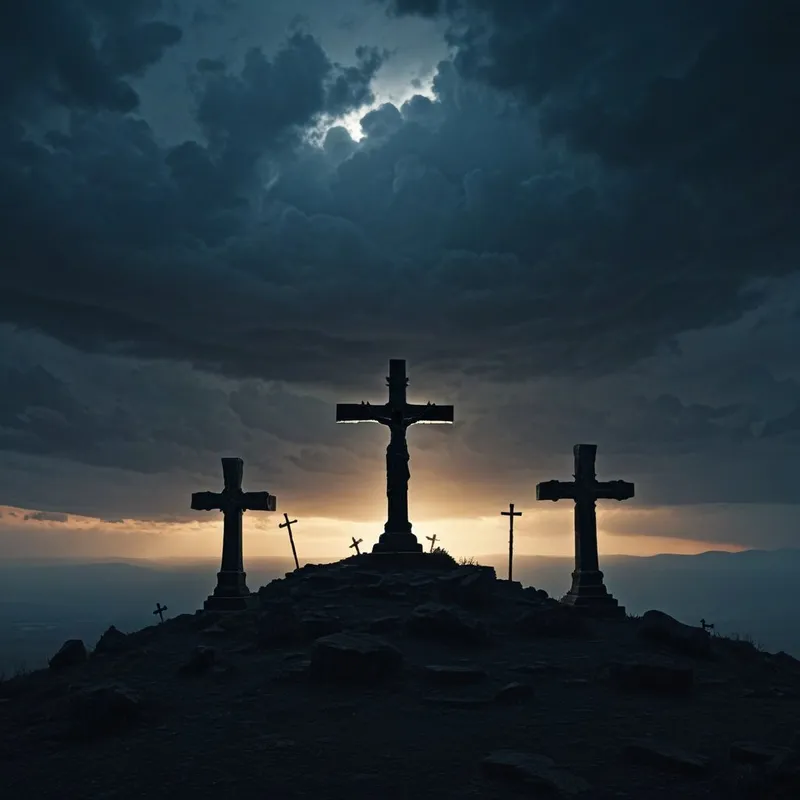
The city slept fitfully, a strange silence heavy in the spring air. Since the third hour, a darkness had fallen—not of night, but of a sun gone cold, a shadow that seeped from the ground and swallowed the light. All eyes were drawn to the hill outside the wall, a barren rise whose contours, in the grim imagination of the age, resembled a death’s head. Golgotha.
Upon its brow stood three rough-hewn timbers. To the left and right, two thieves, their bodies broken by the state’s justice. But at the center… at the center hung a man who was called Christos. His flesh was a tapestry of agony: the lacerations from the flagrum, the crushing weight of his own body on iron nails, the relentless thirst that parched his throat to leather. A crude placard above his head declared his crime in three tongues: “King of the Jews.” The soldiers cast lots for his seamless tunic, the clatter of dice a grotesque counterpoint to his labored breaths.
Beneath the cross stood witnesses. His mother, her face a mask of a grief so vast it seemed to hollow out the world. A beloved disciple, holding her up as her own knees failed. A few faithful women, their tears cutting tracks through the dust on their cheeks. And the others—the curious, the scornful, the religious authorities who nodded in grim satisfaction. “He saved others,” they mocked, their voices slicing through the gloom. “Let him save himself, if he is the Son of God.”
The darkness deepened. From the depths of his being, wrenched from a place beyond physical pain, came a cry that echoed off the skull-shaped hill and into the forever: “Eli, Eli, lema sabachthani?” It was the cry of dereliction, the unthinkable rupture between the beloved and the Beloved. The very fabric of connection seemed to unravel.
Then, a change. A final, soft exhalation, carrying a word of shocking completion: “Tetelestai.” His head bowed. The breath left him.
And in that moment, the earth itself convulsed. The ground shook violently, rocks split, and in the great Temple in the city, the immense woven veil—the barrier that separated the Holy of Holies from all of humanity—was torn in two from top to bottom, as if by an unseen hand. Tombs cracked open. The centurion who stood guard, having watched this man die, felt a terror that was also awe. “Truly,” he whispered into the unnatural quiet, “this was a righteous man. This was the Son of God.”
They took his body down as the sun began, hesitantly, to return. They laid him in a tomb hewn from rock, and a great stone was rolled before the door. The Skull Place was empty, save for three crosses awaiting the carrion birds. The world had ended. And somewhere, in the deep heart of the earth, a new story was waiting to be born.
Cultural Origins & Context
The story of Golgotha is the narrative engine of what would become Christianity, emerging from the volatile context of first-century Judea under Roman occupation. It is not a myth from a distant, forgotten age, but a kerygma—a proclaimed, urgent truth—born from specific historical trauma and fervent hope. Its primary vessels were not bards but evangelists, witnesses, and apostles, whose accounts (the Gospels) were circulated orally within small, often persecuted communities before being codified.
Societally, the function of the Golgotha story was multifaceted. For a marginalized group, it transformed an instrument of Roman terror (crucifixion) into a symbol of ultimate victory and divine solidarity. It served as the foundational logic for a new covenant, arguing that the death of this one man was a cosmic atonement, a sacrificial lamb on a global scale, fulfilling and reinterpreting Jewish prophetic and sacrificial traditions. The story was a radical inversion of worldly power: true kingship was revealed not in conquest, but in self-emptying love; true strength, not in domination, but in surrender. It created a shared identity centered not on ethnic or political victory, but on participation in this sacred, suffering love.
Symbolic Architecture
Golgotha is a universe of symbols compressed into a single, brutal afternoon. The hill itself, the Skull Place, is the ultimate symbol of the mortal condition—the caput mortuum of the alchemists, the dead head that must be fertilized for new life. It represents the summit of human limitation, the bone-yard of ego and finite consciousness.
The cross is the intersection where the vertical aspiration of the spirit meets the horizontal reality of earthly suffering, and is held in that tension unto death.
The central figure embodies the Anthropos archetype, the divine-human who consciously bears the full weight of the world’s shadow—the betrayal, the violence, the abandonment, the sin—into the heart of darkness. His cry of forsakenness is not a failure of faith, but the necessary descent of the conscious ego into the utter alienation of the unconscious, experiencing the God-image as absent. The torn temple veil symbolizes the irrevocable dissolution of the barrier between the human and the divine, the conscious and the unconscious. The path is now open; the ultimate mystery is exposed and made accessible.
The Dreamer's Resonance
When the pattern of Golgotha stirs in the modern psyche, it often signals a profound crucifixion of the ego. The dreamer may find themselves in a place of extreme exposure, bearing a burden they feel is unjust, betrayed by inner or outer figures, and experiencing a core feeling of abandonment—by God, by life, by their own sense of meaning. They are on their own skull-hill.
Somatically, this can feel like a crushing pressure on the chest (the weight of the world), a parched dryness (spiritual thirst), or a piercing pain in the hands and feet (the points of connection and action being nailed down). Psychologically, it is the process of the conscious personality being dismantled by a power greater than itself—the Self. The old identity, the old ways of being and believing, are being executed. The dream is not punishing the dreamer; it is enacting a sacred, if terrifying, necessity. The ego is being asked to consent to its own limitation, to hold the agony of contradiction without fleeing, and to utter its own “it is finished” over a chapter of life that must die.
Alchemical Translation
The alchemy of Golgotha is the opus contra naturam—the work against nature—where the base lead of the mortal condition is transmuted into the gold of redeemed consciousness. It is the model for individuation at its most harrowing and profound.
The first stage is mortificatio: the death on the cross. This is the necessary dissolution, where all the ego’s projects, defenses, and self-images are crucified. The conscious mind must experience its own “god-forsakenness,” the feeling that all guiding principles and meanings have withdrawn. This is not pathology, but the dark night of the soul, the nigredo.
The stone tomb is the alchemical vessel, the sealed place where the chaotic prima materia of the shattered self rests, awaiting recombination by a law not its own.
The second stage is the separatio and hidden solutio within the tomb. The elements of the psyche are separated (body from spirit, humanity from divinity) and dissolved in the waters of the unconscious. This is the silent, invisible Saturday, the day of waiting where all activity ceases and the transformative work happens in darkness.
The final stage, implied by the myth’s full cycle, is the albedo and rubedo: the resurrection. The new, integrated consciousness—the corpus glorificatum—emerges. It bears the wounds of the process, but they are now luminous, the seals of its authenticity. The individual who has internalized this pattern does not avoid suffering but learns to inhabit it consciously, understanding that the point of greatest tension and agony is also the sacred intersection where the mortal and the eternal meet, and where the old self dies so that the true Self may be born. The Skull Place becomes the birthplace.
Associated Symbols
Explore related symbols from the CaleaDream lexicon: