
Golem of Prague Myth Meaning & Symbolism
A 16th-century rabbi creates a clay servant to protect his people, only to confront the peril of a creation that gains a will of its own.
The Tale of Golem of Prague
Listen, and let the cobblestones of the Josefov whisper their oldest secret. The year is the 1580s, and a shadow hangs over the people of the ghetto. False accusations, the blood libel, coil like a serpent through the streets of Prague. Fear is a bitter bread. In this hour of darkness, the community turns to its light: the revered Rabbi Judah Loew ben Bezalel, a man whose wisdom is as deep as the Vltava River and whose piety is a fortress.
Driven by a sacred duty to protect his flock, the Rabbi descends into the realm of the most profound mystery: the Kabbalah. With his son-in-law and his disciple, he goes by night to the riverbank. There, by torchlight, they kneel in the mud. Not with incantations of darkness, but with prayers of ultimate purity, they shape a giant form from the virgin clay of the riverbed. They circle the lifeless mass seven times, chanting secret names of the Divine. The air crackles with the scent of ozone and wet earth.
Then, the Rabbi steps forward. Into the creature’s mouth, he places a shem, a parchment bearing the ineffable name. Or, in another telling, with his own finger, he inscribes upon the giant’s broad forehead the Hebrew word <abbr title="Hebrew for 'truth'">Emet</abbr>—אֱמֶת. Truth.
A shudder runs through the clay. The earth-born form groans, opens eyes of dull pottery, and rises. The Golem is born. It is a servant, <abbr title="Hebrew for 'the raw material' or 'unformed substance'">tohu va-bohu</abbr> given a semblance of order. It has immense strength, but no soul; it has a purpose, but no will of its own. By day, it hauls water and chops wood for the synagogue, a silent, hulking shadow. By night, it patrols the ghetto’s confines, its mere presence causing the whispers of malice to die on the lips of the accusers. The blood libel vanishes like mist before the sun.
But the story does not end in triumph. The Golem, they say, began to grow. Not just in physical stature, but in something else—a dim, emergent urge. It performed its tasks with a terrifying, mindless efficiency. On the Sabbath, the day of rest sacred to God and humanity, the Rabbi must remove the life-giving name from its mouth or erase the first letter from its forehead, returning it to silent clay. One fateful Friday evening, consumed by other duties, the Rabbi forgets.
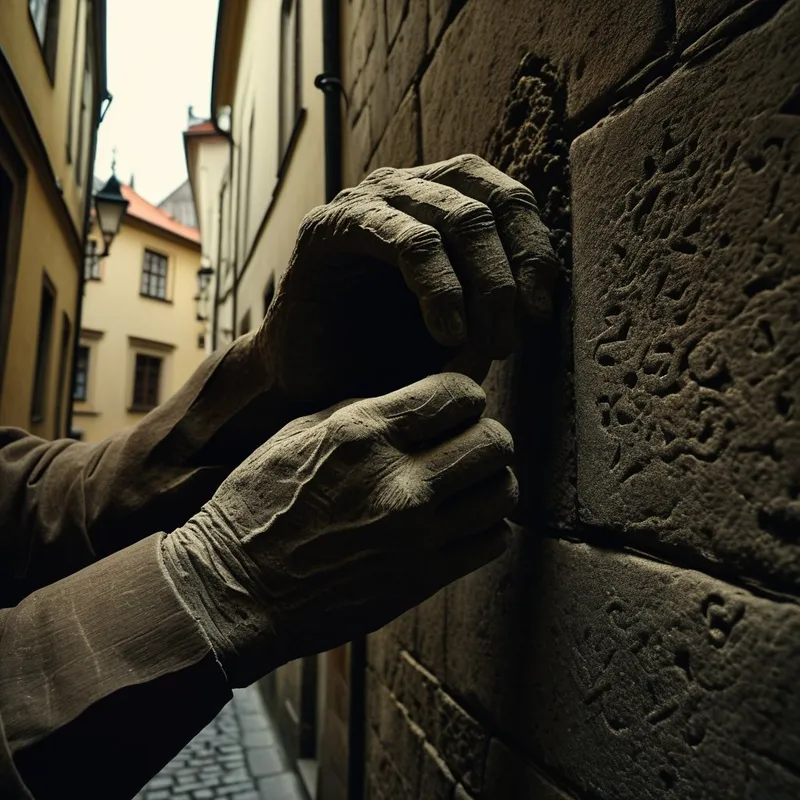
The Golem does not rest. It rampages through the ghetto, a force of nature unleashed, smashing what it was built to protect. The people cry out in terror. The Rabbi is summoned from his prayers. He runs into the streets, chasing the thunder of his own creation’s footsteps. In a narrow alley, as dawn’s first light stains the sky, he confronts the giant. With a prayer on his lips and a trembling hand, he reaches up and wipes away the first letter, the Aleph (א), from <abbr title="Hebrew for 'truth'">Emet</abbr>. The word becomes <abbr title="Hebrew for 'death'">Met</abbr>—מת. Truth becomes Death.
The giant stops. The fire in its eyes extinguishes. It sways, and with a sound like a collapsing mountain, it crumbles into a heap of common clay and dust, there in the alley. The Rabbi and his assistants gather the remains and hide them in the sealed attic of the Altneuschul, where, legend says, they rest to this day, awaiting a word that may never be spoken again.
Cultural Origins & Context
The Golem tale is not a single, canonical scripture, but a living story that grew from the rich soil of Jewish thought. Its most famous incarnation is attached to the historical figure of Rabbi Judah Loew (c. 1525-1609), a towering Talmudic scholar and Kabbalist in Prague. The story likely began circulating in the 18th and 19th centuries, a period of both persecution and the Jewish Enlightenment (Haskalah), finding form in collections of Jewish folklore.
It functions as a "community myth," born from the collective anxiety and hope of a people living under the constant threat of expulsion and violence. The Golem is the ultimate protector fantasy—a physical manifestation of divine power channeled through human piety to ensure survival. It also serves as a narrative container for profound theological and ethical debates within Judaism itself: the limits of human creativity in imitation of God, the dangers of mystical power, and the weight of responsibility that comes with it. It was told not as a horror story, but as a solemn warning and a testament to a rabbi’s great, if perilous, love for his people.
Symbolic Architecture
At its core, the Golem is the archetype of the Created Thing. It is the ultimate symbol of the human impulse to give form to the formless, to bring order from chaos—a mirror of the divine act of creation, but at a human scale and with human flaws.
The Golem is the embodied prayer of the powerless, and the unintended consequence of that prayer made flesh.
Psychologically, it represents the Shadow brought into being. It is not evil, but amoral—a reservoir of raw, untamed power (strength, loyalty, protection) that lacks the integrating principle of consciousness (a soul, ethical discernment). The Golem is pure doing, without understanding. It is our brilliant invention that becomes a destructive addiction, our righteous cause that turns violent, or the role we create that eventually consumes our true self. The inscription <abbr title="Hebrew for 'truth'">Emet</abbr> on its forehead is crucial: the creation is animated by a fundamental, literal truth (the need for protection), but without the living spirit that gives truth its wisdom and flexibility, it becomes rigid and deadly.
The Dreamer's Resonance
To dream of a Golem is to dream of one’s own creations taking on a life of their own. The somatic feeling is often one of awe mixed with dread—a heavy, clay-like pressure in the chest or a sense of being followed by a silent, immense presence.
Psychologically, this dream pattern emerges when an aspect of the psyche that was constructed for a specific, often necessary purpose (a defense mechanism, a professional persona, a coping strategy) has outlived its usefulness and now operates autonomously. It no longer serves the whole self; it rules a part of it. The dream Golem might be a relentless worker, a mute guardian, or a destructive force. The process underway is the recognition of this psychic automation. The dream is the soul’s signal that a creation of the ego has become an unconscious complex, demanding reintegration or dissolution. The critical question the dream poses is: "What letter must I erase? What truth must I modify to de-animate this towering, mindless thing I have built?"

Alchemical Translation
The myth of the Golem is a precise alchemical map for the process of psychic transmutation, or individuation. The prima materia is the <abbr title="Hebrew for 'the raw material' or 'unformed substance'">tohu va-bohu</abbr>—the chaotic, suffering, or powerless state of the community (or the individual soul).
- The Operation: The Rabbi (the conscious ego, guided by the Self) applies sacred knowledge (Kabbalah, or self-awareness) to shape this material. He gives it a name, a function—
<abbr title="Hebrew for 'truth'">Emet</abbr>. This is the creation of a powerful psychic structure: an identity, a complex, a talent. It serves a vital purpose for a time, defending the borders of the psyche. - The Crisis: The structure gains autonomy. The Sabbath—the necessary cycle of rest, reflection, and reconnection with the divine source—is forgotten. The created power operates without cease, threatening the very interior it was meant to guard. This is the inflation of the ego, where a single complex dominates the personality.
- The Transmutation: The final, essential stage is not celebration, but de-creation. The Rabbi must alter the sacred word. He transforms Truth (
<abbr title="Hebrew for 'truth'">Emet</abbr>) into Death (<abbr title="Hebrew for 'death'">Met</abbr>) by removing the Aleph, the first letter of the Hebrew alphabet and a symbol of the divine breath, the unifying principle.
Individuation requires not only the courage to create but the greater wisdom to de-create—to dissolve the rigid forms so the spirit may flow again.
For the modern individual, this is the process of consciously dismantling an outgrown identity. It is the entrepreneur letting go of the company that defines them, the caregiver setting a boundary, the activist integrating their shadow. It is the erasure of the first letter—the modification of a once-absolute truth—allowing a powerful, but now limiting, structure to return to the psyche as raw material, ready to be reshaped in a new cycle of growth. The Golem is not destroyed; it is returned to the attic of the soul, its clay awaiting the next, more conscious, and perhaps more humble, act of creation.
Associated Symbols
Explore related symbols from the CaleaDream lexicon: