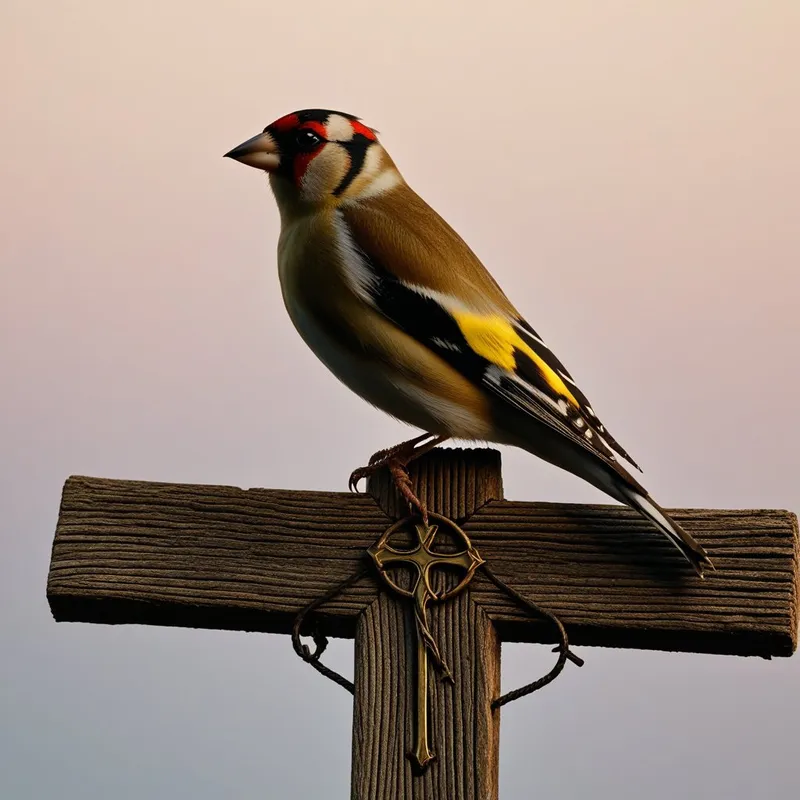
Goldfinch Myth Meaning & Symbolism
A story of a small bird who, through an act of ultimate compassion, takes a thorn from the brow of the crucified Christ, staining itself forever.
The Tale of the Goldfinch
Listen, and let the silence between the words speak. The world was heavy, the air thick with the scent of iron and sorrow. On a hill of skulls, beneath a sky that had turned its back, a great suffering was unfolding. The weight of the world pressed down upon a single figure, nailed to the rough-hewn timber of a cross.
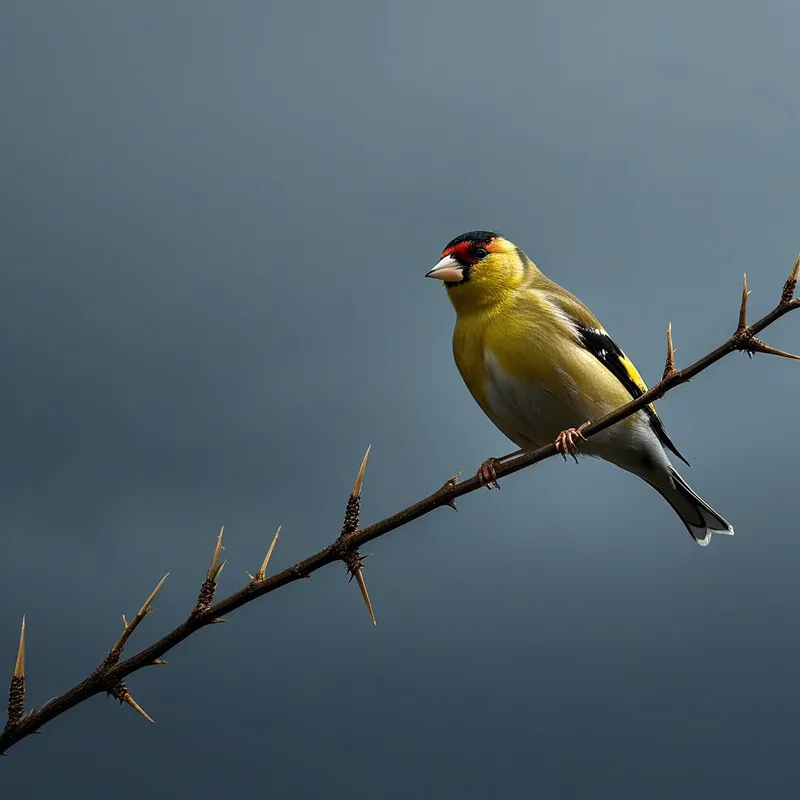
All creatures of the field and forest had fled the terrible sound, the vibration of agony that shook the very roots of the earth. All but one. A tiny Goldfinch, whose nest was in a thorny bramble nearby, heard not just the cry of a dying man, but the cry of the world itself tearing. It flitted from its branch, a speck of gold and crimson against the bruised purple sky.
It saw the crown—not of jewels, but of twisted thorns, driven deep into the brow. It saw the blood, dark and precious, welling from a hundred tiny wounds. And in that moment, the bird’s small heart, a drum of pure instinct, broke open into something vaster. It was not bravery, which knows fear. It was compassion, which knows only the other’s pain.
With a flutter of wings that sounded like a prayer, the Goldfinch alighted upon the crown of thorns. It ignored the jeering crowd, the trembling earth, the gathering dark. Its focus was singular: one particular thorn, longer and more cruel than the rest, embedded just above the eye. The bird, with its delicate beak, took hold. It pulled.
The thorn did not yield easily. It was rooted in suffering. The Goldfinch strained, a tremor passing through its tiny body. With a final, gentle tug, the thorn came free. But as it did, a single drop of sacred blood fell from its tip, splashing upon the bird’s white breast and face, staining the feathers a permanent, brilliant crimson.
The deed was done. The Goldfinch flew away, the thorn still in its beak, leaving a minute but infinite act of mercy inscribed upon the scene. It carried the stain of its compassion, and the thorn of the world’s pain, forever. And it is said that from that day forward, every Goldfinch bore the mark of that blood, and a song that holds the memory of both the suffering and the love that dared to approach it.
Cultural Origins & Context
The tale of the Goldfinch and the Passion is a legend that blossomed in the rich soil of medieval European Christianity, particularly within Catholic traditions. It was not a canonical scripture, but a parable of the natural world, part of a vast body of lore known as the Legends of the Cross or Miracles of the Passion. These stories served to populate the stark biblical narrative with witnesses from nature, making the divine drama immediate and intimate.
The story was passed down through sermons, devotional literature, and most powerfully, through art. From the 13th century onward, the Goldfinch became a frequent, poignant detail in paintings of the Madonna and Child and the Crucifixion. In the hands of artists like Raphael and Carlo Crivelli, the bird in the Christ child’s hand was not merely a pretty pet; it was a foreshadowing, a silent prophet of the Passion to come. For the common folk, seeing this bright, living bird in a sacred painting was a visual sermon. It taught that compassion was the highest calling, accessible to even the smallest creature, and that true service leaves a mark—not a scar of shame, but a badge of sacred honor.
Symbolic Architecture
The myth is a perfect, potent seed of symbolism. The Goldfinch itself represents the soul in its innocent, instinctive state—vibrant, alive, yet ultimately vulnerable to the world’s pain. The thorn is the crystallized essence of suffering, cruelty, and the burdens of existential anguish.
The act of removing the thorn is not an act of salvation, but of witness. It is the psyche choosing to engage with pain rather than flee from it.
The bird does not heal the wound; it cannot stop the crucifixion. But it acknowledges the suffering. Psychologically, this is the first and most critical step in healing: to look directly at one’s own pain or the pain of another without turning away. The resulting stain is the central symbol. This is not a stain of sin, but of consecration. It is the indelible mark of empathy, the permanent change that occurs when we truly take on another’s suffering. The once purely “golden” (innocent) finch is now forever marked by “crimson” (experience, passion, compassion). Its identity is transformed; it becomes a living testament.
The Dreamer's Resonance
When the image of the Goldfinch, the thorn, or the blood-stained breast arises in a modern dream, it signals a profound somatic and psychological process. This is rarely a gentle dream. It often comes during periods of intense empathy fatigue, caregiver burnout, or when confronting a seemingly intractable source of pain—in oneself, a loved one, or the world.
Somatically, the dreamer may feel a constriction in the chest (the stain), a piercing sensation in the head (the thorn), or the frantic, fluttering energy of the bird (the urge to do something in the face of overwhelming suffering). Psychologically, the dream poses a crucial question: What thorn are you trying to pull, and whose brow is it on? It may point to an over-identification with another’s pain, where one’s own vitality is being sacrificed. Alternatively, it may be a call to courageous, compassionate action—to approach the very center of a painful situation you have been avoiding. The dream asks if you are willing to be stained, to be changed forever by the act of engaging with deep pain.
Alchemical Translation
In the alchemical vessel of individuation, this myth models the process of ablutio—the washing that stains. The journey is not from lead to gold, but from pure gold to gold stained with crimson. It is the integration of the shadow of suffering into the substance of the self.
The modern individual often seeks a spirituality or psychology of purity—to be healed, enlightened, and free of pain. The Goldfinch myth proposes a different path: the path of the compassionate witness. The alchemical work here is to consciously take up the thorn—the specific, personal, and collective pain we carry—not to be destroyed by it, but to transform our relationship to it.
The triumph is not in avoiding the stain, but in recognizing that the stain is the gold, transmuted. Our deepest wounds, when engaged with compassion, become the source of our most authentic color and song.
The individuated self, in this light, is not a pristine, detached sage. It is the Goldfinch: bearing the marks of its engagements, its song woven from both joy and sorrow, a small, bright, enduring testament to the courage of a heart that chose to feel, and to act, in the presence of the ultimate.
Associated Symbols
Explore related symbols from the CaleaDream lexicon: