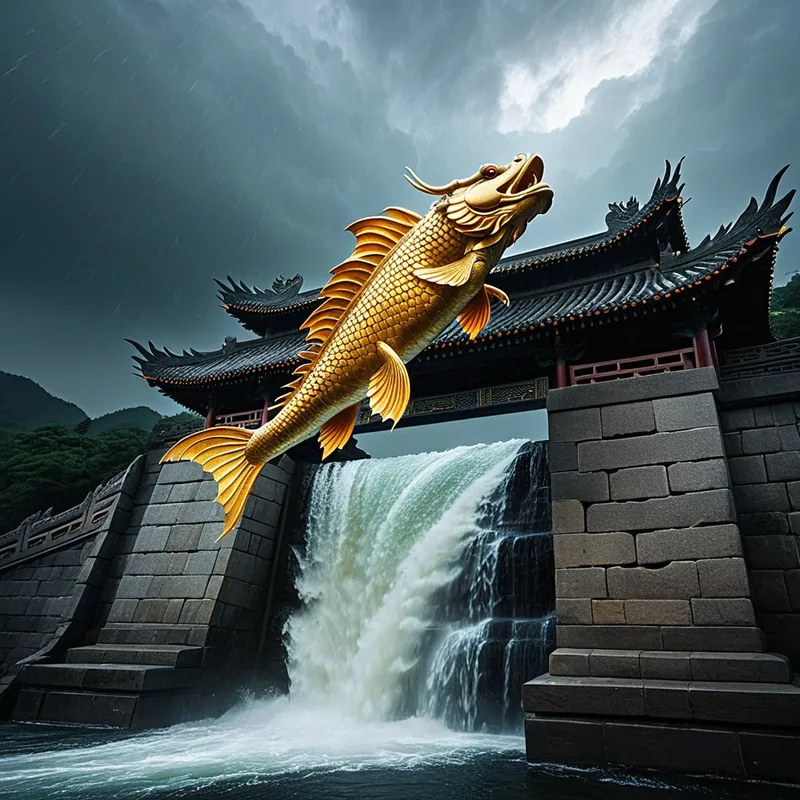
Golden Carp Myth Meaning & Symbolism
A humble carp's epic struggle to leap a waterfall and transform into a celestial dragon, embodying the ultimate triumph of perseverance over destiny.
The Tale of Golden Carp
Listen, and hear a tale not of gods on high, but of a creature of the deep, whose ambition touched the heavens. In the ancient, coursing veins of the Yellow River, there swam a carp unlike any other. Its scales were not the dull grey of its kin, but burned with a deep, inner gold, as if it had swallowed a fragment of the sun. The other fish called it foolish, for this Golden Carp spoke not of fat worms or still pools, but only of the distant, thunderous roar that echoed down the river canyon—the sound of the Dragon Gate.
The Dragon Gate was a myth made stone. A waterfall of such terrifying height and fury that it was said the river itself screamed in despair as it fell. But legend whispered a promise: any carp with the strength, the courage, and the sheer, unyielding will to leap from the churning foam at the base and crest that impossible wall of water would be transformed. Not merely rewarded, but reborn. Its golden scales would blaze, its body would stretch and soar, and it would ascend to the clouds as a Long Dragon, a sovereign of rain and mist.
Season after season, the Golden Carp tried. It would gather speed in the deep currents, a flash of gold in the murky water, and hurl itself at the cascade. And season after season, the waterfall’s mighty hand would slap it back, bruised and battered, into the frothing pool below. The other carps mocked its scars. The river spirits seemed to laugh in the crash of the falls. Yet, with each failure, the fire in its golden eyes burned brighter.
Then came the great autumn flood. The river swelled with fury, and the Dragon Gate roared louder than ever, a deafening challenge. Exhausted, its body a tapestry of old wounds, the Golden Carp positioned itself one last time. It did not think of glory, only of the upward path. It felt the full, terrible power of the current, not as an enemy, but as the very momentum of its own longing. With a final, silent cry that came from the core of its being, it surged forward.
The world became a chaos of white water and thunder. Stone scraped its side. Gravity clawed at it. For an eternal moment, it hung suspended in the spray, a flicker of gold against the grey cliff. Then, it crested the summit. As it passed over the sacred threshold, a bolt of lightning from a clear sky struck the river. The Golden Carp was engulfed in a radiance that dissolved scales, fin, and bone. From the heart of the light emerged a sinuous, majestic form with eyes of pearl and a beard of cloud. With a roar that silenced the waterfall, the newborn dragon coiled once in triumph, and ascended into the waiting sky, leaving only the echo of its transformation and the timeless promise of the Gate.

Cultural Origins & Context
The myth of the carp leaping the Dragon Gate (鯉躍龍門) is one of China’s most enduring and beloved folktales. Its origins are ancient, with textual references appearing in works like the San Qin Ji (Records of the Three Qins) from the Western Han dynasty. It is a quintessential “striving” myth, deeply embedded in the Confucian-influenced meritocratic ideals of Chinese society. Unlike myths centered on divine birthright, this is a story of earned transcendence.
It was propagated not just in literature, but through popular art, New Year’s prints (Nianhua), porcelain designs, and oral storytelling. Its primary societal function was as a powerful metaphor for the imperial civil service examinations (Keju). For over a millennium, scholars from humble backgrounds would undertake years of grueling study for a chance to pass these exams. Success meant a dramatic transformation in status—from “common carp” to “dragon” official—bringing honor to one’s family and clan. The myth thus provided a narrative of hope, perseverance, and the possibility of radically altering one’s destiny through sheer effort and virtue.
Symbolic Architecture
At its heart, the myth is an alchemical map of potentiality actualized. The Carp represents the raw, unactualized self—dwelling in the collective stream (the unconscious, societal norms), yet marked by a distinguishing spark (the gold, the individual’s unique calling or talent). The Dragon Gate is the supreme ordeal, the impossible task that the conscious ego must face to break its current form. It is not an enemy, but the necessary crucible.
The waterfall does not exist to crush the carp, but to provide the resistance against which it can define itself as more than a fish.
The Dragon is the fully realized, individuated Self. It is a being that has integrated its earthly nature (the fish) with celestial power and consciousness. The dragon governs rain—it mediates between heaven and earth, symbolizing the individual who can now consciously channel the unconscious (the waters) for creative and nourishing purposes. The repeated failures are not punishments, but initiatory trials that temper the will and burn away doubt.
The Dreamer's Resonance
When this myth stirs in the modern psyche, it often surfaces in dreams of immense struggle against overwhelming forces. One might dream of swimming desperately against a current, trying to climb a slippery, endless cliff, or preparing for a test for which they are perpetually unprepared. The somatic feeling is one of immense exertion often met with frustration.
Psychologically, this signals that the dreamer is at their personal Dragon Gate. The “waterfall” could be a career challenge, a creative block, a profound life transition, or the daunting task of integrating a shadow aspect of the personality. The golden carp’s journey reflects the process of mustering one’s entire being—will, instinct, and that unique “golden” talent—to face what feels insurmountable. The dream is not a prophecy of failure, but an affirmation of the struggle’s sacred necessity. The frustration in the dream is the friction required for transformation. To dream of finally cresting the falls, or of seeing a dragon, indicates a breakthrough is near—the ego is aligning with the Self’s transformative imperative.

Alchemical Translation
The myth models the individuation process with stark, elegant clarity. We all begin in the river—the flow of familial, cultural, and unconscious patterns. The first step is the emergence of the “gold,” the nagging sense that we are meant for something beyond this stream. This is the birth of psychological consciousness, often felt as dissatisfaction or a peculiar calling.
The long, arduous swim upstream is the conscious life’s work: differentiating from the collective, enduring setbacks, and gathering the strength of character. The leap itself is the critical moment of psychic transmutation. It is the ultimate risk where one must commit wholly, surrendering the old, safe identity (the carp) to the transformative process, with no guarantee of success.
Individuation is not a gentle awakening, but a leap into the catalytic void of one’s own potential.
The transformation into the dragon is the result. It signifies the attainment of a new, more complex and powerful psychic structure. The dragon-Self does not deny its carp origins; it transcends and includes them. It is autonomous (soaring alone in the sky), yet responsible (bringing rain to the earth). For the modern individual, this translates to achieving a state of authentic authority and creativity. One becomes a “dragon” not by dominating others, but by mastering and creatively directing one’s own inner forces, capable of navigating both the depths of the unconscious and the heights of spirit, bringing nourishment and meaning back to the world of human experience. The myth’s enduring power lies in this promise: the gate is always there, and the gold is within.
Associated Symbols
Explore related symbols from the CaleaDream lexicon: