Golden Calf Myth Meaning & Symbolism
A story of a people forging a tangible idol in the desert, breaking their covenant, and the fiery consequences of choosing the immediate over the ineffable.
The Tale of the Golden Calf
The mountain smoked and trembled, a pillar of cloud and fire standing guard over its peak. Below, in the vast, sun-scorched bowl of the desert, the people waited. Their leader, Moses, had vanished into that divine thunderhead forty days and forty nights prior, ascending to meet the Unseen. The air was thick with absence. The memory of Egypt’s fleshpots was a ghost in their mouths; the promise of a land flowing with milk and honey felt like a mirage shimmering on the horizon of an endless now.
Fear, that ancient serpent, began to coil in the camp. “What has become of this man Moses?” they murmured to his brother, Aaron. “Who will go before us? We need a god we can see, a power we can grasp!” The silence from the mountain was deafening, more terrifying than any plague.
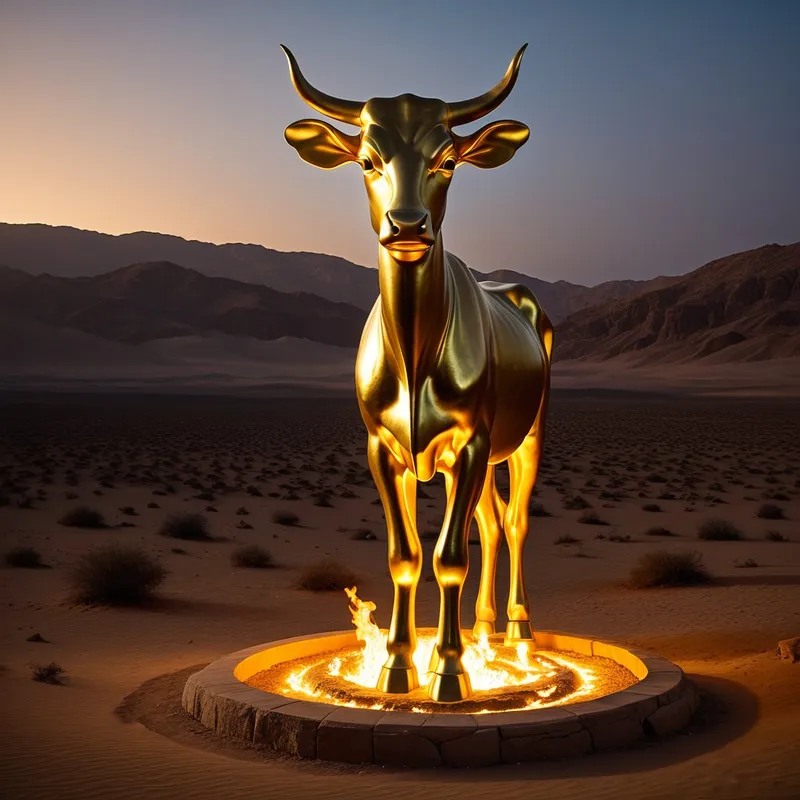
Pressed by the rising tide of panic, Aaron yielded. “Bring me the gold from your ears, your wives’, your sons’ and daughters’ ears.” The people, eager for an answer to their dread, stripped themselves of the Egyptian wealth they carried. Into the fire the treasure went, and with a graver’s tool, Aaron fashioned the molten gold. And from the flames, it emerged: a calf. Not a living beast, but one of gleaming, solid gold.
A cry went up from the multitude. “This is your god, O Israel, who brought you up out of the land of Egypt!” The air, once heavy with dread, now crackled with frenzied relief. They built an altar before it. They offered burnt offerings. They sat down to eat and drink, and they rose up to revel, their dancing wild and unmoored, a celebration of something made, something known.
But on the mountain, the pact was being sealed. The Tablets of the Testimony, written by the very finger of God, were given to Moses. And the Voice spoke: “Go down, for your people, whom you brought up out of the land of Egypt, have corrupted themselves.” The wrath of the Divine was a heat that rivaled the sun.
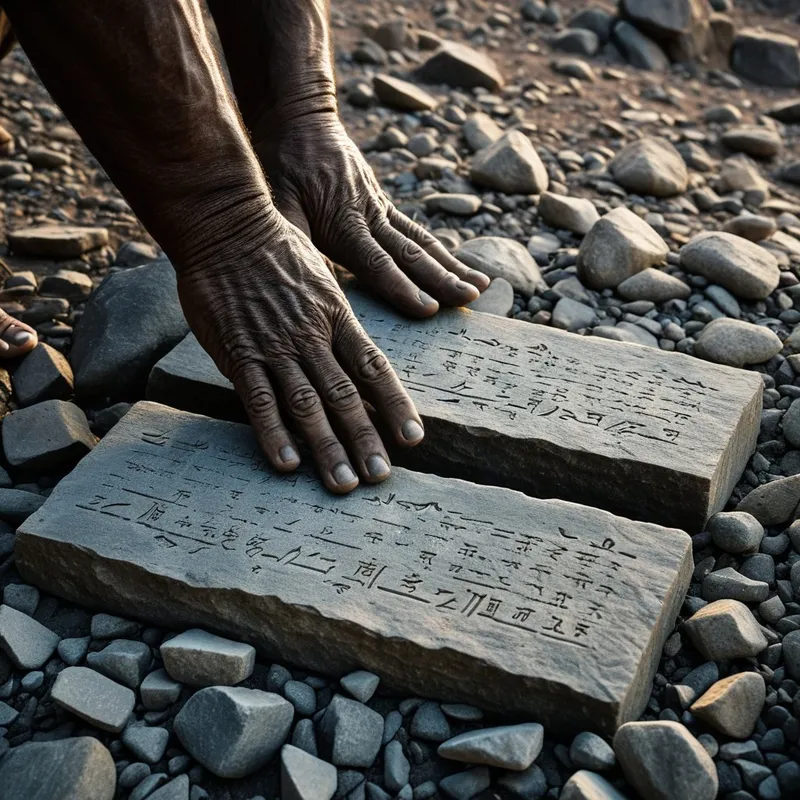
Moses descended, the weight of the stone tablets in his hands a holy burden. As he neared the camp, he heard the singing, saw the dancing, and beheld the golden idol. A fury hotter than the forge-fire that made the calf seized him. In a gesture of catastrophic rupture, he hurled the tablets from his hands, shattering them at the foot of the mountain. The sound of breaking stone cut through the revelry like a knife.
He took the calf they had made, burned it in the fire, ground it to powder, scattered it on the water, and made the people of Israel drink it. The taste of their own idol was bitter on their tongues. The Levites were summoned, and a terrible price was exacted in the camp that day. The covenant was broken, and only through desperate intercession was it ever rewoven, a mended fabric forever bearing the scar of its rending.
Cultural Origins & Context
This foundational narrative is embedded in the Torah, specifically the Book of Exodus. It functions as a critical rupture point in the epic of the Exodus, serving as a polemic and a warning from the priestly and deuteronomic traditions who compiled and shaped these texts. Historically, it likely reflects a deep tension within early Israelite religion between the exclusive worship of YHWH and the pervasive Canaanite and Egyptian cultic practices surrounding bovine deities like El or Hathor.
The story was not merely history but theology performed. Recited during liturgical gatherings and pilgrimage festivals, it served as an eternal reminder of the peril of apostasy—the abandonment of the transcendent, covenantal relationship for the tangible and immediate. It defined the community’s identity in oppositional terms: they were the people who, despite failing catastrophically, were called back to a covenant that demanded faith in the unseen and obedience to the ethical law, even in the terrifying silence of the desert.
Symbolic Architecture
At its heart, the Golden Calf is the archetypal symbol of the ersatz god, the manufactured numinosity. It represents the human psyche’s intolerance for the ambiguous, the unknown, and the profoundly Other. Moses on the mountain engages with the transcendent, which is demanding, ineffable, and requires a terrifying leap of faith. The people in the camp, faced with the “absent father” and the anxiety of freedom, regress to the psychological imperative of the visible.
The idol is not a symbol of a different god, but a symbol of the human desire to have a god on demand—a god whose nature we can determine, whose presence we can control, and whose blessings we can transactionalize.
The calf itself is a condensation of potent symbols: gold for ultimate value and corruptible desire, the bull for raw, untamed power and fertile abundance. It is a god of the lower chakras—security, power, and sensual pleasure—forged to replace a God of the spirit and the ethical command. The shattering of the tablets is not just an act of anger; it is a dramatic representation of the breaking of a psychic container. The law, the structure that gives form to the relationship, cannot coexist with the formless chaos of idolatry. To drink the dust of the idol is the ultimate somatic integration of one’s own shadow—being forced to ingest the literal consequence of one’s spiritual betrayal.
The Dreamer's Resonance
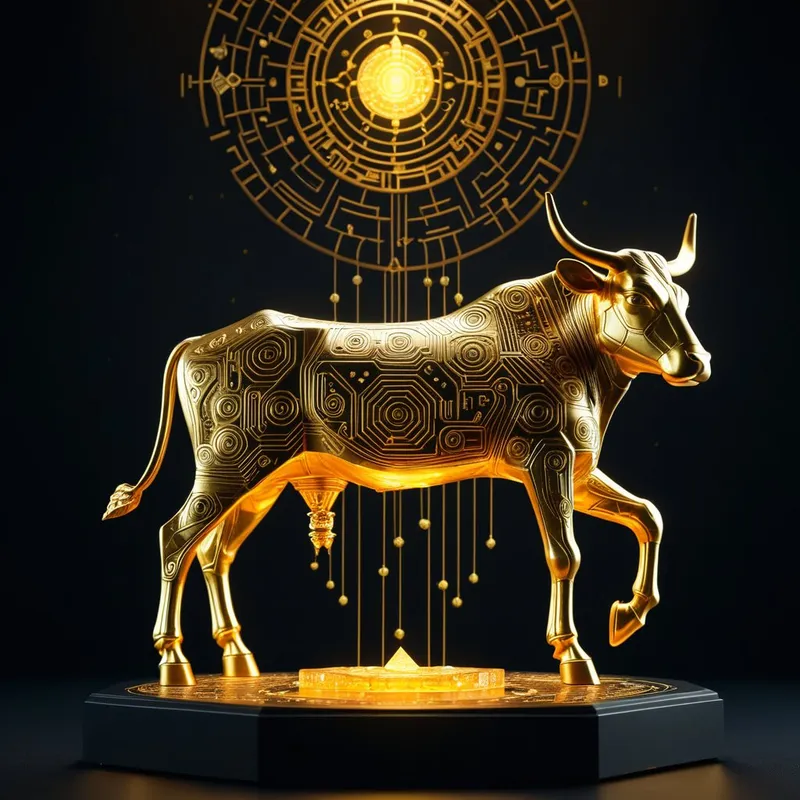
When this myth stirs in the modern dreamscape, it rarely appears as a biblical tableau. Instead, it manifests as the psychology of the quick fix idol. The dreamer may find themselves in a corporate boardroom worshipping a graph of exponential growth, in a gym obsessing over a mirrored reflection, or in a relationship clinging to a partner they have fashioned into a perfect savior. The dream feeling is one of anxious, frantic devotion to something concrete—a career, a substance, a ideology, a bank balance—that has been secretly endowed with divine, salvific power.
Somatically, this can feel like a clutching in the gut, a tightness in the chest—the body’s wisdom recognizing it is bowing to a false master. The psychological process is one of projection: taking one’s own inner need for meaning, security, and power and locating it entirely in an external object. The dream is a signal that the psyche is in a state of covenantal rupture. The true Self (the Moses-function, the connection to the transcendent) feels absent, lost on some distant mountain of inner work, and the ego, terrified of the silence and the solitude, hastily constructs a new center that is immediate, tangible, and ultimately dead.

Alchemical Translation
The alchemy of this myth is a brutal but necessary solve et coagula—dissolution and re-coagulation. The initial state is one of psychic unity under a promised ideal (the covenant, the journey to the Promised Land). The nigredo, or blackening, is the descent into the desert of uncertainty and the subsequent forging of the idol. This is the ego’s attempt to create its own gold, its own meaning, without the suffering of the transformative fire of the unknown.
The transmutation begins not with the finding of a new truth, but with the shattering of the old, false container. One must break one’s own tablets.
Moses’s return represents the eruption of the Self into the ego’s complacent idolatry. The destruction of the calf is the mortificatio, the killing of the false image. This is not a gentle process; it involves fire, grinding, and the bitter draught of self-confrontation. To drink the powdered idol is the ultimate integration—assimilating the knowledge that one’s most cherished source of security was a self-made illusion.
The final stage is not a return to the old, naive covenant. It is a renewed covenant, etched on new stone, but now carried by a prophet whose face shines with a hard-won radiance born of having witnessed both the divine glory and the human capacity for betrayal. The individuation journey modeled here is one of moving from a faith based on external spectacle and immediate gratification (the calf, the miracles of Egypt) to a faith that can endure the silence of the desert and relate to a mystery that can be heard but not seen, a law that structures the soul from within. The gold is not cast into an idol but is instead internalized as the refined, indestructible value of a relationship with the depths, however demanding and ineffable they may be.
Associated Symbols
Explore related symbols from the CaleaDream lexicon: