Golden Age Myth Meaning & Symbolism
A primordial era of harmony between gods, nature, and humanity, lost to time, whose memory echoes as a blueprint for wholeness within the human psyche.
The Tale of the Golden Age
Listen. Before the counting of years, before the naming of sorrows, there was a time when the world was new and the sky was close enough to touch. It was the Age of Kronos, or Satya Yuga, or simply, the First Time. The sun was a gentle father, not a tyrant. The earth, a generous mother, asked for no labor. Her soils were soft and fragrant, yielding grains and fruits of their own accord. Vines bore grapes without tending, and oaks dripped honey. Rivers ran with milk and nectar.
In this dawn, humanity was not separate from the divine. They were the children of the gods, or perhaps the gods themselves in a younger form. They lived alongside them, conversing freely. There was no "you" and "I," but a seamless "we." Bodies did not know age or decay; death was a gentle transition, a falling asleep in one moment and awakening elsewhere, like a breeze shifting direction. There were no cities of stone, for the whole world was a temple. There were no laws carved on tablets, for justice was written in the heart. There was no war, for desire was absent. Each being had exactly what they needed, and in that sufficiency, envy could not take root.
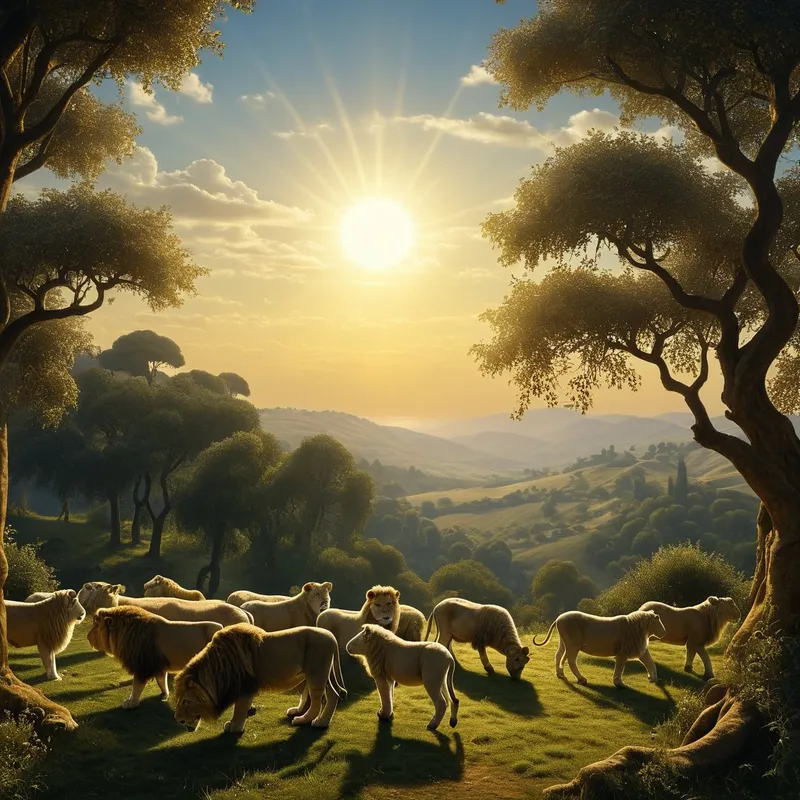
The people of this age passed their days in peaceful communion, dancing in meadows that never faded, singing songs that were the very language of creation. Animals spoke with human voices, and humans understood the speech of wolves and sparrows. The lion lay down with the lamb not as a miracle, but as a simple fact of existence. The seasons were one eternal, perfect spring. Work was play, prayer was breath, and life was a single, unbroken note of joy echoing through a crystal hall.
But within the very fabric of this perfection, a whisper began. A subtle shift, like the first, almost imperceptible chill at the very end of a summer's day. It was not a rebellion or a sin, but a turning of attention. The gaze, once fixed on the unity of all things, slowly lowered. The mind, which had reflected the cosmos like a still pool, began to stir with its own ripples. The first, faint shadow of "mine" appeared. The hand that once received openly began, almost unconsciously, to grasp.
And as that attention turned inward, the sky began to recede. The direct line to the gods grew faint, becoming memory, then myth. The earth, feeling the change, grew quiet. She no longer offered her bounty freely; she required a gesture, a seed planted, a furrow drawn. The eternal spring fractured into four distinct seasons. The golden hue that bathed the world began to pale, leaching into the silver of a lesser age. The people felt a new weight in their limbs, a chill in the air their ancestors never knew. The Golden Age did not end with a cataclysm, but with a sigh—a collective, barely noticed exhalation of a state of grace, as the world and its inhabitants turned to face the long, slow twilight of history.
Cultural Origins & Context
The myth of a lost Golden Age is perhaps the most widespread and persistent story humanity tells about itself. It is not the property of any one culture, but a universal refrain. We find it in the Hesiodic tradition of Greece, in the Vedic cycles of India, in the Taoist legends of a past age of perfect virtue, in the Abrahamic Eden, and in the oral traditions of countless indigenous peoples who speak of a time when animals were kin and the world was whole.
This story was never a literal history lesson. It functioned as a foundational narrative, told by bards, priests, and elders around fires and in temples. Its purpose was threefold. First, it explained the present condition of hardship, toil, and moral ambiguity by contrasting it with a primordial ideal. Second, it established an ethical and spiritual benchmark—a memory of how things could be and, by implication, should be. Third, and most importantly, it served as a cultural lodestone, a shared memory of wholeness that bound a people together, giving them a common origin point from which their current laws, rituals, and social structures were seen as necessary, if melancholy, adaptations.
Symbolic Architecture
Psychologically, the Golden Age is not a historical period but an intrapsychic reality. It symbolizes the original, undifferentiated state of the psyche—the infant's experience of unity with the mother and the world, where needs are met without asking and the self is not yet separate from its environment. It is the primal Self in its wholeness.
The Golden Age is the psyche's memory of its own origin, a perfect circle inscribed in the soul before it was fractured into the geometry of consciousness.
The entities of this age—the talking animals, the walking gods, the eternally youthful humans—represent psychic functions in their original, harmonious alignment. The lion and lamb lying together signify the integration of instinctual aggression (the lion) and vulnerable innocence (the lamb). The earth yielding fruit without labor symbolizes a state of unconscious creativity, where the psyche effortlessly brings forth its contents. The receding sky and the turning of attention mark the inevitable dawn of ego-consciousness, the necessary "fall" into awareness, separation, and individual responsibility. The myth, therefore, is not about a paradise lost, but a paradise relinquished as the price for becoming conscious beings.
The Dreamer's Resonance
When this myth stirs in the modern collective unconscious, it manifests in dreams not as a literal pastoral scene, but as a profound sensation of lost unity. One may dream of a childhood home transformed into a palace of light, now inaccessible. They may encounter a wise, benevolent figure (a grandparent, a guide) who offers a simple, perfect gift—a key, a fruit, a word—that upon waking, they cannot recall, leaving only an ache of nostalgia. The dream landscape might be one of impossible beauty and peace, where the dreamer feels utterly known and accepted, only to watch it dissolve like mist as they approach a threshold (a door, a bridge, a mirror).
Somatically, this dream pattern often accompanies periods of burnout, existential fatigue, or deep alienation. The psyche is crying out for restoration, for a return to its source. The psychological process is one of regression in service of the ego—not a pathological retreat, but a necessary journey back to the primal waters of the Self to remember what wholeness feels like, to drink from that forgotten well before continuing the arduous journey of individuation in a fragmented world.
Alchemical Translation
The alchemical journey begins with the prima materia—the base, leaden state of the confused soul. The myth of the Golden Age provides the original template for the Lapis Philosophorum, the Philosopher's Stone. The process of individuation is, in essence, the conscious recapitulation and re-attainment of that golden state, but on a higher level of integration. We cannot return to unconscious unity; we must strive for conscious wholeness.
The first stage, nigredo (blackening), is our experience of the "fall"—the darkness, conflict, and separation of the modern age. We feel the weight of the silver, bronze, and iron ages. The second stage, albedo (whitening), involves the purification of this material by reconnecting with the memory of the golden template. This is the work of introspection, of sifting through personal and collective memory to find that core of original, unscathed being. The final stages, citrinitas (yellowing) and rubedo (reddening), represent the gradual infusion of consciousness with this recovered golden essence, culminating not in a return to infantile paradise, but in the creation of a temenos within.
The goal is not to dwell in the memory of the garden, but to build a city within the soul that has a garden at its heart.
Thus, the myth guides us. It tells us that our longing for peace, unity, and effortless belonging is not a childish fantasy, but the pull of our deepest, most authentic Self. Our life's work is not to mourn a lost past, but to undertake the alchemical opus: to take the base lead of our fragmented experience and, guided by the memory of gold, transmute it into the living gold of an individuated spirit—a Golden Age reclaimed not in the world, but in the sovereignty of the soul.
Associated Symbols
Explore related symbols from the CaleaDream lexicon: