Gjallarbrú Myth Meaning & Symbolism
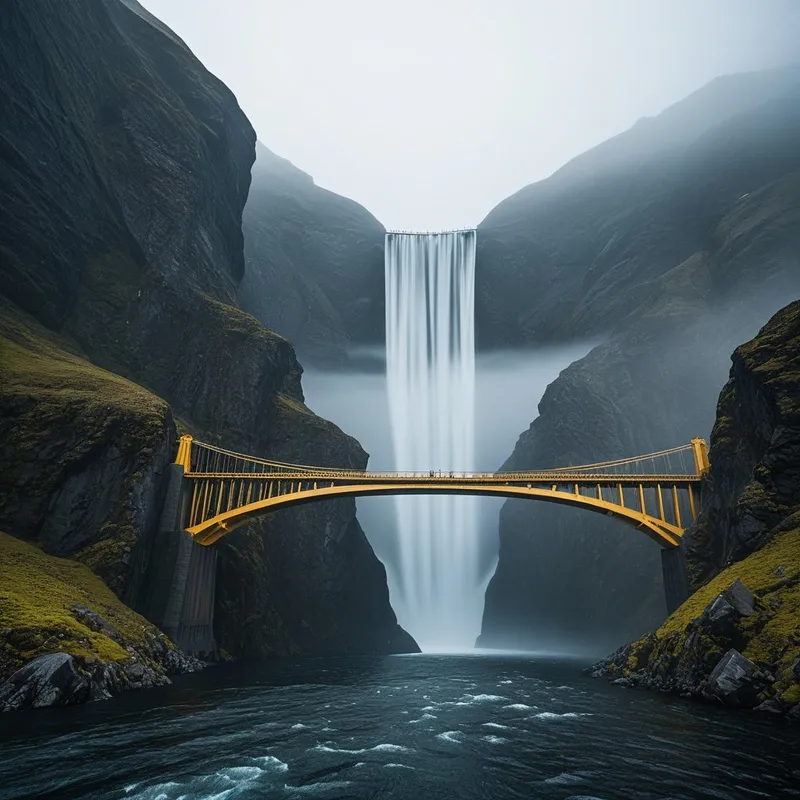
The myth of the trembling, golden bridge over the river Gjöll, guarded by Móðguðr, which the dead and the living must cross to enter the underworld.
The Tale of Gjallarbrú
Listen, and hear the tale of the bridge that echoes with every step, the span that shivers between the lands of the living and the silent halls of the dead. The air here is cold, a damp mist that clings to the skin and muffles all sound, save for one: the ceaseless, mournful roar of the river Gjöll. Its waters are black, churning with the silt of forgotten things, cutting a gorge so deep its bottom is lost to shadow.
To cross this torrent, there is but one way: Gjallarbrú. It is a bridge of gold, they say, but not a gold that brings warmth or comfort. It glows with a cold, ancient light, and it is roofed with precious, gleaming tiles. Yet it is not a sturdy causeway. It trembles. It shudders at the slightest touch, singing a low, metallic hum that gives it its name—the bridge that echoes, that resounds.
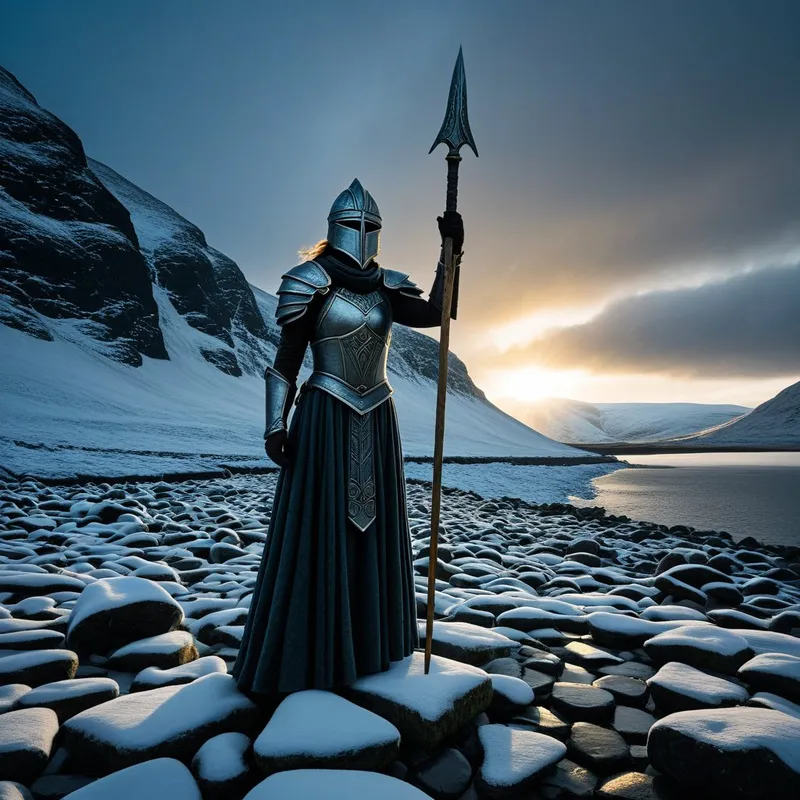
And upon this bridge stands the guardian. She is Móðguðr. Clad in armor that seems forged from the gloom itself, she is a figure of implacable stillness amidst the bridge's constant quiver. In her hand is a spear, its point grounded on the resonant gold. Her watch is eternal, her duty absolute: to question all who seek to pass, to discern the living from the dead, to ensure the order of the worlds is maintained.
The dead come first. A silent procession of shades, their footsteps mere whispers that nonetheless cause the bridge to thrum. Móðguðr watches them pass, a silent sentinel, for they have paid the toll of life and their way is clear. They drift across the trembling span and are swallowed by the mists that veil the high walls and great gates of Hel.
But one day, the bridge echoes with a different step. A step that is too heavy, too full of the pulse of blood and breath. The bridge groans and shudders violently, a clamor that shakes the very mists. Before Móðguðr stands not a shade, but the living god Hermóðr the Bold. Grief is etched upon his face, but his will is iron. He has ridden Sleipnir down the long, dark road of Helveg for nine nights, through valleys of frost and over mountains of shadow, to this final barrier.
Móðguðr stirs. Her voice, when it comes, is like stone grinding on stone. "Why does the bridge thunder so? Your tread is not that of the dead. Your face has the hue of life, not of pallor. What name do you bear, and what madness brings you to the threshold of Hel?"
Hermóðr meets her gaze, his own resolve a fire in the gloom. "I am Hermóðr, son of Odin. My tread is heavy with purpose, not with death. I ride to seek audience with Hel herself. My brother, the shining Baldr, has come this way. I must cross."
A long silence hangs, filled only by the river's roar and the bridge's fading hum. Móðguðr, the furious battle-maid, weighs his words against the ancient law. She sees the truth of his quest, a love that has dared the impossible journey. The law is clear, yet so is the extraordinary nature of this traveler. With a slow, deliberate motion, she lifts her spear from the golden tiles. "Pass, then, son of Odin. The bridge will bear you, for your errand is writ in fate. But know this: the way back is never certain. The echo of your crossing will remain here forever."
And so Hermóðr the Bold, his heart a drum against his ribs, steps onto Gjallarbrú. With every step, the bridge screams its golden, resonant protest, a deafening cacophony that announces a living soul trespassing into the realm of the dead. He walks the trembling, echoing length, feeling the abyss yawn beneath him, until he passes the guardian and is consumed by the waiting mist, on his way to beg for a light to be returned to the world.
Cultural Origins & Context
The myth of Gjallarbrú is preserved primarily in the Prose Edda, specifically in the tale of Hermóðr's ride to Hel in the Gylfaginning section. It is a narrative fragment, a vivid set-piece within the larger, tragic story of Baldr's death. This was not a myth for public festival, but a poetic and cosmological detail shared by skalds and storytellers, a piece of the intricate map of the Norse afterlife.
Its societal function was multifaceted. On one level, it provided a concrete, albeit terrifying, geography for the journey after death—a defined ordeal (the crossing) and a guardian figure enforcing cosmic law. This reinforced the Norse worldview of a structured, if grim, universe with rules even gods must contend with. On another level, it served as a powerful metaphor for the ultimate, irreversible transition. Just as the bridge separated the living world from Hel, such myths helped the living conceptualize the finality and otherness of death. The story of Hermóðr's crossing also elevated the myth, showing it as a threshold not just for the dead, but for heroic, love-driven quests that challenge the very order of the cosmos.
Symbolic Architecture
Gjallarbrú is the ultimate symbol of the Threshold. It is not a passive boundary but an active, responsive entity. Its trembling is the somatic resonance of crossing from one state of being to another—a physical manifestation of psychic shock.
The bridge does not merely allow passage; it feels the passage. Its echo is the sound of the soul's weight upon the fabric of reality.
The river Gjöll below represents the torrent of unconscious material, the chaotic, noisy flow of all that is repressed, forgotten, or deemed "dead" to the conscious ego. The bridge spans this chaos, offering a narrow, precarious way across, but one is always aware of the roaring depths.
Móðguðr is the archetypal Guardian of the Threshold. Psychologically, she embodies the autonomous, often fearsome complex that arises when the ego approaches a profound inner change. She is the resistance, the self-doubt, the fierce protective mechanism that says, "You do not belong here; turn back." She is not evil, but lawful. Her question—"Are you dead or alive?"—is the crucial inquiry of any deep psychological process: Has the old ego-state truly died to make this crossing valid, or are you attempting to enter the realm of the unconscious while still clinging to outdated conscious attitudes?
The Dreamer's Resonance
When the pattern of Gjallarbrú manifests in modern dreams, the dreamer is at a critical juncture of inner transformation. The dream bridge may appear as a narrow footbridge over a canyon, a fragile ladder, or a beam of light over a dark void. Its defining characteristic is its instability and the profound sense of consequence felt about crossing it.
The somatic experience in the dream is key: the trembling of the bridge translates to anxiety, vertigo, or a literal shaking upon waking. This is the body keeping score of a psychic ordeal. The dreamer often encounters a Móðguðr figure—a stern authority, a locked door, a menacing animal, or simply an overwhelming feeling of "you shall not pass." This is the psyche's immune response, challenging the ego's readiness. To dream of successfully crossing, especially after a confrontation with the guardian, indicates the ego has successfully negotiated with a powerful autonomous complex and is integrating new, previously "underworld" material (like repressed grief, talent, or shadow aspects). To turn back or fall signifies a necessary retreat, a recognition that more conscious work is required before attempting such a deep integration.
Alchemical Translation
The journey across Gjallarbrú is a perfect model for the alchemical stage of Nigredo and the process of individuation. The conscious ego (Hermóðr), driven by a compelling need (to retrieve lost wholeness, symbolized by Baldr), must descend into the unconscious (Hel). To do so, it must cross the threshold.
The alchemical gold of the bridge is not the end goal, but the substance of the path itself—the precious, resonant, yet terrifying essence of the transformative process.
The initial, conscious attitude must "die" or be profoundly humbled. This is the question Móðguðr asks. The ego cannot bully its way across; it must state its authentic, vulnerable purpose. The bridge's violent trembling is the experiential cost of transformation—the old structures of the personality shaking to their foundations as something new attempts to pass through.
Successfully crossing does not guarantee the quest's overall success (Hermóðr ultimately fails to free Baldr). But it does achieve a crucial, irreversible shift: the ego has legally entered the realm of the deep Self, witnessed its landscapes, and can return changed. For the modern individual, this translates to those pivotal life moments—after great loss, during a psychological crisis, or at the start of a spiritual awakening—where one must consciously, bravely, and respectfully engage with the deepest, darkest parts of oneself. One must answer the guardian's challenge truthfully, accept the terrifying resonance of the journey, and cross over, knowing the echo of that crossing will forever change the architecture of the soul.
Associated Symbols
Explore related symbols from the CaleaDream lexicon: