Ægir's Hall Myth Meaning & Symbolism
The gods of Asgard journey to the sea-god's hall for a feast, only to be confronted by the raw, untamed forces of the deep and their own brewing fate.
The Tale of Ægir's Hall
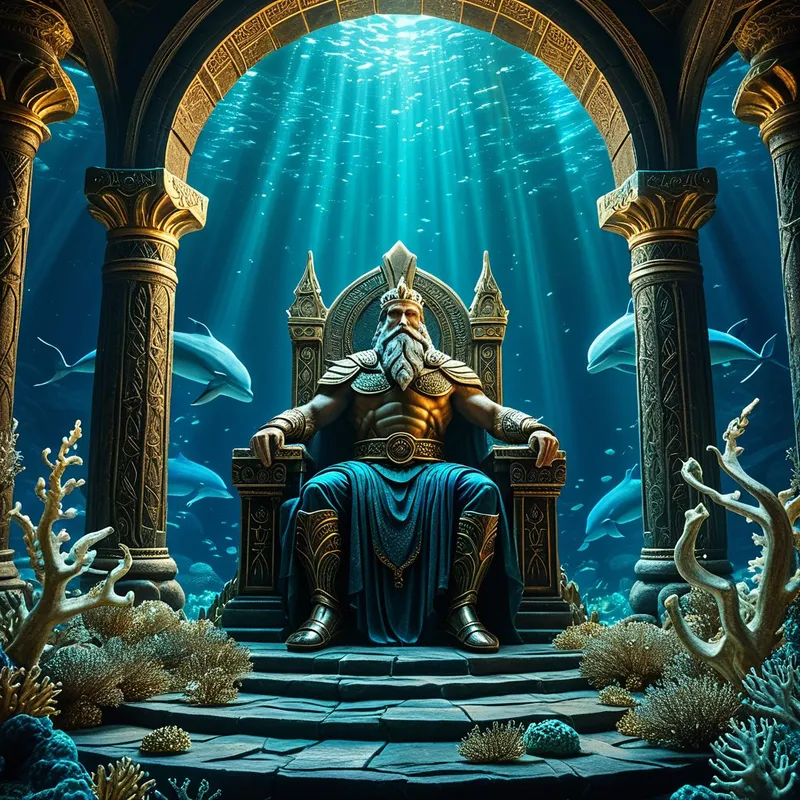
Hear now the tale of the hall beneath the waves, where the laughter of gods meets the silence of the deep. The mead of Aesir had run dry in Asgard, and the boastful tongues of warriors grew still. It was Bragi who spoke the name that stirred them: Ægir. The brewer of the ocean’s ale, whose hall stood where the light of the sun drowned in green gloom.
They came, a glittering procession from the world above. Odin with his one eye seeing all paths, Thor with his red beard and restless might, Frigg in her knowing silence. They descended to the sea-floor, to a realm where gold grew like coral and the walls were the ribs of leviathans. Ægir’s hall was not built; it was grown, a cavern of living stone lit by the captured glow of drowned stars and the gold that paved its floor.
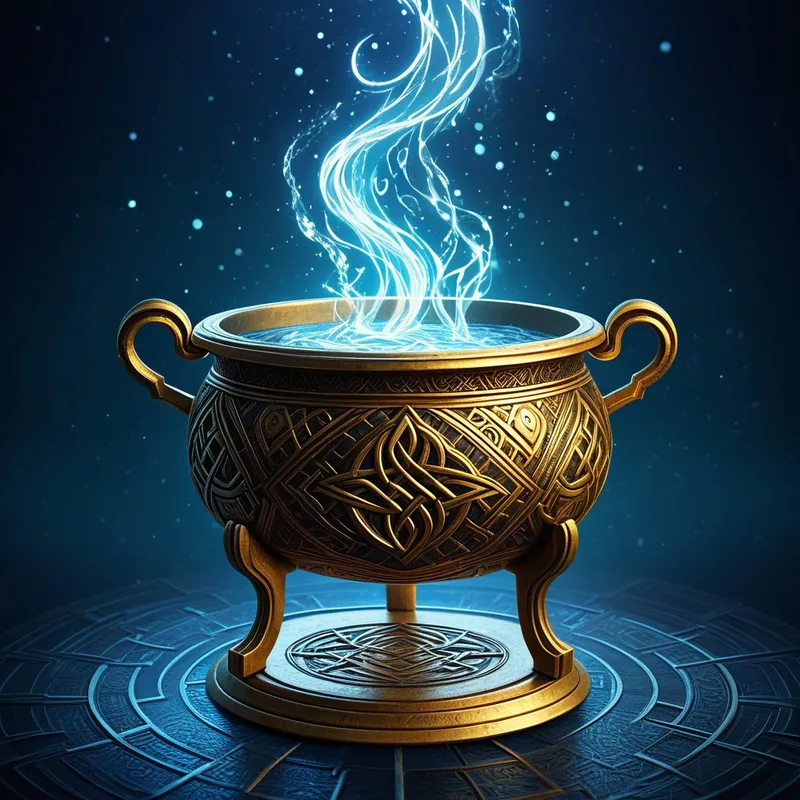
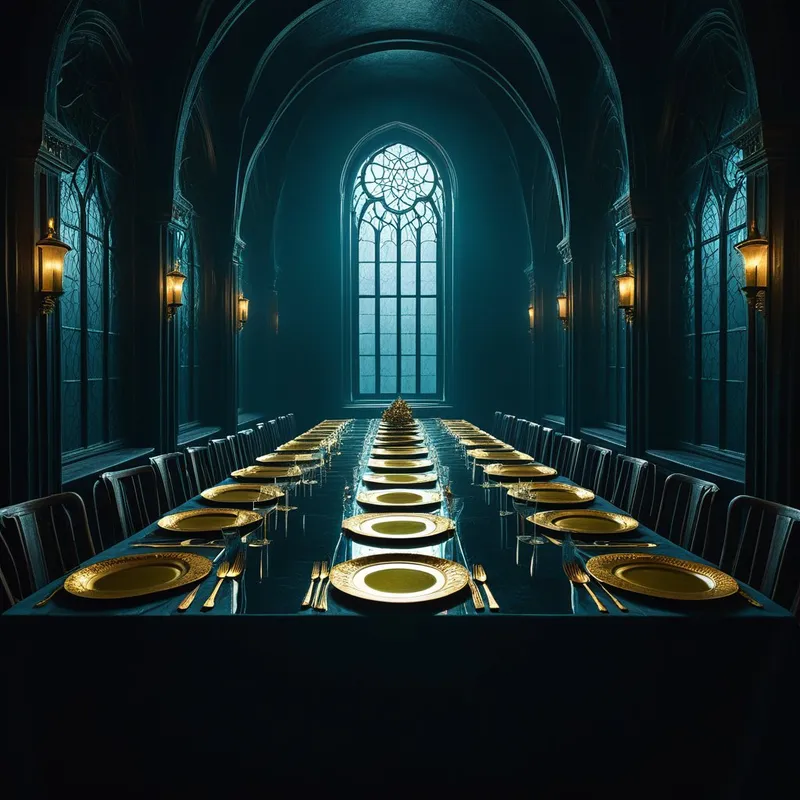
Ægir welcomed them, his face like weathered rock, his eyes the color of a winter sea. His wife, Rán, moved through the throng, her smile as cold and beautiful as moonlight on a still lagoon. The feast began. The hall roared with the sound of gods at ease. Mead, dark and sweet as the deep itself, flowed from a cauldron so vast it could hold the tide—a cauldron lent by the giant Hymir, for even Ægir had none large enough to slake the thirst of deities.
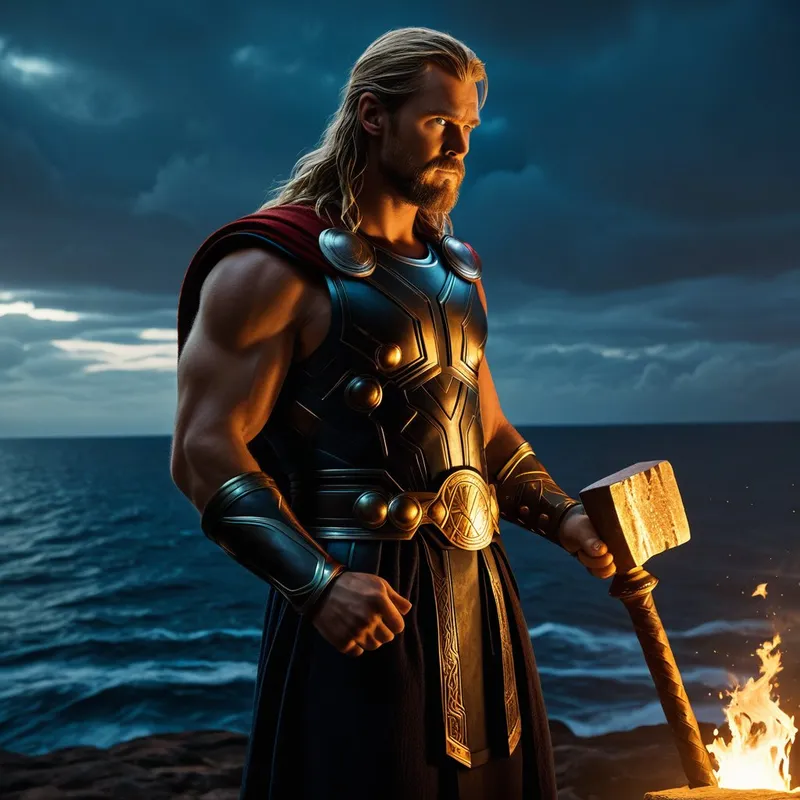
But in this hall of borrowed splendor, beneath the weight of the entire ocean, a shadow settled. The laughter began to ring hollow against the eternal sigh of the abyss outside. The gods, masters of their sunlit realm, were guests in a domain that did not obey their laws. The sea does not reason; it is. It does not build order; it envelops it. Thor, ever the bulwark against chaos, grew sullen. His mighty Mjölnir lay at his side, useless against a host who offered no threat but his own immutable presence.
The climax was not a battle, but a revelation. As the feast wore on, the sea itself became the entertainer. Ægir’s servants, the waves personified, brought forth not just food and drink, but the raw essence of the deep. The hall grew colder. The light dimmed, save for the gold underfoot, which seemed not to reflect light but to drink it. The gods saw, in the silent, fathomless gaze of their host, the truth: they were temporary. Their halls would fall; their fires would gutter. But the sea, and Ægir’s hall within it, would remain, brewing its silent ale long after the last god was gone. They left not in anger, but in a sober silence, carrying back to Asgard not just mead, but the taste of eternity—and it was salt.
Cultural Origins & Context
This myth, primarily preserved in the 13th-century Poetic Edda and later elaborated in the Prose Edda, was not mere entertainment. It functioned as a sophisticated cosmological and psychological anchor for a culture intimately bound to the sea. The skalds who recited these tales were not just poets but philosophers and historians, weaving the gods into the very fabric of the Norse world-view.
The story of Ægir’s feast sits at a crossroads. It is a myth of hospitality and reciprocity—the gods must seek out the giant for a fundamental resource—but it inverts the typical power dynamic. In most tales, the gods conquer or outwit the jötnar. Here, they are humble, if honored, guests. This reflects a deep-seated Norse understanding: civilization (Asgard) is perpetually surrounded and dependent upon the untamable wild (the sea, the giants). The feast was a ritual acknowledgment of that dependence, a temporary truce where the structured world of gods and humans sat, uneasily, at the table of primal, unconscious nature.
Symbolic Architecture
Ægir’s Hall is not a location but a state of being. It is the psyche’s encounter with the foundational, impersonal layers of the Self that exist before and beyond personal identity.
The hall of the deep is the psyche's bedrock, where the personal "I" meets the impersonal "It." To dine there is to know you are a guest in your own soul.
The golden hall itself symbolizes consciousness and culture—something precious, crafted, and luminous. But it is submerged, meaning it is built upon and entirely contained by the unconscious (the sea). Ægir, the host, is the archetype of the Deep Self, the non-egoic center of the psyche. He is not evil, but other—immense, calm, and utterly indifferent to the dramas of the ego (the gods). The cauldron, the central artifact, is the vessel of transformation. It holds the "mead" of the unconscious, the potent, often intoxicating brew of latent potentials, memories, and instincts that fuel conscious life.
The gods’ discomfort is the ego’s anxiety when it is removed from its throne. Thor’s sullenness represents the ego’s defensive, aggressive posture when its tools of control (Mjölnir) are rendered symbolic. The entire feast is a ritual of numinous humiliation, where the ruling principles of the psyche are reminded that they are not the source, but merely temporary stewards, of life’s vitality.
The Dreamer's Resonance
When this myth stirs in modern dreams, it often manifests as dreams of vast, submerged buildings, of being a guest at an overwhelming or silent banquet, or of encountering a calm, powerful figure who embodies a natural element (like an ocean or a mountain). The somatic experience is one of profound awe mixed with visceral unease—a feeling of being "out of one’s depth" in the most literal sense.
Psychologically, this dream pattern signals a confrontation with what Jung termed the "objective psyche." The dreamer is not dealing with personal complexes or repressed memories, but with archetypal forces that transcend personal history. It is the process of the conscious personality (the dream-ego as a "god") being taken down to meet the bedrock of its own existence. The feeling of being a "guest" is crucial; it indicates a necessary shift from an attitude of ownership and control ("This is my psyche, I rule it") to one of respectful dialogue and witness ("I participate in a psyche much larger than myself").
Alchemical Translation
The journey to and from Ægir’s Hall is a perfect map for the alchemical stage of nigredo, the blackening, and the beginning of albedo, the whitening. The gods’ descent is a willing immersion into the prima materia—the chaotic, salty sea of the unconscious. The feast itself is the coniunctio, the sacred marriage, not of opposites, but of the structured (gods) with the foundational (sea). This union is not blissful, but sobering.
Individuation is not about becoming a god, but about learning to sit, humbled and awake, at the table of the giant who was there before you.
The triumph of the myth is not a victory, but a successful return with a transformed perspective. The gods go back to Asgard with the sea’s mead. For the modern individual, this translates to the process of bringing a conscious relationship with the deep Self back into daily life. One does not "solve" the unconscious or conquer it. One learns to host it, to provide a "hall" (consciousness) where its depths can be acknowledged without being allowed to flood and destroy. The ego’s role shifts from tyrannical ruler to responsible steward, from Thor angrily gripping his hammer to Odin quietly drinking in the wisdom of the deep. The cauldron—the capacity to hold, brew, and transform the potent waters of the unconscious—becomes the central artifact of a mature psyche. We leave the feast not with answers, but with a better question, and the strength to hold its weight.
Associated Symbols
Explore related symbols from the CaleaDream lexicon: