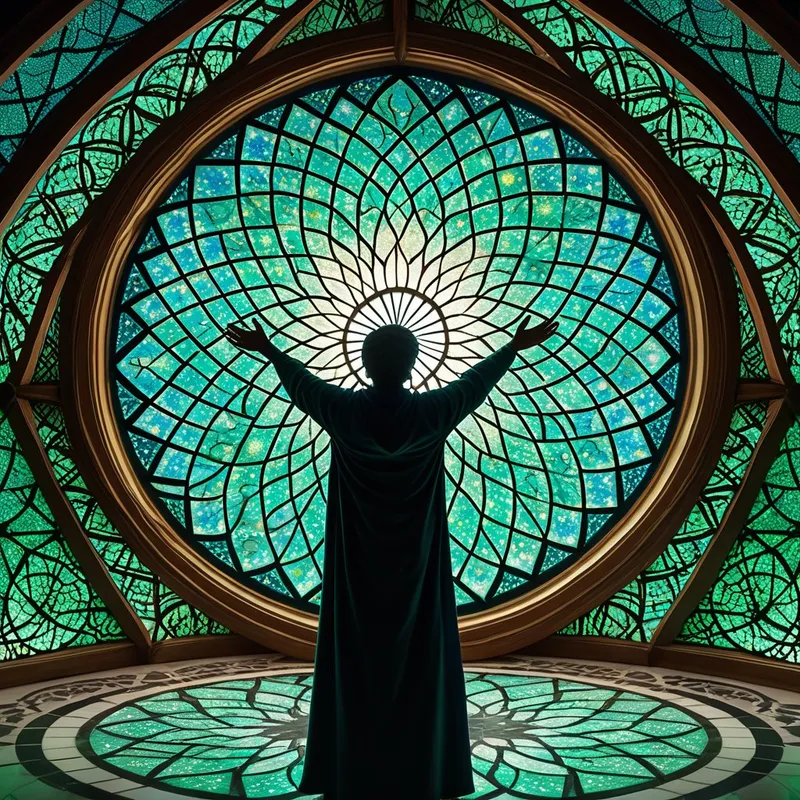
Girih Tiles & Arabesque Myth Meaning & Symbolism
A myth of the artisan who, guided by a celestial pattern, weaves the infinite into the finite, revealing the hidden structure of divine beauty.
The Tale of Girih Tiles & Arabesque
In the beginning, there was the Point. And from the Point, the Circle was drawn, the breath of the Divine. Within the silent, perfect circle, the geometers of heaven inscribed the first lines, the Primordial Grid. But this grid was a skeleton, a stark and silent architecture of potential. The world awaited its flesh, its breath, its soul.
In a city of dust and light, where the call to prayer carved the hours from the sky, there lived an artisan named Yusuf the Seeker. His hands were skilled, but his soul was parched. He could replicate the patterns of his masters, but their secret life, the why of their endless flow, eluded him. He dreamt of lines that were not cages, but rivers; of shapes that did not end, but transformed.
One scorching noon, in the cool gloom of the library, a beam of sunlight fell upon a forgotten manuscript. Not on the text, but on the blank margin. And in that dust-moted light, Yusuf saw it. A faint, shimmering lattice, a web of five-fold symmetry—a decagon, a pentagon, a bowtie, a rhombus, a hexagon—all interlocking in a silent, perfect dance. This was the Girih Tiles, the hidden bones of paradise. He heard no voice, but a command as clear as crystal: Follow the line.
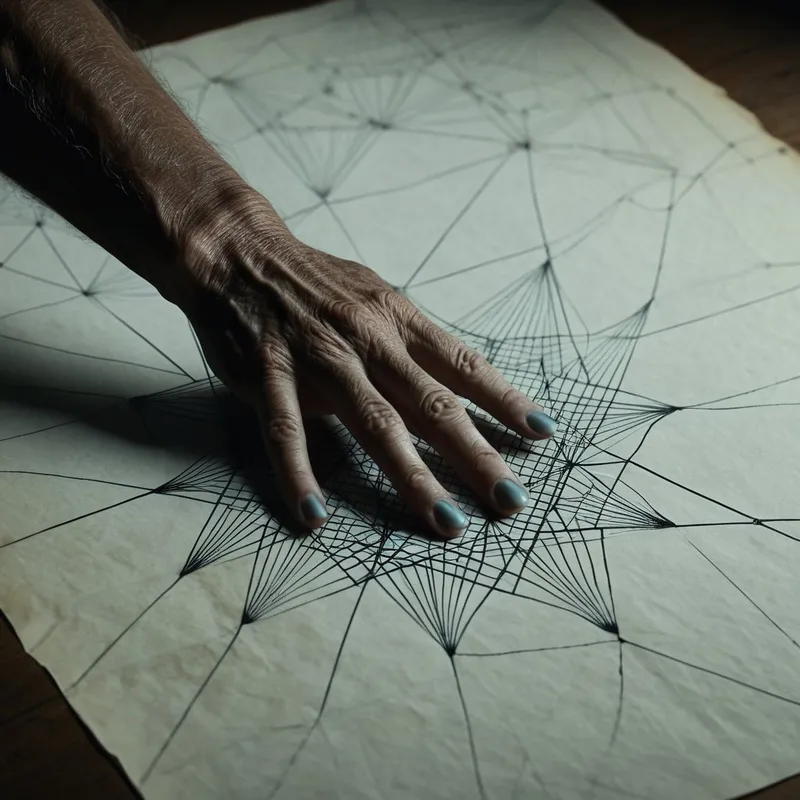
With a trembling hand, he took his pen. He began to trace not the tiles themselves, but the path where their edges met. The line flowed from his nib, a single, unbroken thread. It danced from star to polygon, a continuous journey that knew no beginning and promised no end. As the line snaked and spiraled, a miracle unfolded. The rigid geometry began to soften, to bloom. At the vertices where lines crossed, they burst forth not into more lines, but into tendrils, into leaves, into flowers. The skeletal grid was being clothed in the living, breathing garment of the Arabesque.
Yusuf worked as one in a trance. Day turned to night. The single line became a universe on parchment. The conflict was not against a monster, but against finitude itself—the desperate human desire for an end, a summary, a final corner. His triumph was surrender. He surrendered his will to the path of the line, allowing it to weave the infinite from the finite, to marry the immutable law of the angle with the boundless generosity of the curve. When the dawn call came, he set down his pen. Before him was not a drawing, but a window. A window into a garden where geometry was alive, where order was not rigid but generative, where every end was a beginning, and the soul could walk the path of beauty forever.
Cultural Origins & Context
This is not a myth of gods and heroes written in a single tome, but a living, breathing narrative encoded in stone, plaster, wood, and parchment across the Islamic world, from the 8th century onward. It emerged from a profound theological and philosophical context: the imperative to create beauty that reflects divine unity (Tawhid) without depicting the created form. The myth was "told" by master artisans and mathematicians in the workshops of Samarkand, Isfahan, Cordoba, and Istanbul.
Its societal function was multifaceted. It was a spiritual discipline, a meditation on infinity and divine order. It was a pedagogical tool, passing down esoteric geometric knowledge through generations of craftsmen. It was also a public declaration, adorning mosques, madrasas, and palaces, silently preaching that the universe is not chaos, but a coherent, intelligent, and infinitely beautiful design in which humanity participates as co-creators. The myth was transmitted not through words, but through the hands, through the compass and straightedge, through the very act of making.
Symbolic Architecture
At its heart, the myth symbolizes the reconciliation of fundamental cosmic dualities. The Girih Tiles represent the unseen, transcendental order—the divine law, the mathematical substrate of reality, the archetypal world of pure form. The Arabesque represents the immanent, manifest world—the overflowing abundance of life, the organic, the sensual, the ever-unfolding now.
The straight line is the absolute, the curve is the contingent. In their marriage, eternity kisses the moment.
Psychologically, Yusuf the Seeker is the ego-consciousness that feels separate from the deeper, ordering patterns of the Self. His journey is one of discovery and channeling. He does not invent the pattern; he discovers the hidden grid (the unconscious order) and then becomes the vessel through which it is expressed into the world of form. The single, unbroken line is the thread of consciousness itself, navigating the complex, pre-existing structures of the psyche to create a coherent, beautiful, and endless narrative of being.
The Dreamer's Resonance
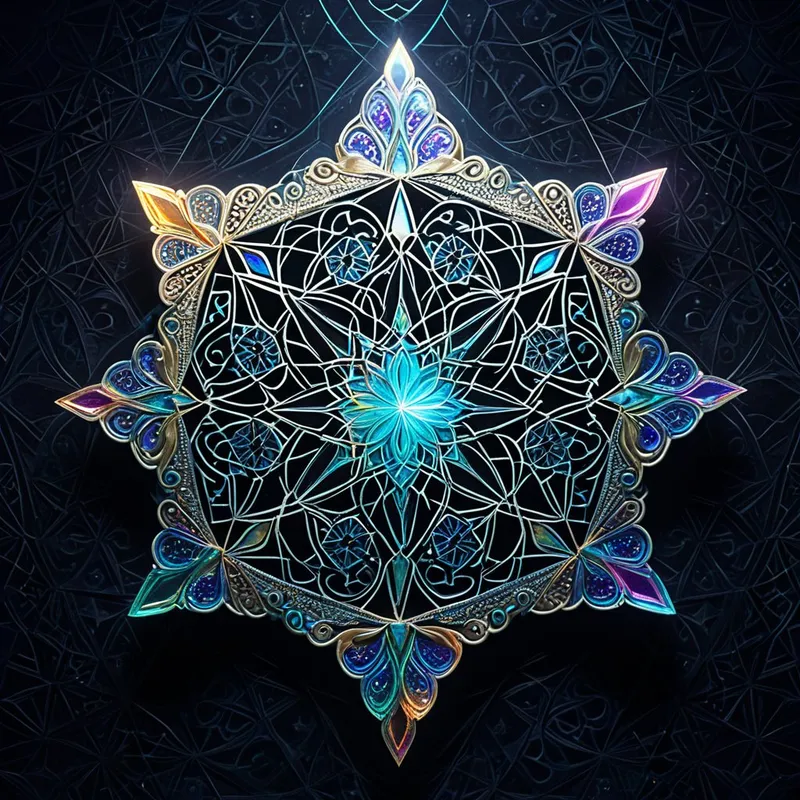
To dream of the Girih and Arabesque pattern is to dream of integration at the deepest level. The dreamer is often in a state of psychological fragmentation or feels trapped in rigid, repetitive life patterns (the bare grid). The emerging, flowing arabesque in the dream signals the psyche's innate movement toward healing, complexity, and beauty.
Somatically, this might feel like a release of tension—a tightness in the chest (the rigid structure) softening into a flowing breath (the arabesque curve). Psychologically, it is the process of finding the hidden, elegant order within apparent chaos. The dreamer is tracing their own "single line"—the thread of their unique destiny—through the pre-existing, archetypal structures of family, culture, and trauma. The dream asserts that a path exists, that the fragments can cohere into a design that is both lawful and liberating, structured and free.

Alchemical Translation
The alchemical process modeled here is the coniunctio oppositorum—the sacred marriage of opposites. For the modern individual, the "Primordial Grid" is the inherited and often unconscious structure of one's life: genetic predispositions, familial complexes, cultural conditioning, the "rules" we live by. It can feel confining, a cage of fate. The yearning for the "Arabesque" is the longing for personal expression, fluidity, creativity, and soul.
Individuation is not the destruction of the grid, but the discovery of the divine line that transforms it into a garden.
The alchemical work is Yusuf's act: to sit with the blank page of one's life, to still the noise, and to discern the hidden, elegant pattern within one's own psyche. Then, one must have the courage to trace the single, continuous line of authentic experience through it. This requires surrendering the ego's desire for a simplistic, finite story. The transmutation occurs in the moment the rigid "tile" of a traumatic memory or a limiting belief is encountered by the conscious line, and instead of stopping, the line transforms it—softens its edge, makes it a node from which new growth (understanding, compassion, creativity) can emerge. The goal is not a finished picture, but the eternal, self-renewing process of weaving one's finite existence into the infinite pattern of meaning.
Associated Symbols
Explore related symbols from the CaleaDream lexicon: