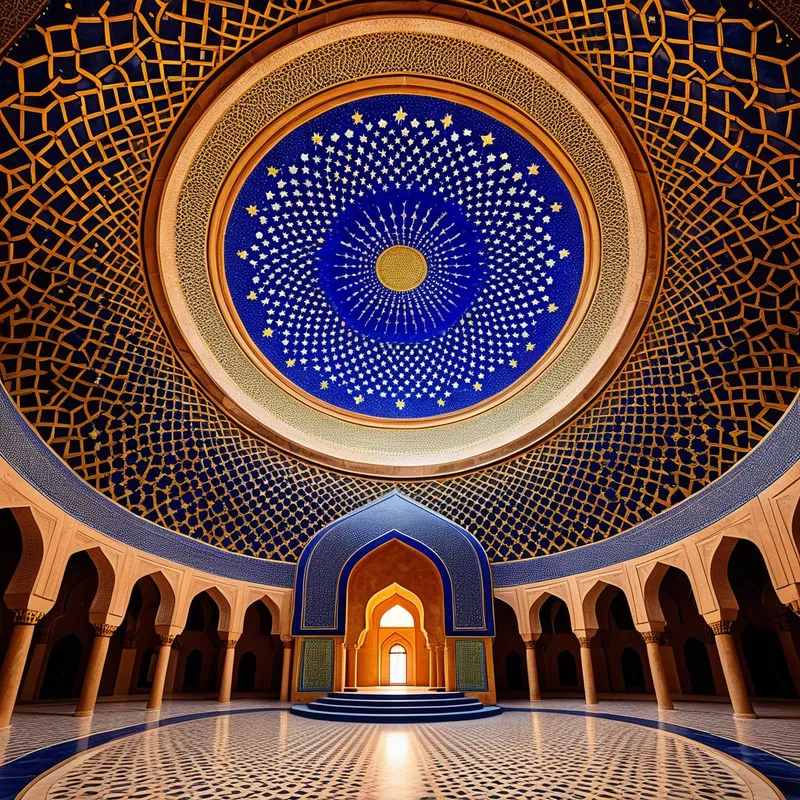
Girih tiles Myth Meaning & Symbolism
A tale of artisans seeking the divine pattern, weaving infinite complexity from five sacred shapes to mirror the cosmos and find the hidden center.
The Tale of Girih Tiles
Listen, and let the story settle in the quiet space behind your eyes. In the time when the world was a younger mirror, reflecting a clearer sky, there lived a brotherhood of artisans. They were not kings or warriors, but their hands held a different kind of power—the power to converse with lines and angles, to coax form from the formless. They dwelled in a city of baked earth and turquoise sky, where the sun was a relentless scribe and the night a velvet page.
Yet, a great silence hung over their work. They could build walls that defied the desert wind, and arches that stole the curve of the rainbow. But their souls yearned for a pattern that was not merely beautiful, but true—a design that echoed the very architecture of creation. They sought the Divine Template, the hidden blueprint from which all stars, petals, and snowflakes were cut.
One night, the eldest master, his beard white as plaster dust, dreamed of a chamber without walls. Floating in that darkness were five shapes, glowing with a cool, interior light: a decagon, a pentagon, a hexagon, a bowtie, and a rhombus. They danced a silent, precise dance, clicking together and apart, weaving an endless, non-repeating tapestry of stunning complexity. He awoke with the shapes etched on his heart.
He gathered the brotherhood. "The dream has spoken," he whispered, his voice rough with awe. "Not one shape, but five. Not a single pattern, but the seed of infinite patterns. Our task is not to invent, but to discover the conversation between them."
For years, they became hermits of geometry. Their workshops were forests of parchment, inked with a thousand false starts. Fingers grew stained, eyes grew weary. The decagon, proud and complete, resisted connection. The pentagon, secretive and odd, seemed an outsider. Despair, a hot desert wind, began to blow through their ranks. Had the dream been a mirage?
Then, the youngest among them, a girl who mixed pigments with the patience of a glacier, had a vision. She saw not the shapes themselves, but the spaces between them—the negative spaces were also stars, also hexagons. "We have been looking at the clay," she said, "and ignoring the mold." She took a stylus and drew not the tiles, but the lines that would bind them—the girih lines themselves.
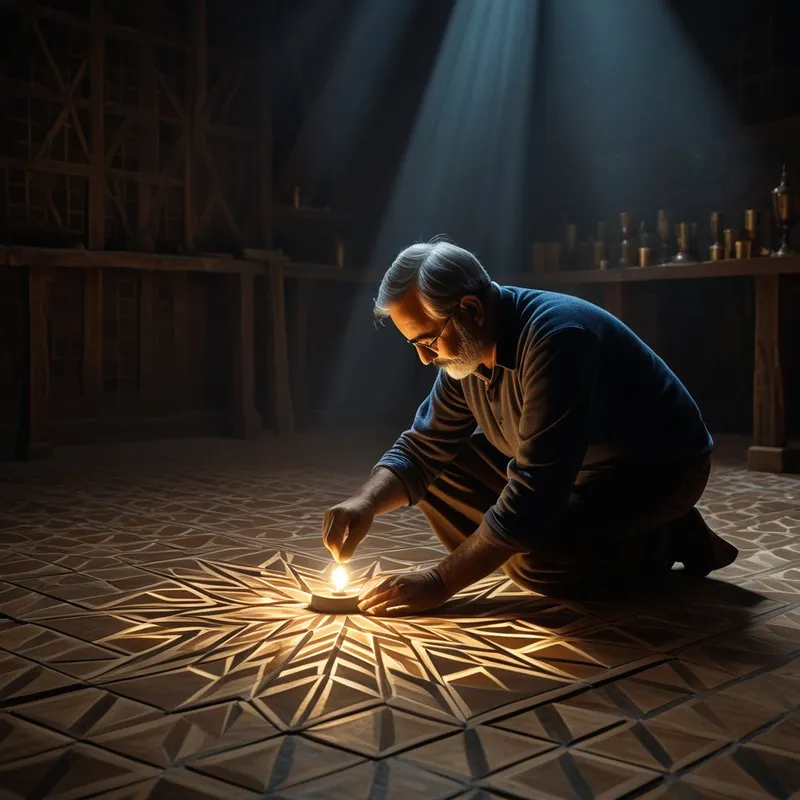
And there, in the negative space, the five shapes suddenly fit. The decagon embraced the bowties, the pentagons nestled into stars, the rhombus became the key that turned the entire lock. They began to tile a courtyard floor, starting from a central decagon. With each placed tile, the pattern grew outward, not repeating, yet perfectly balanced, a frozen explosion of harmony. They worked until their backs ached and the moon rose, and when they stepped back, they did not see stone and glaze.
They saw a net of light cast upon the earth. They saw the orbits of planets and the structure of crystals. In the infinite, unfolding repetition of their finite set of tiles, they found the center they sought—not a point on the floor, but the silent, awe-filled space within their own chests. They had not built a pattern; they had unveiled a law. And in that law, they heard the echo they had longed for all their lives.
Cultural Origins & Context
The tale of the Girih tiles is not a myth of gods and monsters, but a myth of the mind and the hand, born from the zenith of Islamic science and art. Its origins are woven into the architectural triumphs of the Timurid and Safavid empires, particularly in the sacred and scholarly spaces of mosques and madrasas.
This "myth" was passed down not through epic poetry, but through the silent language of pattern scrolls and the master-apprentice tradition in building workshops. The story was the work itself. The societal function was profound: to embody the Islamic philosophical principle that beauty is not arbitrary, but a visible expression of divine unity (Tawhid). The complex, non-repeating patterns—achievable with only a compass and straightedge—demonstrated that infinite complexity could arise from simple, rational principles, mirroring the creation of the cosmos by a single, unified source. It was a spiritual exercise in material form, a meditation on order, infinity, and the human capacity to participate in cosmic logic.
Symbolic Architecture
At its heart, the myth of the Girih tiles is a profound map of the psyche's journey toward integration. The five rigid, distinct tiles represent the fragmented aspects of the self—our separate skills, our conflicting desires, our isolated intellects. The initial despair of the artisans symbolizes the ego's futile attempt to force these fragments into a pleasing, yet ultimately repetitive and sterile, order.
The breakthrough comes not from dominating the shapes, but from perceiving the relationship—the girih line—that already exists between them.
The decagon symbolizes the encompassing Self, the totality of the psyche that feels out of reach. The pentagon is the unruly, odd, and essential element of the unconscious that doesn't fit conscious logic. The girih lines themselves are the symbolic equivalent of the transcendent function—the psychic process that forges a third, new position from the tension of opposites. The resulting infinite pattern is the individuated personality: a unique, complex, and coherent whole that is ever-unfolding yet consistently itself.
The Dreamer's Resonance
To dream of Girih tiles is to dream of a psyche in the active, often frustrating, process of self-assembly. The dreamer may find themselves in a labyrinth of shifting geometric walls, or trying to fit impossible tiles together. This is the somatic experience of cognitive dissonance and psychological reorganization.
The feeling is one of profound puzzle-solving at a level deeper than intellect. There is a pressure, a somatic urgency, to "find the pattern." If the dream culminates in the tiles suddenly clicking into place, revealing a vast, beautiful structure, it signals a moment of synthesis in waking life—the "aha!" moment where disparate life experiences, skills, or internal conflicts suddenly reveal their hidden connective logic. The dream is the psyche's workshop, where the fragmented tiles of experience are being tested, rotated, and finally, harmonized.
Alchemical Translation
The alchemical process modeled here is the transformation of the massa confusa—the confused, fragmented soul—into the lapis philosophorum—the philosopher's stone of an integrated Self. The "base materials" are the five rigid tiles of our identified traits and complexes. The "fire" is the creative frustration and yearning of the artisans. The crucial "transmutation" is not an act of force, but of perception: shifting gaze from the isolated substance (the tile) to the binding relationship (the line).
Individuation is not about adding more to the self, but about discovering the pre-existing, elegant joints that allow our fragments to interlock into a stable infinity.
For the modern individual, the myth instructs us to cease trying to hammer our pentagonal quirks into hexagonal holes. Instead, we must look for the girih lines—the hidden principles, the core values, the recurring themes—that naturally connect our decagon of ambition to our rhombus of compassion, our bowtie of social skill to our pentagon of solitary passion. The goal is not a static, finished portrait, but a living, non-repeating pattern that can grow organically from its center. We become both the artisan and the tile, the weaver and the woven, building a life that is a finite expression of infinite possibility.
Associated Symbols
Explore related symbols from the CaleaDream lexicon: