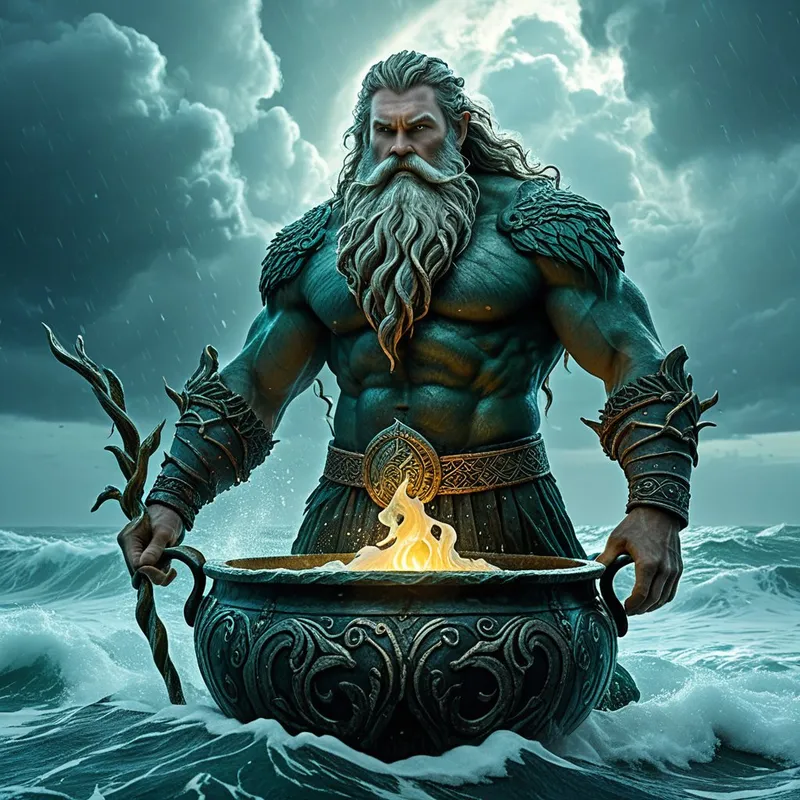
Ægir Myth Meaning & Symbolism
The myth of the sea-giant Ægir, who brews ale for the gods in a cauldron of chaos, revealing the deep, hospitable order within the primal unconscious.
The Tale of Ægir
Listen, and let the salt-spray fill your lungs. The world is not only rock and root, but also the deep, dark, singing abyss. In that abyss dwells Ægir. He is not a god of the bright Asgard, but a lord of the fathomless, a giant whose halls are the drowned mountains and whose breath is the tide. His wife, Rán, casts her net to gather sailors, and his nine daughters are the waves themselves, each with a name like a crashing poem.
One season, when the winds grew quiet and the gods of Asgard thirsted for more than mead, they turned their minds to the deep. They desired a feast, a gathering of all kin, and for that, they needed a brewer of peerless skill and a vessel of impossible size. Only Ægir possessed the cauldron. But Ægir was reluctant. "The sea provides no fire to boil such a brew," he rumbled, his voice the sound of grinding continental shelves.
Then came Thor, his eyes lightning in the gloom of the sea-hall. With him was the cunning Loki. They had journeyed east, to the hall of the giant Hymir, to fetch the cauldron Ægir required. The tale of that fetch is one of peril and brute force: Thor fishing for the Midgard Serpent, shattering mountains with his rage, and finally, wrenching the colossal cauldron from Hymir's terrified grasp.
With the cauldron delivered, Ægir's condition was met. Now, in the heart of the ocean, in the hall of Hlesey, lit not by torch or sun but by the radiant, piled gold of the sea-floor itself, the work began. Ægir stirred the depths. Into the cauldron went the essence of storm and calm, the memory of every shipwreck, the joy of every leaping dolphin, the salt of ancient tears. He brewed not with fire, but with the slow, immense pressure of the abyss, with time itself as his flame.
And so the gods descended. Odin the All-Father, Frigg the wise, Freyja of the seidr, all the bright host of Asgard, entered the domain of the deep giant. In his hall, under the weight of the ocean, they drank the ale of transformation. They feasted, and for a night that was an age, the order of Asgard and the chaos of the deep were not at war, but in communion, held together by the sacred, terrifying law of hospitality, served from a cauldron born of threat and won by might.
Cultural Origins & Context
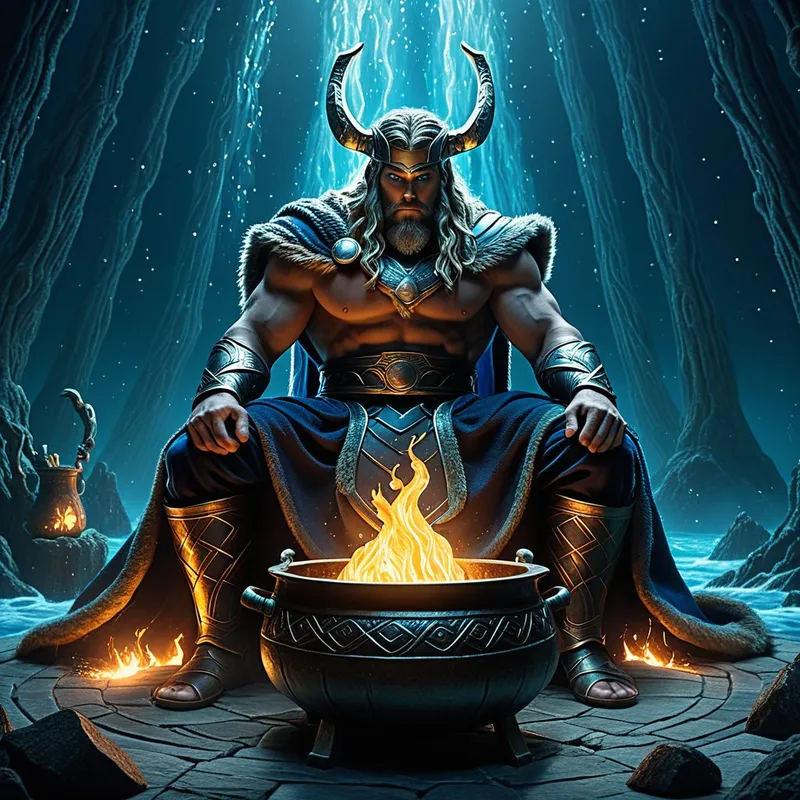
The myths of Ægir are preserved primarily in the Poetic Edda, in poems like Hymiskviða (The Lay of Hymir) and Lokasenna (Loki's Quarrel). These stories were part of a vast oral tradition, recited by skalds (poets) in the halls of Viking Age chieftains. Ægir's role is distinct. He is a jötunn, yet he is not typically an enemy. His relationship with the Æsir is one of uneasy alliance and necessary exchange.
This reflects the Norse worldview's profound respect for and terror of the sea. For a seafaring culture, the ocean was the ultimate source of bounty, pathway to adventure, and ever-present grave. Ægir embodies this ambiguity. His feast is a societal metaphor: even the gods must negotiate with the uncontrollable, primal forces of nature. The story functioned not just as entertainment, but as a cosmological model for how culture (the gods) engages with the raw, untamed world (the giants), establishing rules—like hospitality—that create temporary, sacred order in the face of eternal chaos.
Symbolic Architecture
Ægir is the personified unconscious. He is not the personal unconscious of repressed memories, but the collective, impersonal, and ancient psyche—the objective world of instinct and archetype that exists before and beneath the constructed world of the ego (Asgard). His hall at the bottom of the sea is the deepest stratum of the psyche, where the luminous treasures (the gold that lights his hall) and the terrifying monsters (like the Midgard Serpent) coexist.
The cauldron is the central symbol. It is the vessel of transformation, the vas of alchemy. It contains and processes the chaotic, undifferentiated contents of the deep—the salty waters of emotion, memory, and instinct—and through a mysterious process (brewing), transmutes them into the intoxicating "ale of the gods."
The cauldron represents the containing function of consciousness, which alone can take the raw stuff of the unconscious and give it a form that can be integrated, shared, and understood.
The feast itself is the symbolic act of integration. The gods, representing the various facets of a conscious attitude (wisdom, law, force, fertility), must venture into the unconscious and partake of its product. This is not a conquest, but a ritualized, respectful engagement. The conflict with Hymir to obtain the cauldron shows that this vessel of transformation is not easily won; it requires a heroic (or hubristic) confrontation with the shadowy, possessive aspects of the primal world.
The Dreamer's Resonance
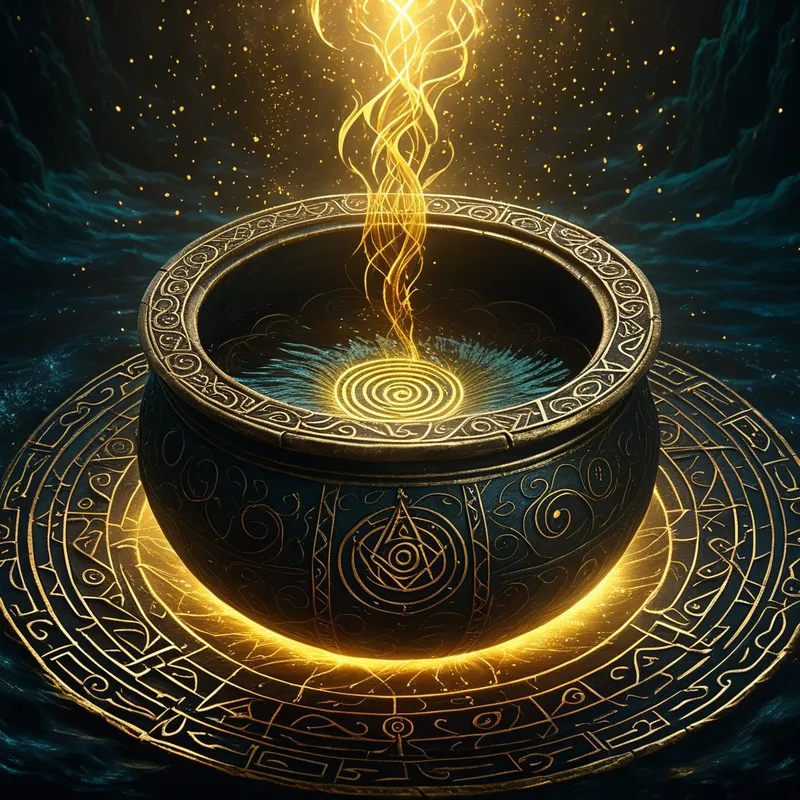
When the pattern of Ægir stirs in the modern dreamer, it speaks to an encounter with the deep, impersonal layers of the psyche. To dream of vast, calm, or stormy oceans is to stand at the shore of the collective unconscious. To dream of being in a hall underwater, or of a great, ominous feast with powerful but unknown figures, signals that a process of profound psychic fermentation is underway.
The somatic experience might be one of weight, pressure, or buoyancy—a literal feeling of being in deep water. Psychologically, the dreamer is likely in a phase where old certainties are dissolving, and new, potent but undefined energies are brewing within. There is often a sense of being "hosted" by a force greater than oneself, which can feel both awe-inspiring and threatening. This is the ego being invited, or compelled, to the feast in Ægir's hall. The dream asks: Can you sit with the deep, chaotic truths of your own nature? Can you drink what is offered, even if its source is mysterious and frightening?
Alchemical Translation
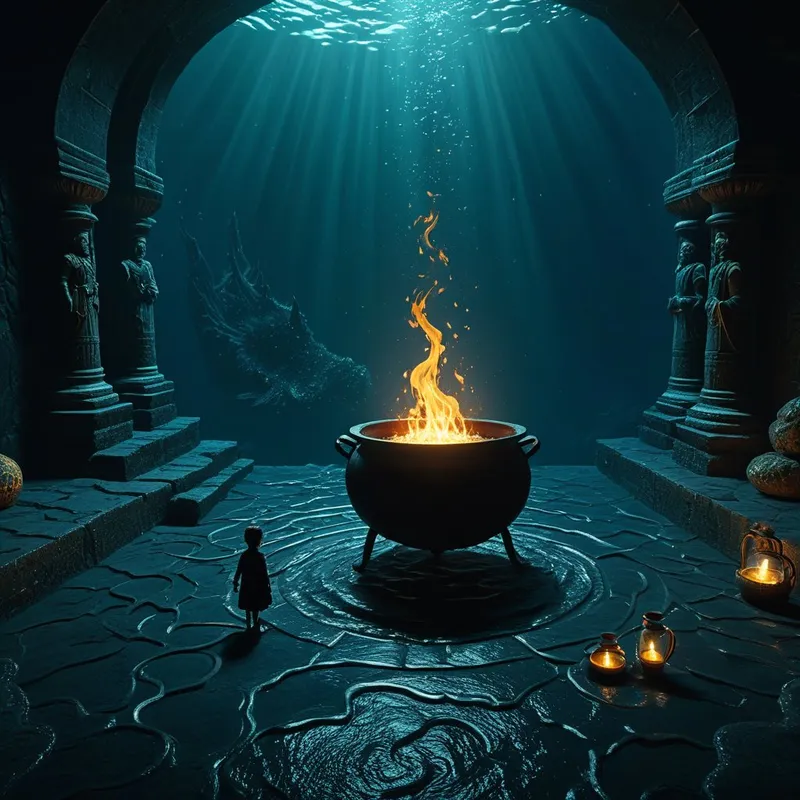
The myth of Ægir models the alchemical stage of solutio—dissolution into the primal waters—followed by coagulatio—the re-formation into a new, more potent substance. The individuation process requires that the conscious personality (the society of the gods) does not remain isolated in its well-ordered fortress. It must actively seek out the cauldron, the vessel of transformation, from the realm of the giants (the rejected, shadowy, or instinctual parts of the self).
The journey to Hymir and the confrontation with the serpent is the necessary struggle to secure this capacity for containment. Once the cauldron is obtained, the work of Ægir—the unconscious itself—can begin. The ego does not do the brewing; it provides the vessel and then must wait, trust, and finally participate.
Individuation is not self-made; it is self-offered to a process greater than itself, hosted by the deep psyche. We do not create our transformation; we consent to be its vessel and then its guest.
Finally, the feast represents the coniunctio oppositorum—the sacred marriage of opposites. In Ægir's hall, light and dark, god and giant, consciousness and the unconscious, meet in a shared ritual. The intoxicating result is not mere escape, but a symbolic substance that allows for a temporary, ecstatic wholeness. For the modern individual, this translates to those rare, integrated states where one feels profoundly connected to an inner and outer depth, where personal struggles are seen as part of a vast, impersonal, and ultimately creative process, brewing in the cauldron of the soul.
Associated Symbols
Explore related symbols from the CaleaDream lexicon: