
Ginger as 'Universal Medicine' Myth Meaning & Symbolism
An ancient tale of a fiery root, born from divine compassion, offering universal healing and symbolizing the inner fire that transforms suffering into wisdom.
The Tale of Ginger as 'Universal Medicine'
In the time before time, when the breath of the world was still finding its rhythm, a great imbalance settled upon the earth. A creeping cold, born not of season but of spirit, seeped from the cracks between realms. It was a cold that stiffened the joints, that settled in the belly like a stone, that clouded the mind and stilled the vital winds. Humanity grew sluggish, their fires dimming, their connections to each other and the earth fraying into a dull ache of separation.
The celestial beings looked down from their luminous abodes and saw the suffering. Among them was a deity of profound compassion, known in some whispers as Shen Nong, the Divine Farmer, and in others as Agni in his aspect as the digestive fire. This being did not merely observe; they felt the collective chill in their own essence. A resolve, hot and purposeful, kindled within them. They would descend, not with a thunderous proclamation, but with a secret buried in the heart of the world.
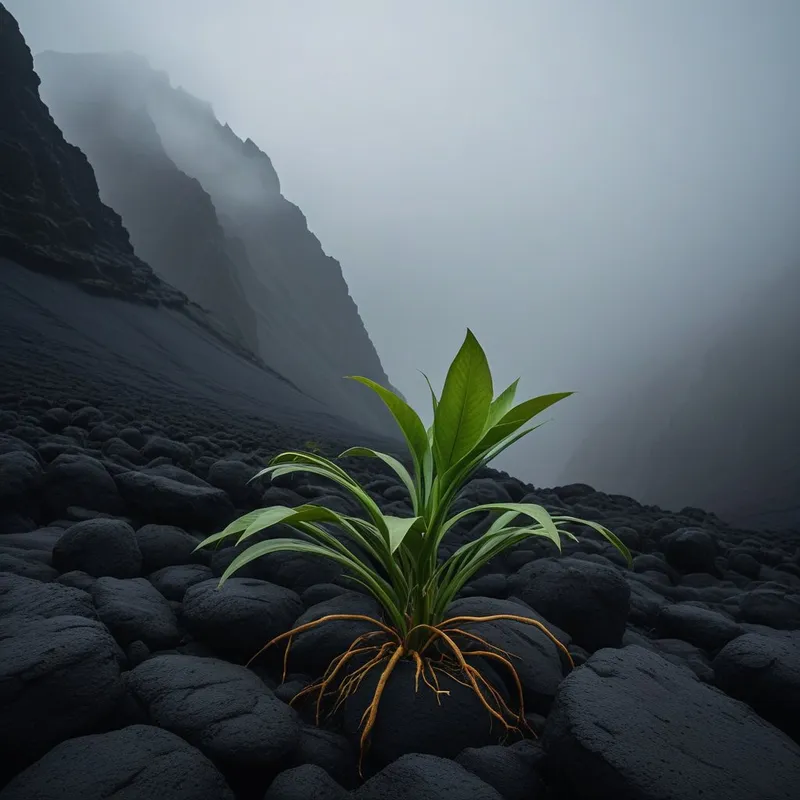
The deity walked the frozen paths, their feet leaving prints of steaming earth. They came to a place where the world’s deep, tectonic fire met the surface—a volcanic slope shrouded in perpetual mist. There, they knelt and pressed their palms, burning with compassionate intent, into the black, fertile soil. From their fingertips, a seed of concentrated, medicinal fire was planted, a piece of their own restorative prana or Qi.
The earth groaned and shifted. Where their hands had been, the soil cracked, and from the dark fissure, a strange plant emerged. Its leaves were sharp, spear-like, resisting the damp air. But below, hidden in the nurturing darkness, a rhizome began to swell. It was knotted and gnarled, like a fist clenched around a secret. Its skin was the color of sun-baked earth, but within, when broken, it revealed a flesh of fierce gold, fibrous and vibrant. A scent rose—piercing, warm, alive—that cut through the miasma of cold. It was the smell of awakening.
The deity harvested this first root, this embodied spark. They did not hoard it in the heavens. Instead, they journeyed to the villages of men. To the elder whose bones creaked with the cold, they gave a piece to brew into a tea. A warmth spread from the core outward, melting the internal frost. To the mother whose child shivered with stagnant digestion, they grated the root into a paste, and the child’s belly settled, its fire rekindled. To the warrior whose mind was clouded with lethargy, they offered a sliver to chew, and clarity returned like the dawn.
The people called it Jiang in one tongue, Shunthi in another. But its true name was understood in the body before language: the Universal Medicine. It was not a cure for one ill, but a restorer of the fundamental fire—the Agni, the Yang principle—that had been diminished. The great chill began to recede, not by a grand exorcism, but by this humble, fiery root offered from a place of deep, embodied compassion. The healer had become the medicine, and the medicine, in turn, made everyone a healer of their own inner climate.
Cultural Origins & Context
This mythic narrative is not housed in a single, canonical text but is woven into the living fabric of two of the world’s oldest continuous healing traditions: Ayurveda and TCM. In Ayurveda, ginger, or Ārdraka (fresh) and Shunthi (dried), is celebrated as the Vishwabheshaja—the Universal Medicine. Its properties are detailed in ancient compendia like the Charaka Samhita, where it is said to kindle Agni, dispel toxins (Ama), and clear the body’s channels.
In China, the mythos is intimately tied to the legendary figure Shen Nong, who is said to have tasted hundreds of herbs to discern their properties, founding the pharmacopeia. Ginger (Jiang) is classified as acrid and warm, entering the Lung, Spleen, and Stomach meridians to disperse cold and revive Yang. The story was passed down orally by healers, herbalists, and cooks—the true custodians of everyday magic. Its societal function was pedagogical and existential: it encoded complex medical principles into a memorable narrative, teaching that the most powerful healing often comes from the earth (not the heavens), is fiery and stimulating (not just gentle), and requires integration into daily life (a tea, a meal, a tonic) to be truly universal.
Symbolic Architecture
At its core, the myth presents ginger as an archetypal symbol of awakened, grounded fire. Unlike the destructive, sky-bound fire of lightning, this is a subterranean, generative heat. The rhizome growing in darkness represents the healing potential that resides in the ignored, the earthy, and the unconscious parts of ourselves.
The Universal Medicine is not found in perfection, but in the knotted, fibrous truth of embodied experience.
The deity’s act of planting a piece of their own essence signifies that true healing power arises from compassionate self-sacrifice and deep connection. The ginger root becomes a psychopomp, a guide that moves energy from stagnation (cold, damp, Ama) to flow (warmth, digestion, clarity). Symbolically, it addresses the "cold of the spirit"—the depression, dissociation, and lack of vitality that comes from emotional or psychic congestion. Its sharp, pungent nature represents the necessary irritation, the "bitter truth" or stimulating challenge that awakens us from numbness.

The Dreamer's Resonance
When this myth surfaces in modern dreams, it often signals a somatic call to stoke one’s inner fire. Dreaming of finding, eating, or cooking with ginger may point to a psyche grappling with a "cold" condition: a period of lethargy, emotional frigidity, or digestive issues (both literal and metaphorical—an inability to "digest" experiences).
The ginger root in a dream acts as a compensatory symbol from the deep unconscious. It arrives not to soothe, but to stimulate. It suggests the dreamer’s system is seeking a catalyst to break up psychic stagnation, to reintegrate repressed vitality, or to warm up a frozen aspect of the personality. It might appear when one is "cold" with resentment, "chilled" by fear, or suffering from a lack of creative or libidinal heat. The dream is a prescription from the inner healer, urging a reconnection with one’s own fiery, grounded core energy.

Alchemical Translation
The myth models the individuation process as one of internal climate regulation. The "great chill" represents the collective or personal shadow—the cold, neglected, and undigested parts of the self that lead to dis-ease. The compassionate deity is the emerging Self, the central organizing principle of the psyche that seeks integration.
Individuation is not about becoming spiritually cool, but about learning to responsibly tend the sacred, digestive fire within.
The alchemical work is the descent of consciousness (the deity) into the dark, fertile ground of the body and the unconscious. There, it plants the intent to heal. The resulting "ginger"—the integrated, fiery wisdom—is not a abstract concept, but an embodied, tangible change in one’s being. It is the development of a personal "medicine": a capacity to warm oneself from within, to metabolize painful experiences into wisdom, and to stimulate circulation between all parts of the self. The ultimate triumph is not the eradication of all cold, but the cultivation of a reliable, inner source of heat that allows one to move through the world’s inevitable chills with resilience, clarity, and compassionate warmth. You become both the healer and the healed, the planter and the nourishing root.
Associated Symbols
Explore related symbols from the CaleaDream lexicon: