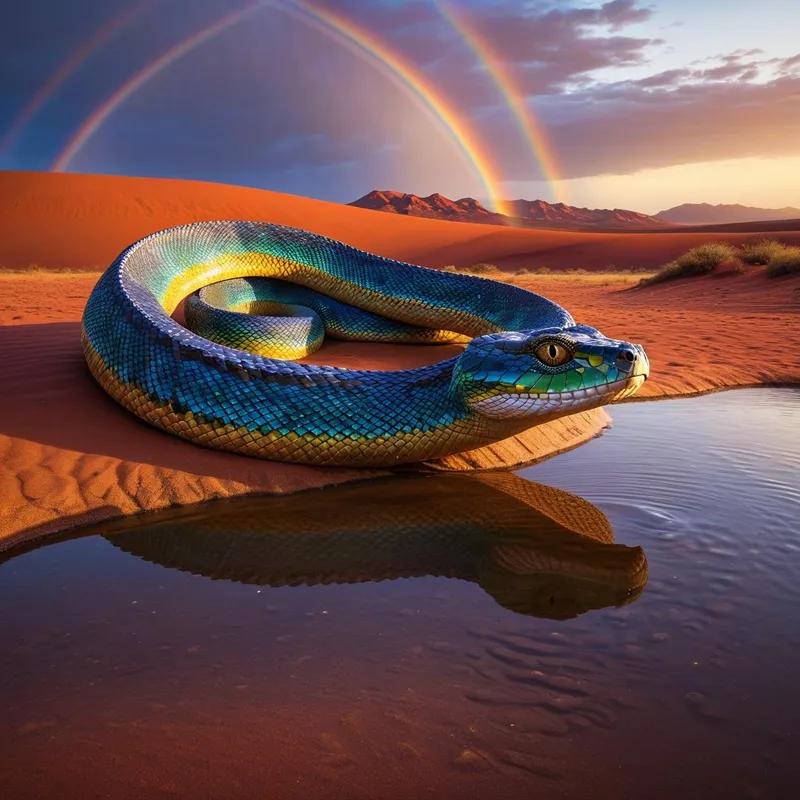
Ginga Myth Meaning & Symbolism
The story of Ginga, the Rainbow Serpent, who shaped the land, brought forth life, and embodies the eternal cycle of creation and destruction.
The Tale of Ginga
In the beginning, there was the Dreaming. The world was flat, silent, and asleep beneath a vast, empty sky. Then, from the deep, timeless sleep of the earth, Ginga stirred.
Feel the cool, dark clay. Smell the damp, primordial earth. Ginga, the great Rainbow Serpent, uncoiled from her slumber within the world’s secret heart. She was immense, her body a river of muscle and scale that held all colors and none. With a mighty heave, she pushed upward, breaking the surface of the flat plain. Where her head rose, the first waterhole bubbled forth, dark and deep. She drank, and her thirst was the thirst of the world.
Then, she began to travel.
She slid across the barren land, and where her heavy belly dragged, it gouged great valleys and riverbeds. She pushed mountains up with her crest and carved gorges with her coils. She was not gentle. The earth groaned and cracked at her passage, a birth cry of stone and soil. When she grew tired, she would settle, her body forming ranges and hills. When she was playful, she would arch her back high, and the curve of her spine became the arc of a rainbow bridging world and sky.
She sang as she moved. Her song was not made of words, but of the sound of water flowing over rock, of wind in deep crevices, of the grind of continent against continent. This song was the first law. It called forth life. From the mud churned by her tail, the first plants unfurled. From the waterholes she left behind, animals emerged, blinking in the new light. She placed each creature in its country, giving it language and law.
But Ginga’s power was wild and untamed. In her travels, she sometimes encountered the first people. Some she welcomed, teaching them the songs for the land. Others, who were foolish or disrespectful, she swallowed whole, taking them into her dark belly before spitting them out, transformed, as stones or new kinds of beings. She was the giver and the taker, the creator and the destroyer.
Finally, her great work done, Ginga returned to the deepest waterhole. She coiled herself at the bottom, in the cool, dark silence. But she did not sleep. She listens. Her body is the land—the rivers are her veins, the mountains her bones. Her rainbow is a promise and a reminder: she is always here, dreaming the world into being, holding the balance between chaos and order, life and the deep, quiet earth from which all things come and to which all return.
Cultural Origins & Context
The stories of Ginga, and the Rainbow Serpent more broadly, are among the most significant and widespread narratives across the many and diverse Aboriginal nations of Australia. This is not a single, monolithic myth, but a vast, interconnected tapestry of stories that vary by language group and Country. In some traditions, the being is male; in others, like the Kunwinjku people of West Arnhem Land, she is Ginga, a female creator.
These stories are the foundational bedrock of Aboriginal Law and spirituality. They were not merely "told" but performed, sung, painted on bark and rock, and danced in ceremony. The knowledge was—and is—carefully passed down through generations by Elders, not as entertainment, but as a sacred map. The myth of Ginga’s travels literally charts the landscape, creating the Songlines. To know the story is to know the location of waterholes, the reason for a mountain’s shape, the origin of a local species, and the moral code for living in that place.
Its societal function is profound: it establishes a cosmology of reciprocal belonging. The people belong to the land because the land was shaped by a sacred being whose law they follow. The myth is a continuous, living contract between the people, their ancestors, and the animate, intelligent landscape. It is a narrative framework for environmental stewardship, social order, and spiritual identity, all woven into one.
Symbolic Architecture
Ginga is the ultimate symbol of primal, creative energy. She is the unconscious, chaotic force that precedes and generates all form.
The serpent does not build; it unfolds. Its creation is not an act of assembly, but of revelation, scraping away the blank surface to expose the living world beneath.
Psychologically, Ginga represents the raw, instinctual libido—not merely sexual, but the total life-force energy of the psyche. Her movement from the dark, featureless earth into the shaped, differentiated landscape mirrors the journey of unconscious content into conscious awareness. The rivers she carves are the channels of emotion and thought; the mountains are the enduring structures of the self and its complexes.
Her dual nature is critical. She is both nurturer (bringing water and life) and devourer (swallowing the unprepared). This embodies the psyche's own ambivalence: the creative drive can also be destructive, especially to old, rigid structures of the personality. The transformation of those she swallows speaks to the necessary, often terrifying, process of being dissolved by the unconscious to be remade. She is not "good" or "evil"; she is a natural law. She represents the totality of existence where creation and destruction are two sides of the same coiling body.
The Dreamer's Resonance
When the pattern of Ginga stirs in modern dreams, it often signals a profound encounter with the creative/destructive forces of the deep psyche. It is not a gentle nudge, but a tectonic shift.
You may dream of immense, coiling shapes in the earth, of landscapes violently reforming, or of a majestic yet terrifying serpentine presence. There is a somatic quality to these dreams—a feeling of being physically moved, shaped, or even consumed. This can correlate with life periods of intense upheaval: the breakdown of a long-held identity, a surge of repressed creative energy, or a confrontation with a primal fear or desire that reshapes your inner world.
The dream is an experience of being in Ginga’s country. The feeling of awe mixed with dread is the correct response to touching this archetypal power. The dreamer is not an observer but a feature of the landscape being actively formed. The psychological process is one of erosion and deposition—old psychic material is worn away, and new structures are laid down from the raw substance of the self. To dream of Ginga is to feel the bedrock of your being in motion.
Alchemical Translation
The myth of Ginga provides a potent model for the alchemical process of individuation—the Jungian journey toward psychic wholeness. Her journey from the prima materia of the featureless earth to the articulated, living landscape is the archetype of the individuation process.
The first stage, nigredo (the blackening), is Ginga’s stirring in the dark earth—the initial, often disturbing, emergence of unconscious content. The albedo (whitening) is her emergence into the light and the carving of distinct forms (rivers, mountains)—the beginning of differentiation and analysis. The rubedo (reddening) is the infusion of life, color, and law—the integration of this new consciousness into a vibrant, functioning whole.
The ultimate goal is not to conquer the serpent, but to recognize that you are made of its substance, living on the land it shaped. Individuation is learning to sing its song.
For the modern individual, the "traveling" is the inner work of confronting the chaotic, creative Self. We must allow this serpentine energy to move through us, to carve new channels in our rigid perceptions, even if it is disruptive. The "waterholes" she leaves are the deep, nourishing wells of insight we can return to. The key is to approach this inner Ginga not with control, but with respect—learning its songs (the authentic voice of the Self) and accepting its transformative power, which can feel like both a gift and a swallowing. The triumph is the resulting landscape: a psyche that is uniquely, authentically shaped, teeming with life, and in sacred relationship with the vast, dreaming power that formed it.
Associated Symbols
Explore related symbols from the CaleaDream lexicon: