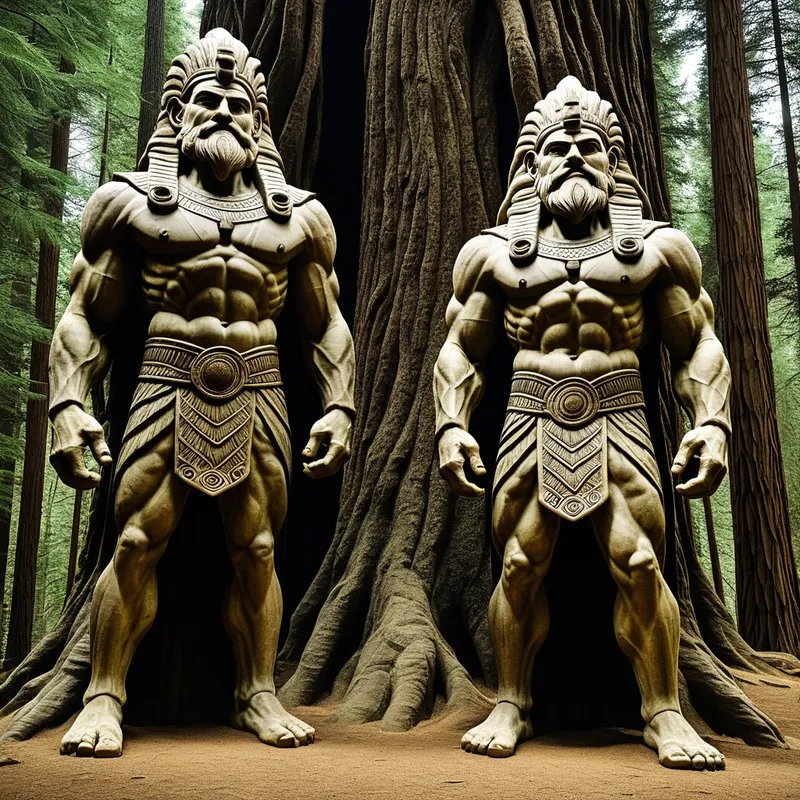
Gilgamesh and Enkidu - the arc Myth Meaning & Symbolism
A tyrannical king meets his wild mirror, forging a bond that conquers monsters but cannot defeat death, leading to a desperate search for eternal life.
The Tale of Gilgamesh and Enkidu - the arc
Hear now the tale of the king who was two-thirds god and one-third man, and how he learned to be human.
In the sun-baked city of Uruk, the walls groaned under the weight of a single man’s will. Gilgamesh, son of a goddess, ruled with the strength of a wild bull and the restlessness of a storm. He claimed the rights of a bridegroom with every new bride, and drove his young men to exhaustion in ceaseless contests. The people cried out to the gods, and the gods heard. They fashioned a counterweight to his unchecked power from the very clay of the earth. This was Enkidu, a creature of shaggy hair and uncanny strength, who ran with the gazelles and drank at the waterhole with the beasts.
A trapper, terrified by this wild man, brought a temple woman to the forest’s edge. For six days and seven nights, she taught Enkidu the ways of humanity. When he rose, the animals fled from him; he had gained understanding, but lost his innocence. She clothed him and brought him to the shepherds, where he learned to eat bread and drink ale. Meanwhile, in Uruk, Gilgamesh was troubled by dreams of a falling star and a mighty axe, dreams his divine mother interpreted as the coming of a mighty friend.
Enkidu, hearing of the king’s excesses, strode into Uruk as the people gathered for a festival. He blocked Gilgamesh’s path to the temple. They clashed in the street like battling bulls, shaking the very foundations of the city. Doors splintered, walls trembled. In their titanic struggle, they found not hatred, but recognition. Gilgamesh saw his own wild strength mirrored, and Enkidu saw a purpose for his newfound power. Their combat ended in embrace. A friendship was forged that was stronger than any metal.
Restless and seeking immortal fame, Gilgamesh proposed a quest to the distant Cedar Forest, to slay its demon guardian, Humbaba, and claim its timber. Enkidu, who knew the wilds, warned of the danger, but loyalty prevailed. Journeying across sun-scorched mountains, they encouraged each other through fear. In the eerie, silent forest, they faced Humbaba, whose face was a maze of entrails, whose roar was a flood. Together, they prevailed, and in a moment of ruthless triumph, Gilgamesh slew the monster despite Humbaba’s curses and pleas.
Returning in glory, Gilgamesh washed and donned his royal robes. The goddess Ishtar saw his beauty and offered herself to him. He spurned her, recounting the fates of her past lovers. Enraged, she summoned the Bull of Heaven to destroy Uruk. Again, the two friends stood together. Enkidu seized the bull by its tail, while Gilgamesh drove his blade between its neck and horns. They offered its heart to the sun god Shamash. But their defiance of the gods was complete.
That night, Enkidu dreamed a council of gods decreed that one of the two must die for their transgressions. He fell sick. For twelve days, Gilgamesh watched helplessly as the wild man who had become his brother wasted away, cursing the trapper and the temple woman who civilized him, then blessing them for bringing him to his friend. When Enkidu died, Gilgamesh’s world shattered. He let out a roar that shook the palace, a lament for the mighty companion who had made him whole. He refused to let the body be buried for seven days, until a maggot fell from Enkidu’s nose. Then, confronted with the utter reality of decay, Gilgamesh donned lion skins and fled his kingdom, consumed by a new, desperate quest: to conquer death itself.

Cultural Origins & Context
The Epic of Gilgamesh is humanity’s oldest surviving great work of literature, with origins stretching back to Sumerian poems of the third millennium BCE. These stories were consolidated into a more unified Akkadian epic around 2100 BCE. It was not the work of a single author, but a living, breathing tradition passed down by court scribes and reciters in the cuneiform script of ancient Mesopotamia—the land between the Tigris and Euphrates rivers.
Its societal function was multifaceted. On one level, it was a thrilling adventure story of kings and monsters. On another, it was a profound piece of theological and philosophical exploration for a culture deeply preoccupied with the relationship between humanity, the gods, and the underworld. It asked the questions that define civilization: What is the proper use of power? What is a good life? How does one face the inevitable fact of death? The epic served as both a mirror for rulers, warning against tyranny, and a solace for all people, giving poetic form to the universal grief of loss and the bitter acceptance of mortal limits.
Symbolic Architecture
At its heart, the myth is a profound map of the psyche’s development. Gilgamesh represents the conscious ego—civilized, powerful, but immature and tyrannical. Enkidu is the embodied shadow and the instinctual self, the raw, natural force that exists before socialization.
The meeting of Gilgamesh and Enkidu is the psyche’s first, necessary civil war, where the ego must grapple with its own untamed depth. Their friendship symbolizes the integration of the shadow, where raw instinct is not destroyed, but allied to conscious purpose.
The slaying of Humbaba and the Bull of Heaven represents the heroic ego’s triumph over monstrous, chaotic forces, both external and internal. Yet, this triumph contains its own hubris. The gods’ decree of Enkidu’s death is the inevitable consequence: the integrated, instinctual self (Enkidu) must be sacrificed for the conscious ego (Gilgamesh) to fully awaken to its mortal condition. Enkidu’s death is not a punishment, but a brutal initiation. It forces Gilgamesh out of the heroic project of conquest and into the human project of seeking meaning.

The Dreamer's Resonance
When this mythic pattern stirs in the modern dreamer, it signals a critical phase of psychological differentiation. To dream of a fierce, wild figure (an Enkidu) may indicate the emergence of long-repressed instincts, passions, or energies that feel alien yet powerfully compelling. The somatic feeling is often one of both fear and thrilling vitality.
Dreams of a mighty but arrogant ruler (a Gilgamesh) can reflect an over-identification with the persona—the social mask—that has become tyrannical, exhausting the dreamer with its demands for control and recognition. The climactic dream of losing this wild companion or brother signifies a profound, often painful, shift. The psyche is moving from a state of identified wholeness (the joyful partnership) into a state of conscious mourning and seeking. It is the dream equivalent of the "dark night of the soul," where the comforts of old identities and partnerships fall away, leaving the dreamer raw, alone, and compelled to ask the biggest questions about life, purpose, and impermanence.

Alchemical Translation
The arc of Gilgamesh and Enkidu is a perfect model for the alchemical process of individuation. It begins with the nigredo, the blackening: Gilgamesh’s tyrannical rule is the leaden, base state of the unexamined ego.
The creation and integration of Enkidu is the albedo, the whitening. The shadow is made conscious, purified through relationship, and brought into the light of the ego, creating a temporary, potentiated self. This is the "heroic" phase of life, where one feels capable of great deeds.
The death of Enkidu is the crucial rubedo, the reddening. It is not a failure, but the central, fiery ordeal. The integrated instinct (the friend) must die so that the ego can be stripped bare and humbled. The quest for immortality that follows is the soul’s necessary, if futile, protest against this loss.
Gilgamesh’s ultimate failure to secure physical immortality, and his return to Uruk to admire its enduring walls, represents the final stage. He returns to the same place, but as a transformed man. The treasure he sought was not the plant of youth, but wisdom. The alchemical gold he produces is not eternal life, but the acceptance of mortality and the commitment to a legacy within the bounds of time. The modern individual undergoing this transmutation moves from seeking to conquer the world, to integrating their inner wildness, to being shattered by loss, and finally, to finding meaning not in eternity, but in the mortal, human work of building, loving, and remembering within the walls of their own, finite life.
Associated Symbols
Explore related symbols from the CaleaDream lexicon: