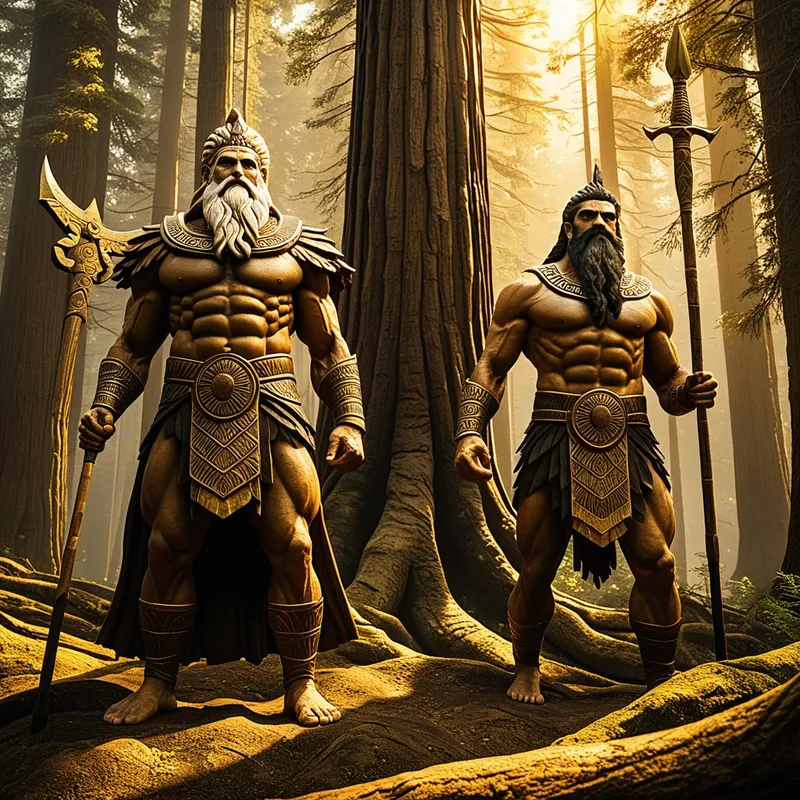
Gilgamesh and Enkidu from the Myth Meaning & Symbolism
A tyrannical king, a wild man created by the gods, and a deep friendship that challenges mortality and the nature of civilization itself.
The Tale of Gilgamesh and Enkidu
Hear the tale of the king who knew everything, and the one thing he could not know.
In the great, walled city of Uruk, the people cried out to the heavens. Their king, Gilgamesh, was a storm, two-thirds god and one-third man. His strength had no rival, but his heart knew no restraint. He claimed the right of first night with every bride, conscripted every young man into ceaseless labor on his walls and temples. The city groaned under his glorious, oppressive energy.
The gods heard the lament. Anu commanded the mother-goddess, Aruru, to fashion a match for Gilgamesh, a counterweight to his tyranny. She pinched off clay from the silent, primal steppe, and with spit and intent, she shaped Enkidu. He was a man, yet not a man—his body shaggy with hair, his mind knowing only the gazelle he ran with, the waterhole he drank from. He was the wilderness given form, a protector of beasts, unknowing of bread, beer, or the city’s ways.
A trapper, whose snares Enkidu destroyed, brought word of this wild creature to Uruk. Gilgamesh devised a plan: send Shamhat, whose arts were of civilization, to meet him. For seven days and nights, she lay with Enkidu, and in that joining, the wildness fled from him. The beasts ran from his new scent. He had gained understanding, but lost his home. Shamhat clothed him, gave him bread and beer, and spoke of Gilgamesh and his mighty dreams in Uruk.
Enkidu journeyed to the city, drawn by a fate he could not name. He arrived as Gilgamesh, in his arrogance, moved to claim another bride. Enkidu blocked the doorway to the bridal chamber. The two titans clashed in the street, a quake of muscle and will, shaking the very foundations of Uruk. Doors splintered, walls trembled. In the furious, equal struggle, something broke—not a bone, but a barrier in Gilgamesh’s soul. He saw his equal. The fight ended not in victory, but in recognition. They embraced, and a friendship was forged that was stronger than any weapon.
To seal this bond, Gilgamesh proposed a quest to slay Humbaba, the fearsome guardian of the distant Cedar Forest. Though Enkidu feared the omen, he would not let his friend go alone. They traveled to the forest, a place of ancient shadows and whispering terror. With the aid of the sun god Shamash, they confronted the monster. In the moment of victory, as Humbaba begged for mercy, Enkidu urged the killing blow, sealing their fate with the gods.
Returning in triumph, the goddess Ishtar desired Gilgamesh. He spurned her, recounting the grim fates of her past lovers. Enraged, she sent the Bull of Heaven to destroy Uruk. Together, the friends slew the bull, an act of ultimate defiance. But the gods convened in council. A price must be paid. Enkidu, who urged the killing of Humbaba and helped kill the bull, was marked. He fell ill, cursed by a divine decree.
For twelve days, Gilgamesh watched helplessly as his friend wasted away. Enkidu, in fever dreams, lamented the trapper and Shamhat who civilized him, for it led him to this bitter end. He died, and with his last breath, Gilgamesh’s world shattered. The king who knew everything was confronted with the one thing he did not know and could not conquer: the finality of death. He wept over the clay-cold body, refusing to bury it until a maggot fell from the nostril. His great wail echoed through Uruk, not of a king, but of a man utterly, devastatingly alone.
Cultural Origins & Context
This epic, the oldest surviving great work of literature, originates in ancient Mesopotamia, the cradle of civilization between the Tigris and Euphrates rivers. Its earliest Sumerian poems date back to the Third Dynasty of Ur (c. 2100 BCE), later compiled into a more unified Akkadian version in the 18th century BCE, famously preserved in the library of Ashurbanipal at Nineveh. It was not mere entertainment; it was a foundational text, recited by scribes and likely performed in ritual contexts. It served as a mirror for a society grappling with the very concepts it had invented: kingship, urbanization, and the existential gap between human ambition and natural law. The story of Gilgamesh asked the first cities: What is the cost of building walls? What do we gain and lose when we leave the wilderness? And what meaning can a life hold when it must end?
Symbolic Architecture
At its heart, the myth is a profound map of the psyche. Gilgamesh represents the archetypal Conscious Ego—driven, civilized, ambitious, but tyrannical in its one-sidedness. Enkidu is the embodied Shadow—the instinctual, natural, and repressed self. Their violent meeting is the necessary, often painful, confrontation between the ego and what it has excluded.
The friendship is the alchemical vessel where the raw material of the self is contained and transformed. One cannot integrate the shadow by ignoring it; one must wrestle with it, embrace it, and journey with it.
Enkidu’s civilization by Shamhat is not a fall, but a necessary awakening to consciousness, however painful. Their quest to the Cedar Forest—the realm of the unconscious—to slay Humbaba (the terrifying guardian of repressed contents) is classic heroic and psychological work. The tragedy is that integrating the shadow (Enkidu) changes the ego (Gilgamesh) forever, and part of that change is the agonizing awareness of mortality that the natural self always knew. Enkidu’s death is the death of Gilgamesh’s innocence and invincibility, the shattering of the heroic persona, which forces the quest for meaning onto a deeper, spiritual plane.
The Dreamer’s Resonance
When this myth stirs in the modern dreamer, it often signals a critical phase of individuation. Dreaming of a powerful, antagonistic wild figure may point to a neglected instinctual or passionate side of the self demanding recognition. Dreams of a profound, soul-deep friendship with someone utterly different from oneself can symbolize the psyche’s attempt to forge a union between conscious attitudes and unconscious potentials.
The somatic feeling is often one of immense tension—the grinding struggle before the embrace—followed by either the exhilarating energy of a shared purpose or the devastating grief of a loss that feels like losing a part of one’s own body. This grief, in the dream state, is not about an external person, but the painful realization that an inner companion, a way of being, must die for growth to continue. It is the psyche preparing the dreamer for a necessary, if sorrowful, transformation.

Alchemical Translation
The epic models the full arc of psychic transmutation. The nigredo, or blackening, is Gilgamesh’s tyrannical rule and Enkidu’s initial wild state—chaos and unrefined matter. Their clash is the separatio, the distinguishing of elements (conscious vs. unconscious). Their friendship is the coniunctio, the sacred marriage of opposites within the soul, which produces the energy for the great work (the quest).
The slaying of Humbaba and the Bull of Heaven represents the necessary mortificatio—the killing of old, inflated identifications (the invincible hero, the pure natural man) to make way for new consciousness.
Enkidu’s death is the ultimate putrefactio, a rotting away of the former psychic structure. Gilgamesh’s subsequent wanderings, his search for Utnapishtim and the plant of immortality, is the albedo (whitening)—a lonely, spiritual pilgrimage for meaning. His final failure to secure immortality and his return to Uruk, now valuing his city’s walls not as a monument to his ego but as a legacy for his people, signifies the rubedo (reddening). He returns, not as a god-king, but as a wise, mortal ruler. The gold produced is not eternal life, but meaningful mortality—the acceptance of limits, and the realization that true immortality lies in what one builds in community and in the story that outlives the self. The wild man and the king are both gone, but the integrated human remains.
Associated Symbols
Explore related symbols from the CaleaDream lexicon: