Gilgamesh and Enkidu
The epic tale of a powerful king and a wild man whose profound friendship challenges gods, explores mortality, and defines ancient heroism.
The Tale of Gilgamesh and Enkidu
In the sun-baked city of Uruk, a king ruled with a force that was both magnificent and terrible. [Gilgamesh](/myths/gilgamesh “Myth from Mesopotamian culture.”/), two-thirds divine and one-third mortal, was a storm of restless energy. He was the builder of towering walls, yet he exhausted his people, claiming the right of first night with every bride and driving young men into ceaseless contests of strength. The city groaned under his boundless vitality. Their lamentations rose to the heavens, and the gods, hearing the clamor, devised a remedy. They would create a counterweight, a mirror to reflect the king’s own wild nature back at him.
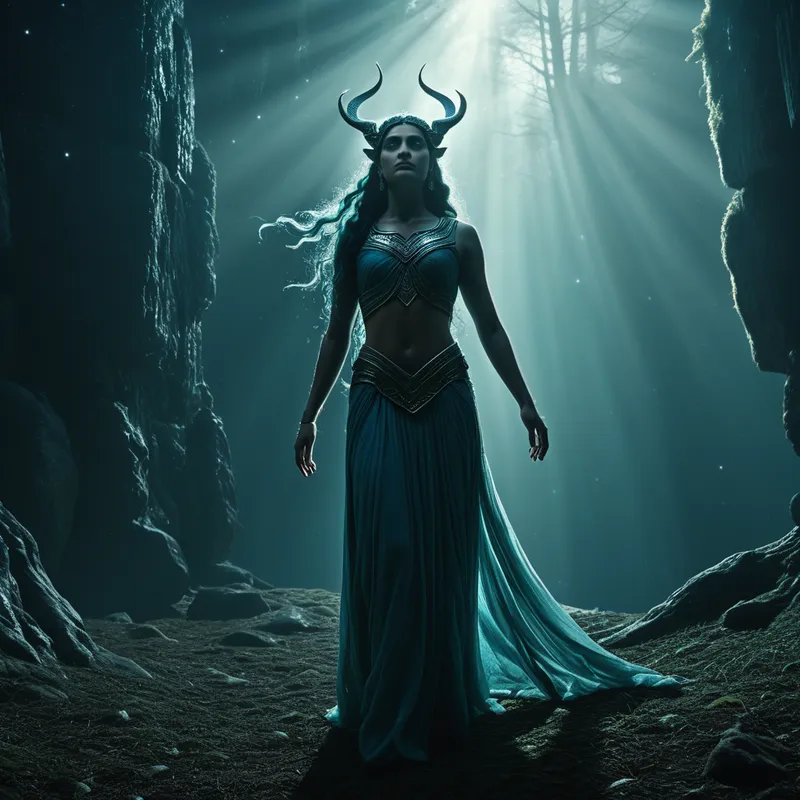
From the silent clay of the steppe, the goddess Aruru fashioned [Enkidu](/myths/enkidu “Myth from Sumerian culture.”/). He was a creature of raw, untamed earth: his body shaggy with hair, his mind knowing only the company of gazelles at the waterhole. He was strength in its primal form, a guardian of the wild who freed animals from the trapper’s snare. When news of this wild man reached Uruk, a plan was formed. A temple woman, Shamhat, was sent to meet him. For seven days and nights, she initiated Enkidu into [the world](/myths/the-world “Myth from Tarot culture.”/) of humanity—not just through intimacy, but through shared bread and wine. This sacred communion severed his bond with the beasts; they fled from him, for he now possessed knowing. He was civilized, yet his strength remained undiminished, a force now directed by a nascent human heart.
Enkidu, learning of Gilgamesh’s oppressive ways, journeyed to Uruk. He arrived as the king was about to assert his privilege in a bridal house. Blocking the doorway, Enkidu became the embodied conscience of the people. The two titans clashed in a battle that shook the city’s foundations. They fought with the fury of opposing storms, but in the shattering of their strength, something else was forged. Gilgamesh, who had never met his equal, found a reflection that did not break. Enkidu, who had known only the solitude of the wild, found a purpose. Their combat dissolved into embrace. They had tested each other to the core and discovered not an enemy, but a companion for the soul.
This newfound friendship demanded a shared quest. They set their sights on the distant Cedar Forest, guarded by the monstrous demigod [Humbaba](/myths/humbaba “Myth from Mesopotamian culture.”/). This was no mere adventure; it was a deliberate assault on the sacred, forbidden realm of the gods. With the sun god Shamash’s aid, they triumphed, felling the sacred cedars and slaying Humbaba. In victory, they claimed the forest’s majesty for the city, but also its curse. The goddess [Ishtar](/myths/ishtar “Myth from Babylonian culture.”/), witnessing Gilgamesh’s glory, offered herself to him. He spurned her with a litany of her past lovers’ tragic fates. Humiliated, she summoned [the Bull of Heaven](/myths/the-bull-of-heaven “Myth from Babylonian culture.”/) to ravage Uruk. Once more, the friends stood together, slaying the celestial beast and casting its haunch in the goddess’s face. Their defiance was complete. They had mastered the wild, insulted the divine, and stood triumphant.
But the axis of the world had been tilted. The council of gods decreed that one of the pair must die for their transgressions. The lot fell upon Enkidu. Stricken with a wasting sickness, the wild man turned from the sun, cursing the trapper and [the temple](/myths/the-temple “Myth from Jewish culture.”/) woman who had drawn him from his innocence. In a vision, the sun god counseled him to bless them instead, for they had given him the greatest gift: the friendship of Gilgamesh. Enkidu’s fury turned to a profound, aching sorrow. He described a terrifying dream of the Netherworld, a house where inhabitants wore feathers of dust. After twelve days of agony, his vibrant spirit fled.
Gilgamesh’s world shattered. He wept over the body of his friend for seven days, refusing burial until a maggot fell from the corpse. His lament was a raw hymn of grief: “My friend, whom I loved deeply, who went with me through every hardship, Enkidu, my friend, whom I loved deeply, has turned to clay.” The [death](/myths/death “Myth from Tarot culture.”/) of Enkidu was the death of Gilgamesh’s own untouchable self. For the first time, the king who was two-thirds god felt the cold, absolute touch of his one-third humanity. The terror of mortality, now intimate and personal, ignited a new, desperate quest: to flee death itself.
Cultural Origins & Context
[The Epic of Gilgamesh](/myths/the-epic-of-gilgamesh “Myth from Mesopotamian culture.”/) is humanity’s oldest surviving epic narrative, inscribed on Sumerian Tablets over four millennia ago. It emerged from the fertile crescent of Mesopotamia, the very cradle where humanity first experimented with the Civilization Model. The tale is not a simple legend but a foundational meditation from the dawn of history. Gilgamesh himself was likely a historical king of Uruk from the Early Dynastic period, whose legend was amplified and mythologized over centuries.
The epic’s themes are inextricably linked to the Sumerian worldview. Their [pantheon](/myths/pantheon “Myth from Roman culture.”/) of anthropomorphic gods was deeply involved in human affairs, yet capricious and dangerous. The story explores the tension inherent in the newly forged urban life—the glory and arrogance of building walls and defining laws (the domain of Gilgamesh) against the lost innocence and raw power of the natural world (the original state of Enkidu). It is a story born from a culture acutely aware of its own constructedness, asking the primordial questions that civilization forces to the surface: What is lost when we leave the wild? What is the price of order and fame? And above all, how does a conscious being live with the knowledge of inevitable death?
Symbolic Architecture
The [friendship](/symbols/friendship “Symbol: A bond characterized by mutual affection and support, representing an essential aspect of human social interaction.”/) between Gilgamesh and Enkidu is the central pillar of the epic’s symbolic [structure](/symbols/structure “Symbol: Structure in dreams often symbolizes stability, organization, and the framework of one’s life, reflecting how one perceives their environment and personal life.”/). They are not merely allies, but two halves of a complete [human](/symbols/human “Symbol: The symbol of a human represents individuality, complexity of emotions, and social relationships.”/) being. Gilgamesh represents the civilized: intellect, ambition, cultural order, and the restless drive to leave a [legacy](/symbols/legacy “Symbol: What one leaves behind for future generations, encompassing values, achievements, possessions, and memory.”/) against [the void](/myths/the-void “Myth from Buddhist culture.”/). Enkidu embodies the natural: instinct, bodily [strength](/symbols/strength “Symbol: ‘Strength’ symbolizes resilience, courage, and the ability to overcome challenges.”/), [empathy](/symbols/empathy “Symbol: The capacity to understand and share the feelings of others, often manifesting as emotional resonance or intuitive connection in dreams.”/) with the animal world, and a [life](/symbols/life “Symbol: The symbol of ‘Life’ represents a journey of growth, interconnectedness, and existential meaning, encompassing both the joys and challenges that define human experience.”/) lived in [harmony](/symbols/harmony “Symbol: A state of balance, agreement, and pleasing combination of elements, often associated with musical consonance and visual or social unity.”/) with, not domination over, the environment. Their clash and union symbolize the necessary but painful [integration](/symbols/integration “Symbol: The process of unifying disparate parts of the self or experience into a cohesive whole, often representing psychological wholeness or resolution of internal conflict.”/) of these poles within the individual and society.
Enkidu’s civilizing by Shamhat is not a fall from grace, but a painful awakening into consciousness. He gains knowledge and self-awareness, but loses his unconscious unity with nature. This is the primordial cost of becoming human.
The [Cedar](/symbols/cedar “Symbol: Aromatic wood symbolizing purification, protection, and sacred connection, often associated with spiritual cleansing and enduring strength.”/) [Forest](/symbols/forest “Symbol: The forest symbolizes a complex domain of the unconscious mind, representing both mystery and potential for personal growth.”/) is more than a physical [location](/symbols/location “Symbol: The symbol of ‘Location’ signifies a sense of place, context, and the environment in which experiences unfold.”/); it is the psychological [realm](/symbols/realm “Symbol: The symbol of ‘Realm’ often signifies the boundaries of one’s consciousness, experiences, or emotional states, suggesting aspects of reality that are either explored or ignored.”/) of the untamed and numinous, the sacred [chaos](/symbols/chaos “Symbol: In Arts & Music, chaos represents raw creative potential, uncontrolled expression, and the breakdown of order to forge new artistic forms.”/) that civilization must both confront and draw resources from. Humbaba is its fierce [guardian](/symbols/guardian “Symbol: A protector figure representing safety, authority, and guidance, often embodying parental, societal, or spiritual oversight.”/), the [terror](/symbols/terror “Symbol: An overwhelming, primal fear that paralyzes and signals extreme threat, often linked to survival instincts or deep psychological trauma.”/) that must be faced to access one’s own inner [depth](/symbols/depth “Symbol: Represents profound layers of consciousness, hidden truths, or the unknown aspects of existence, often symbolizing introspection and existential exploration.”/) and power. Their [journey](/symbols/journey “Symbol: A journey in dreams typically signifies adventure, growth, or a significant life transition.”/) there is the [hero](/symbols/hero “Symbol: A hero embodies strength, courage, and the ability to overcome significant challenges.”/)’s first foray beyond the known world of [the ego](/myths/the-ego “Myth from Jungian culture.”/).
The most profound symbolic turn is Enkidu’s [death](/symbols/death “Symbol: Symbolizes transformation, endings, and new beginnings; often associated with fear of the unknown.”/). He, the companion, becomes the sacrifice. His death is the catalyst that transforms Gilgamesh’s [quest](/symbols/quest “Symbol: A quest symbolizes a journey or search for purpose, fulfillment, or knowledge, often representing life’s challenges and adventures.”/) from one of external glory to an internal, spiritual journey. The wild man dies so that the [king](/symbols/king “Symbol: A symbol of ultimate authority, leadership, and societal order, often representing the dreamer’s inner power or external control figures.”/) can be born into a true, if sorrowful, humanity.
The Dreamer’s Resonance
To dream of Gilgamesh and Enkidu is to dream of the fundamental partnerships within the [psyche](/myths/psyche “Myth from Greek culture.”/). It speaks to the encounter with one’s shadow—the untamed, instinctual self (Enkidu) that initially appears as an obstacle or rival, but whose integration leads to wholeness and immense power. The dream may highlight a current “battle at the gate,” where a raw, authentic part of [the self](/myths/the-self “Myth from Jungian culture.”/) is challenging a tyrannical, over-civilized [persona](/myths/persona “Myth from Greek culture.”/) (the Gilgamesh who oppresses his city).
The devastating grief of Gilgamesh resonates with any profound experience of loss that shatters our sense of immortality. It is the moment when an abstract knowledge of death becomes a visceral, personal reality, initiating a “[dark night of the soul](/myths/dark-night-of-the-soul “Myth from Christian culture.”/).” The subsequent frantic quest—often manifesting in dreams as an endless journey, searching for a hidden cure or answer—mirrors our own attempts to outrun despair, to find meaning after a foundational pillar of our world has crumbled. The myth assures us that this agonizing journey, though it may not grant eternal life, grants something perhaps more valuable: wisdom, and the capacity to return to one’s life and duties with sober compassion.

Alchemical Translation
The epic narrates the alchemy of the soul. The initial state is one of separation: Gilgamesh (spirit, order) and Enkidu (matter, [chaos](/myths/chaos “Myth from Greek culture.”/)) exist in opposition, each incomplete and causing distress. Their violent confrontation is the [nigredo](/myths/nigredo “Myth from Alchemical culture.”/), the blackening, the necessary dissolution of old forms. From this clash emerges the conjunctio, [the sacred marriage](/myths/the-sacred-marriage “Myth from Various culture.”/) of opposites, symbolized by their deep friendship. This united entity then undertakes [the great work](/myths/the-great-work “Myth from Alchemical culture.”/)—slaying the guardians of the unconscious (Humbaba, the Bull)—a stage of inflation and heroic defiance.
The death of Enkidu is the crucial mortificatio, the killing of the prized substance. The beloved partner, the instinctual body, must die so that the spirit can be humbled and purified. Gilgamesh’s putrefaction in grief is the fertilizer for transformation.
His journey to find [Utnapishtim](/myths/utnapishtim “Myth from Mesopotamian culture.”/) is the [albedo](/myths/albedo “Myth from Alchemical culture.”/), the whitening, a lonely pilgrimage of purification through trials (the passage under the mountain, the garden of jewels). The final realization—that immortality is a stolen plant easily lost—is the [rubedo](/myths/rubedo “Myth from Alchemical culture.”/), the reddening. It is not a triumphant gold of eternal life, but the sober, crimson wisdom of mortality. The king returns to Uruk, to his walls, not as a god, but as a man who has seen the deep and now values the mortal city, the mortal life, the mortal work. The circle is complete; [the opus](/myths/the-opus “Myth from Alchemical culture.”/) is the wisdom etched in clay, not in everlasting flesh.
Associated Symbols
Explore related symbols from the CaleaDream lexicon:
- Friendship — The alchemical vessel within which the raw materials of the self—civilization and wildness—are combined, dissolved, and reconstituted into a more complete being.
- Mortality — The inescapable horizon of human existence, whose cold touch is the ultimate teacher, transforming restless glory-seeking into the search for authentic meaning.
- Civilization Model — The constructed world of walls, laws, and legacy that defines humanity against nature, yet whose pressures create the very inner conflicts the myth explores.
- Forest — The primal, untamed realm of the psyche, home to both vital resources and terrifying guardians, which must be entered and confronted for growth.
- Journey — The fundamental movement of the soul from ignorance through experience to wisdom, often propelled by loss and characterized by trials of endurance and insight.
- Grief — The transformative fire that burns away the illusion of self-sufficiency and immortality, creating the fertile ground from which wisdom can grow.
- Shadow — The instinctual, untamed aspect of the personality, initially perceived as a threat or rival, whose integration is essential for wholeness and true power.
- Dream — Both a literal narrative device for prophecy and warning in the epic, and a metaphor for the inner, symbolic landscape where the soul’s truths are revealed.
- River — A boundary between states of being; it is at the watering hole that Enkidu is civilized, and across the Waters of Death that Gilgamesh seeks immortality.
- Snake — The cunning, earthly creature that steals the plant of rejuvenation, symbolizing the inevitable, cyclical nature of life and loss that defeats linear human ambition.
- Clay — The primal substance from which Enkidu is fashioned and to which all mortals return, representing the humble, earthly origin and destiny of humanity.
- Sumerian Tablet — The physical medium of the story, symbolizing the human attempt to etch transient experience and hard-won wisdom into a lasting, if fragile, record.