Gilgamesh Myth Meaning & Symbolism
A tyrannical king, transformed by friendship and loss, embarks on a futile quest for eternal life, only to find wisdom in accepting mortality.
The Tale of Gilgamesh
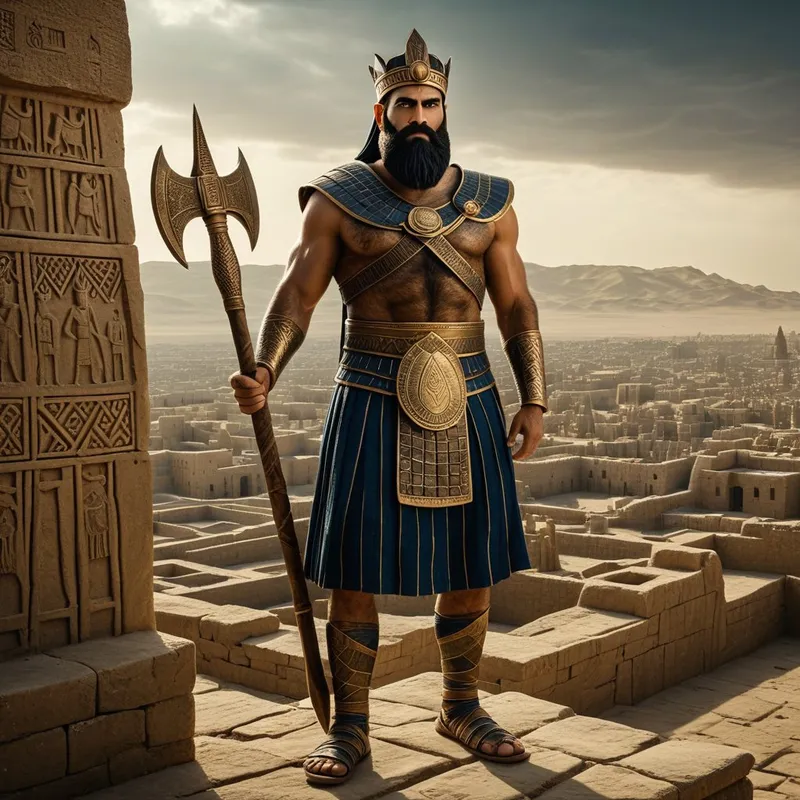
Hear the tale of the king who was two-thirds god and one-third man, and in that fraction of clay found all his torment and his glory. In the sun-baked city of Uruk, the walls groaned under the weight of a king’s restless spirit. Gilgamesh, son of a goddess and a mortal king, was a storm in human form. His strength had no rival; his energy was a flood that breached the dams of decency. By day, he drove his warriors to exhaustion. By night, he claimed the right of the first night with every bride, leaving the city’s fathers weeping and its new husbands hollow with shame. The people’s cries rose like smoke to the ears of the gods.
In the green wild, the gods fashioned an answer from clay and spit: Enkidu. Hair covered his body like a pelt; he knew no language but that of the gazelle and the lion. He was the untouched earth, the unbounded wilderness. A trapper, terrified by this creature who freed animals from his snares, brought a temple woman, Shamhat, to the watering hole. For seven days and nights, she taught Enkidu the ways of civilization. When he rose, the beasts fled from his new scent. He was now aware, and his awareness was a loneliness that drew him to Uruk, to challenge the source of the disturbance he felt in the world’s order.
They met in the city’s broad way, a collision of two cosmic forces. Gilgamesh, the polished, oppressive order; Enkidu, the raw, untamed chaos. They fought like bulls, shaking the very foundations of the gate. Walls trembled, dust clouds rose, and in the shattering of a doorframe, something else broke: Gilgamesh’s isolation. He looked into the eyes of his equal and found not a rival, but a reflection. Their rage turned to laughter, their grips to embraces. The wild man had tamed the tyrant.
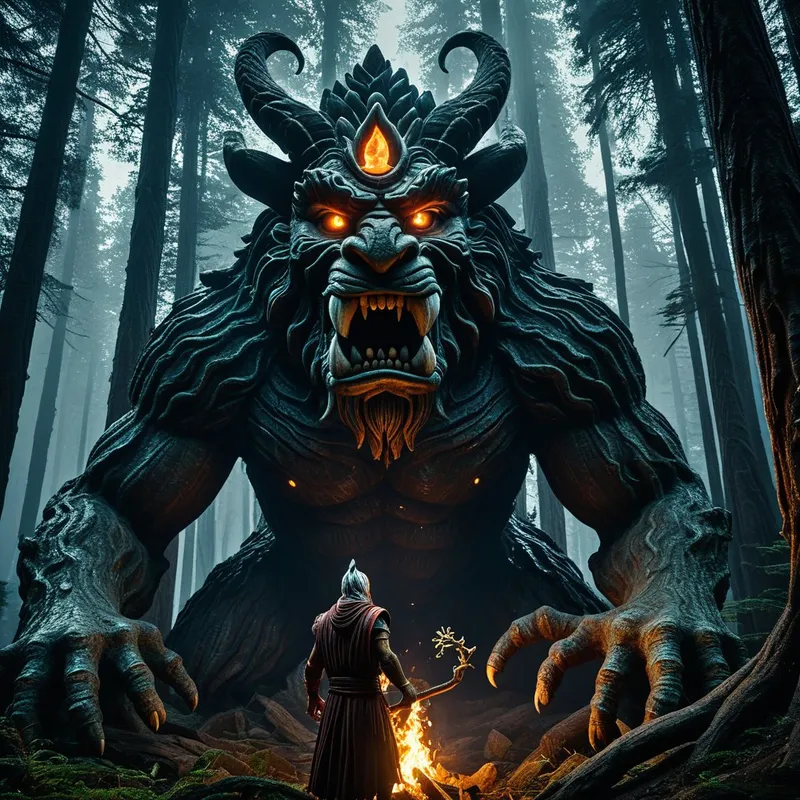
Seeking immortal fame to fill their boundless vigor, they journeyed to the distant Cedar Forest. They faced the guardian, Humbaba, whose face was a knot of entrails, whose roar was a furnace blast. Together, they prevailed, felling the sacred cedars. But in their triumph, they incurred divine wrath. The gods decreed one must die for the slaying of Humbaba and the insult to the Bull of Heaven sent by the goddess Ishtar. Enkidu, the man of clay, was chosen. He fell to a wasting sickness, cursing his fate before dying in his friend’s arms.
Gilgamesh’s howl of grief echoed through the cosmos. He roamed the wilds, clad in lion skins, his heart a cavern of terror. The death of his brother had shown him his own mortal fraction. He would not accept it. He embarked on a desperate quest, crossing the Waters of Death, to find Utnapishtim, the one man granted eternal life. At the world’s edge, the ancient flood survivor told him of a secret: a plant at the bottom of the sea that restores youth. Gilgamesh dove, retrieved the thorny prize, and began his journey home, hope flickering anew. But while he bathed in a pool, a serpent slithered from the water and stole the plant, shedding its skin as it vanished. Gilgamesh sat on the shore and wept. He returned to Uruk, not with immortality, but with a story. He showed the ferryman the mighty walls he had built, the enduring work of his hands. “Look at it now,” he said, “the city, the foundation, the brickwork. Is it not magnificent?” The quest ended where it began, but the king who looked upon his walls was not the same man who had left them.
Cultural Origins & Context
The Epic of Gilgamesh is not a single book, but a living river of stories that flowed through Mesopotamia for nearly two millennia. Its earliest fragments, in Sumerian, date to the Third Dynasty of Ur (c. 2100 BCE), telling discrete tales of the king of Uruk. These stories were woven into a unified Akkadian epic, most completely preserved on twelve clay tablets from the library of the Assyrian king Ashurbanipal at Nineveh.
It was recited, not read, performed by skilled narrators for royal courts and public festivals. Its function was multifaceted: it was a foundational literary text, a repository of wisdom, and a meditation on kingship. It asked what it meant to be a good ruler, exploring the transition from a tyrant who consumes his people to a wise king who builds for them. It served as a cultural anchor, connecting later empires to the deep Sumerian past, and provided a narrative framework for contemplating humanity’s greatest, unanswerable questions—the nature of death, the limits of power, and the legacy of community.
Symbolic Architecture
At its core, the epic is a profound map of the psyche’s confrontation with the Shadow and the Self. Gilgamesh begins as a fragmented ruler, all conscious ego and divine inflation, utterly disconnected from his human, instinctual base. Enkidu is that base—the embodied, uncivilized Shadow.
The meeting of Gilgamesh and Enkidu is the sacred marriage of consciousness and the unconscious, the moment the ego recognizes its missing half not as an enemy to be destroyed, but as a brother to be integrated.
Their friendship symbolizes the heroic ego’s necessary and transformative engagement with the Shadow. Only through this union can they achieve great deeds (slaying Humbaba, the Bull of Heaven). Humbaba itself represents the terrifying, primal guardians of the deeper unconscious, the resistance one must face to access the “cedar forest” of inner resources and psychic timber needed to build a conscious life.
Enkidu’s death is the pivotal trauma. It represents the inevitable dissolution of the initial, heroic identification with the Shadow. The integrated instinct cannot remain a companion; it must die as a separate entity and be absorbed. This loss forces the ego (Gilgamesh) out of its heroic inflation and into the desert of the soul—the quest for meaning beyond physicality. Utnapishtim represents the archetypal Wise Old Man, the symbolic Self, who imparts the ultimate, bitter wisdom: life is given, not taken. The stolen plant of rejuvenation, taken by the serpent, is the final, cruel symbol. The serpent, an ancient emblem of cyclical life, death, and rebirth, claims the prize of linear immortality. The message is alchemical: true renewal is not the avoidance of death, but the transformation through the acceptance of it.
The Dreamer's Resonance
When this myth stirs in the modern psyche, it often manifests in dreams of profound partnership followed by catastrophic loss. One may dream of a powerful, wild companion—a beast, a mysterious stranger, or a twin—with whom they accomplish impossible tasks, only to see this figure vanish, die, or turn against them. The somatic experience is one of exhilarating strength dissolving into a hollow, gut-wrenching emptiness.
Psychologically, this signals the end of a phase of identification with a powerful, often unconscious, complex. Perhaps you’ve been fueled by a fierce, untamed ambition (Enkidu’s raw power) in partnership with your conscious will (Gilgamesh). The “death” in the dream indicates that this mode has served its purpose and must now be internalized. The subsequent dream imagery—wandering through wastelands, searching for an impossible cure, confronting vast waters—maps the depressive, disoriented, yet necessary stage of grieving that old identity. The dreamer is in the liminal space between who they were with that energy and who they must become without it as a separate crutch.

Alchemical Translation
The alchemy of Gilgamesh is the transmutation of the lead of mortal terror into the gold of conscious, meaningful existence. The process follows the Nigredo, Albedo, Rubedo.
The Nigredo is the initial state: the tyrannical, restless ego, black with isolation and inflation. The Coniunctio (sacred marriage) with Enkidu begins the work. The Mortificatio (putrefaction) is Enkidu’s death—the crushing, black despair that dissolves the old heroic self. Gilgamesh’s journey through the wilderness is the Albedo, the whitening, where in the barren landscape, the quest is purified of its literal goal (immortality) and reveals its true object: wisdom.
The serpent does not steal immortality; it performs the final alchemical operation. It takes the literal, ego-driven desire and, by consuming it, forces the transformation of that desire into a symbolic understanding.
The Rubedo, the reddening or completion, is not a triumphant return with an elixir. It is Gilgamesh’s weary return to Uruk. He points to the walls. The work of the soul, the “city” of the integrated psyche, is not an eternal life for the ego, but an enduring creation in time. The immortality he finds is in the story itself, in the legacy of consciousness passed down. For the modern individual, the epic models the journey from inflation to deflation to grounded realization. Our “Uruk” is the conscious life we build—our relationships, our work, our art—knowing it is bounded by time. Our immortality is in the quality of our brickwork, the story we inscribe on the clay tablets of our days, and the wisdom we leave echoing in the walls for those who come after. The quest ends not with an answer, but with a different, more profound question: not “How do I live forever?” but “How shall I live, now that I know I will not?”
Associated Symbols
Explore related symbols from the CaleaDream lexicon: