Gereltei the Radiant One Myth Meaning & Symbolism
A celestial being of pure light descends into a world of primal darkness, initiating a cosmic struggle that births the sun, moon, and stars.
The Tale of Gereltei the Radiant One
In the time before time, when the world was not a world but a churning, formless dream in the mind of the eternal Tengri, there was only the Khaos. It was a deep, hungry dark, a silence so profound it had weight and texture—a cold, wet blanket over nothingness. There was no up or down, no life, no death. Only potential, asleep and dreaming of itself.
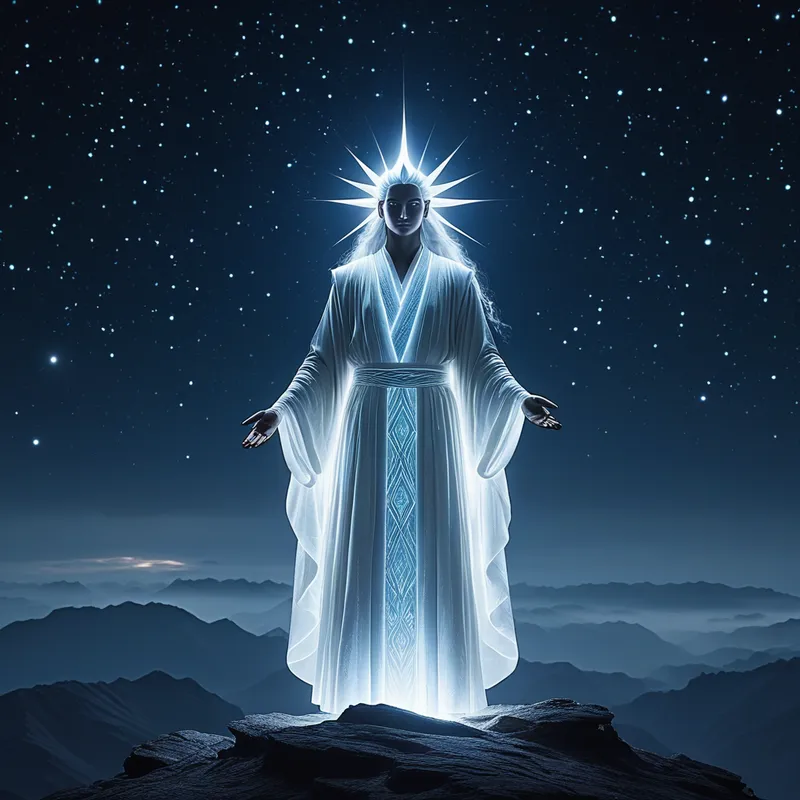
And from the highest vault of this potential, a thought crystallized. It was a point of pure, agonizing awareness. This was Gereltei. They were not born; they were recognized. A singular consciousness of luminous self-knowing, existing as a sphere of perfect, white radiance. For eternities, Gereltei simply was, a solitary witness to the dark. But within the light, a question formed, and the question was a longing: "What lies beyond my own illumination?"
Driven by this sacred curiosity, Gereltei began to descend. They fell not through space, for there was none, but through layers of dreaming substance. The closer they came to the heart of the Khaos, the heavier the darkness became. It was no longer passive; it was a sentient, viscous tide that pushed back against the light, whispering with the voices of unborn things. It feared the definition, the shape, that light would bring.
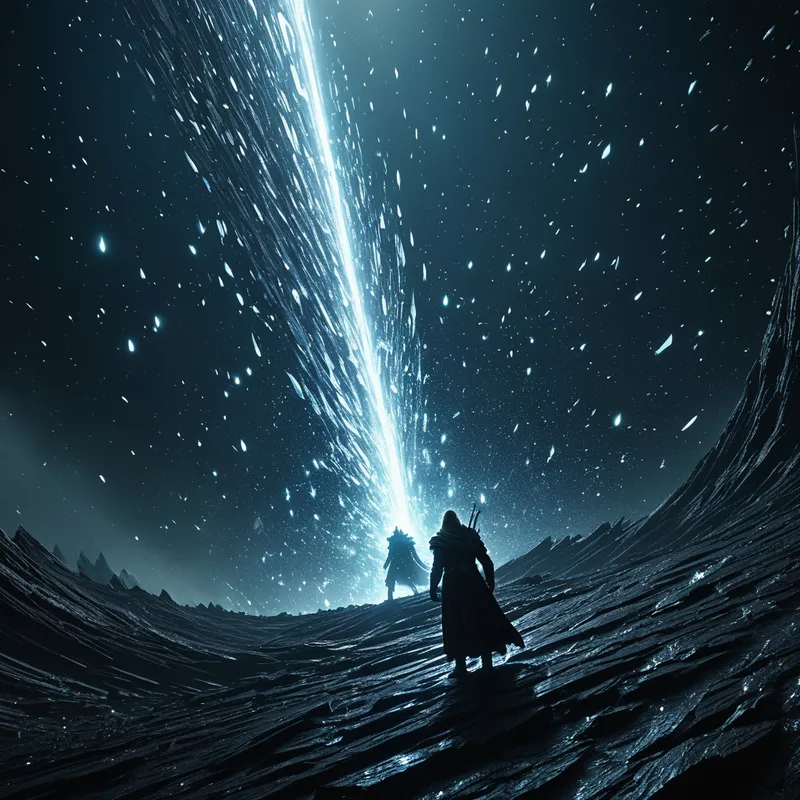
The descent became a battle. Gereltei’s radiance, which in the high void had been effortless, now required terrible will to maintain. The dark coiled around them like a great serpent, its cold scales leaching the warmth from the light. Gereltei did not fight with violence, but with persistence. Each step forward was a act of creation, pushing back the formless with the sheer fact of their presence. Where their light touched, the dark recoiled, and in recoiling, it gained a edge, a contrast. For the first time, there was difference.
Finally, Gereltei reached the very core—a dense, swirling maelstrom of primal matter, the womb of the world. Here, the resistance was absolute. The darkness converged, a multitude of shadowy tendrils grasping, pulling, seeking to extinguish the source of this painful clarity. In a final, cataclysmic embrace, the dark consumed the light.
But to consume light is to be transformed by it.
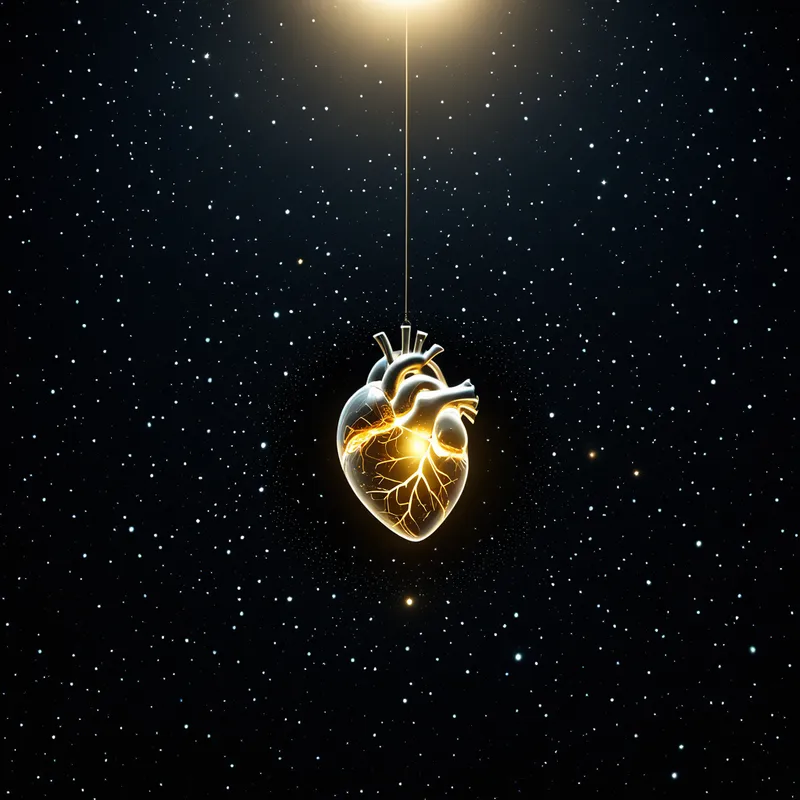
Gereltei did not die. They shattered. Their singular, perfect radiance exploded into a billion fragments. The largest piece, burning with defiant courage, soared upward and anchored itself in the high void, becoming the Sun, the eternal eye of day. A cooler, reflective shard, imbued with the memory of the struggle, became the Moon, the watcher of the night. Countless tiny sparks, each carrying a sliver of Gereltei’s original curiosity, scattered across the black velvet, becoming the Stars.
The dark, now pierced and patterned by these eternal lights, was forever changed. It became the Sky, a defined dome. The agitated primal matter below, stirred by the explosion, began to settle. The heaviest parts became the Earth, the steppes and mountains. The lighter waters became rivers and seas. And from the place where Gereltei’s core had dissolved, mingling their essence with the substance of the dark, the first life stirred—a green shoot, reaching for the new sun.
Order was born from the sacrifice of unity. The cosmos, with its cycles and distances, began its great, slow dance. And it is said that on the clearest nights, if you listen with your soul and not your ears, you can hear the stars humming the last, lingering note of Gereltei’s original, solitary song.
Cultural Origins & Context
The fragments of Gereltei’s story are woven into the ancient fabric of Tengrism and pre-Buddhist Mongolian cosmology. It is not a single, codified epic like those of sedentary civilizations, but a migratory myth. It was carried on the wind-swept steppes, told not by scribes in temples but by shamans (Böö) and storytellers around the hearth-fire in the ger.
Its primary function was ontological—it explained the why of the world's fundamental structure. For a nomadic people living directly under the immense, domed sky, the origin of the sun, moon, and stars was not an abstract curiosity but a daily, visceral reality. The myth provided a sacred map of the cosmos, explaining the eternal tension between light and dark, not as a moral battle of good versus evil, but as a necessary, creative struggle. The darkness is not vilified; it is the necessary raw material, the maternal chaos from which the paternal light brings forth form. This reflects the Mongolian worldview’s deep balance between masculine and feminine, active and receptive principles.
The story also served a societal function, modeling the ideal of the heroic individual. Gereltei’s journey is one of voluntary descent into chaos for the sake of a greater order—a metaphor for the chieftain or warrior who faces the chaos of battle or the harshness of winter to ensure the survival and structure of the clan. The myth legitimized struggle and sacrifice as cosmically meaningful acts.
Symbolic Architecture
At its heart, the myth of Gereltei is a profound allegory for the birth of consciousness itself. Gereltei represents the initial spark of self-aware ego emerging from the undifferentiated unity of the unconscious.
The first light is not a weapon against the dark; it is the faculty that allows the dark to be perceived. Consciousness does not destroy the unconscious; it enters into a creative, and often painful, relationship with it.
Gereltei’s state of perfect, solitary radiance in the high void symbolizes a potential consciousness that has not yet engaged with the world—pure spirit, untested and unrealized. The descent is the inevitable journey of incarnation, of spirit taking on the burden of existence. The resisting, sentient darkness is the personal and collective unconscious, which contains all latent life, memory, and instinct. It instinctively resists the clarifying, defining power of the conscious mind, which seeks to name, categorize, and control.
The climactic shattering is the critical symbolic moment. It signifies the end of psychic inflation—the illusion of a perfect, unified, and omnipotent ego. The conscious mind cannot simply impose its will on the unconscious without being utterly transformed in the process. The "death" of the singular Gereltei is the birth of a complex psyche. The sun becomes the continuing, guiding principle of consciousness (the ego). The moon becomes the reflective, intuitive function that illuminates the dark, inner world (the personal unconscious). The stars represent the fragmented but connected aspects of the self and the ancestral, cultural patterns (the collective unconscious) that now populate the inner sky.

The Dreamer's Resonance
When this mythic pattern stirs in the modern dreamer, it often heralds a profound confrontation with one's own inner Khaos. One might dream of being a source of light in an overwhelming darkness, feeling the light dim under pressure. Or, more abstractly, dream of catastrophic fragmentation—a precious object shattering, a body breaking apart, or a star exploding.
Somatically, this can feel like a crisis of integrity. The dreamer may experience a sense of being "pulled apart" by conflicting demands, a loss of core identity, or the terrifying dissolution of long-held beliefs. This is the ego’s experience of Gereltei’s struggle. The darkness in the dream is not necessarily "evil"; it is the un-lived life, the repressed emotion, the ignored instinct, or the vast, unknown potential within that demands recognition. The dream is initiating a necessary disintegration.
The psychological process at work is the breakdown of a too-rigid or inflated conscious attitude. The psyche is forcing a descent into material that has been kept in shadow. The feeling of being consumed or shattered, while terrifying, is the precondition for a new, more adaptive, and more complex psychic order to be born. The dreamer is not being destroyed; they are being prepared to become a cosmos.
Alchemical Translation
The myth of Gereltei is a perfect map of the alchemical nigredo and albedo, applied to the soul. The journey of individuation requires this exact sequence: the voluntary descent into the primal matter of the psyche (the prima materia), the confrontation and engagement with it, the apparent destruction of the old, simple self, and the subsequent reorganization into a more luminous, differentiated whole.
Individuation is not about becoming a brighter, singular light. It is about consenting to be shattered, so that your essence can become the sun, the moon, and the starfield of your own being.
For the modern individual, Gereltei’s path models the courage needed for deep shadow work. We must leave the comfortable "high void" of our intellectual certainties and social personas and descend into the messy, chaotic, and often resistant material of our emotional wounds, inherited traumas, and instinctual drives. This is the "hero's" true task—not to slay a dragon, but to be digested by it and emerge, transformed, as the creator of a new inner world.
The triumph is not in remaining untouched, but in being so thoroughly touched that one’s very substance is redistributed to create order, beauty, and life. The sun we become is our conscious purpose, shining with clarity. The moon is our capacity for introspection and cyclical renewal. The stars are the myriad talents, memories, and connections that make up our unique constellation. We achieve wholeness not by returning to a pristine, pre-fall unity, but by integrating our fragmentation into a sacred, celestial pattern.
Associated Symbols
Explore related symbols from the CaleaDream lexicon:
- Light — The primordial consciousness and defining principle that Gereltei embodies; it creates order from chaos not by destruction, but by revealing difference and form.
- Darkness — The necessary, primal unconsciousness and potentiality; not evil, but the maternal substance that resists yet ultimately collaborates with light to create reality.
- Sun — The largest fragment of Gereltei, representing the enduring, guiding force of the conscious ego and the active, life-giving principle in the psyche.
- Moon — The reflective shard of Gereltei, symbolizing the intuitive, receptive function that illuminates the inner night and governs the cyclical nature of the unconscious.
- Star — The scattered sparks of Gereltei’s essence, representing the fragmented aspects of the self, ancestral wisdom, and the interconnected patterns of the collective unconscious.
- Sacrifice — The core action of the myth; the voluntary dissolution of a unified state to give birth to a complex, living cosmos of multiplicity.
- Sky — The transformed darkness, now defined and patterned by light; it represents the vast container of the conscious and unconscious mind after the act of creation.
- Earth — The solidified primal matter, born from the agitation of the struggle; it symbolizes the manifested world, the body, and the grounded reality that results from the interplay of spirit and chaos.
- Journey — Gereltei’s deliberate descent from unity into complexity, mapping the essential path of incarnation, psychological development, and the hero’s quest for meaning.
- Order — The final state achieved through sacrifice; the cosmic structure of cycles, distances, and relationships that replaces the formless void, mirroring the achieved integrity of the individuated Self.