Ger Myth Meaning & Symbolism
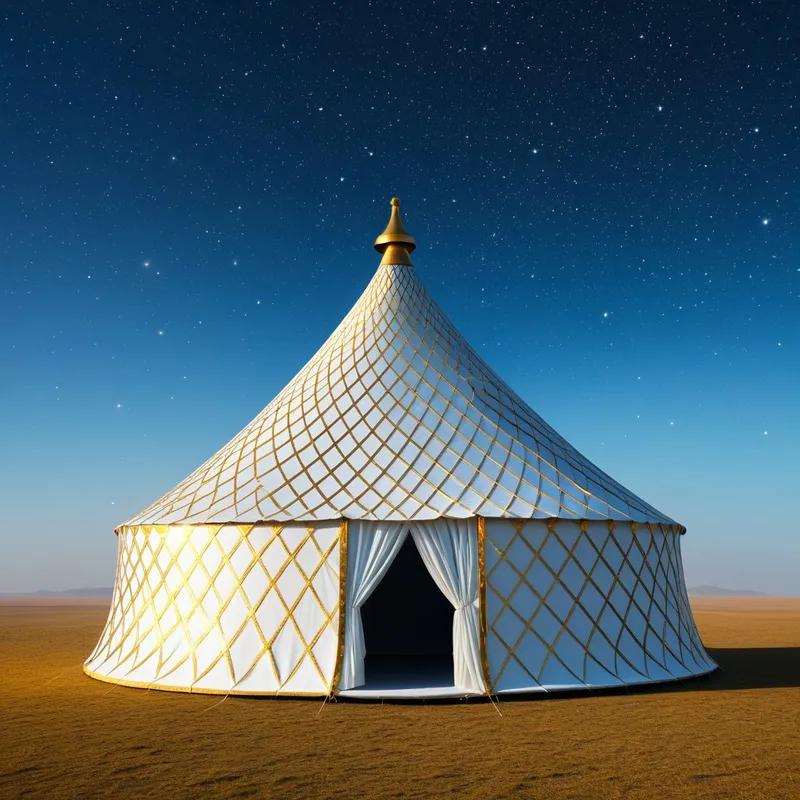
The myth of Ger tells of the sacred tent born from the union of Heaven and Earth, establishing the cosmos and the blueprint for the human soul.
The Tale of Ger
Listen, child of the wind, to the tale that was old when the first horse was tamed. In the time before time, there was only the Tengri, a vault of endless, fathomless blue, and Etugen, a formless, sleeping expanse of dark soil. They were separate, yearning across a silent gulf. The world was not a home; it was an echo of loneliness.
Then, a sound began. It was not a word, but a rhythm—the heartbeat of the unborn steppe. From the longing of Tengri fell a single, perfect tear of light. It struck the breast of Etugen, and where it landed, a sapling of golden birch sprang forth, reaching for the father above. From the answering sigh of Etugen rose a warm mist, which coiled around the tree like a loving embrace. This was the first meeting, the first conversation.
The tree grew, but it was lonely between the two vast realms. So, Tengri sent down his breath, the Sulde, to shape the mist. Etugen offered her strength, the unyielding patience of stone. The Sulde whirled, drawing fibers from the light and the soil, weaving not a wall, but a circle. From the golden birch, it formed a lattice of countless ribs—a wooden sky held in a perfect ring. Over this frame, it stretched the felt of cloud and soil, white and sturdy.
And at the center, where the tear had first fallen, a space was left open. Through this Toono, Tengri could look down upon his creation. Beneath it, Etugen kindled the first fire from her own warmth, the Golomt. The smoke rose, a gray column of prayer, mingling with the breath of the sky.
Thus, the first Ger was born. It was not built; it was begotten. It stood as a child of the union, a microcosm of the cosmos itself. Within its round walls, the desolate space between Heaven and Earth became place. It became home. The wind, which had once been a howling void, now sang as it brushed the guy-lines. The world had a center, a hearth, a direction. The Ger was the covenant made visible, the sacred architecture where the great opposites could meet and make a world worthy of life.
Cultural Origins & Context
This myth is not a story confined to ancient texts; it is etched into the daily rhythm and physical reality of nomadic life on the Mongolian steppe. The Ger is the ultimate portable homeland, and its creation myth is recited in blessings (Yorols), embedded in ritual, and understood in the very act of raising the dwelling. It is told by elders during the assembly of a new home, with each component—the door facing south, the placement of the hearth, the tying of the rope—re-enacting the primordial act.
Its societal function is profound: it is a cosmological anchor for a people perpetually in motion. In a landscape of overwhelming horizontality, the Ger establishes a vertical axis, connecting the family within to the heavens above and the earth below. It transforms nomadic movement from rootless wandering into a sacred procession, carrying the center of the world with you. The myth legitimizes the nomadic way of life as not merely practical, but as a holy mimicry of cosmic order, a continual re-creation of the world.
Symbolic Architecture
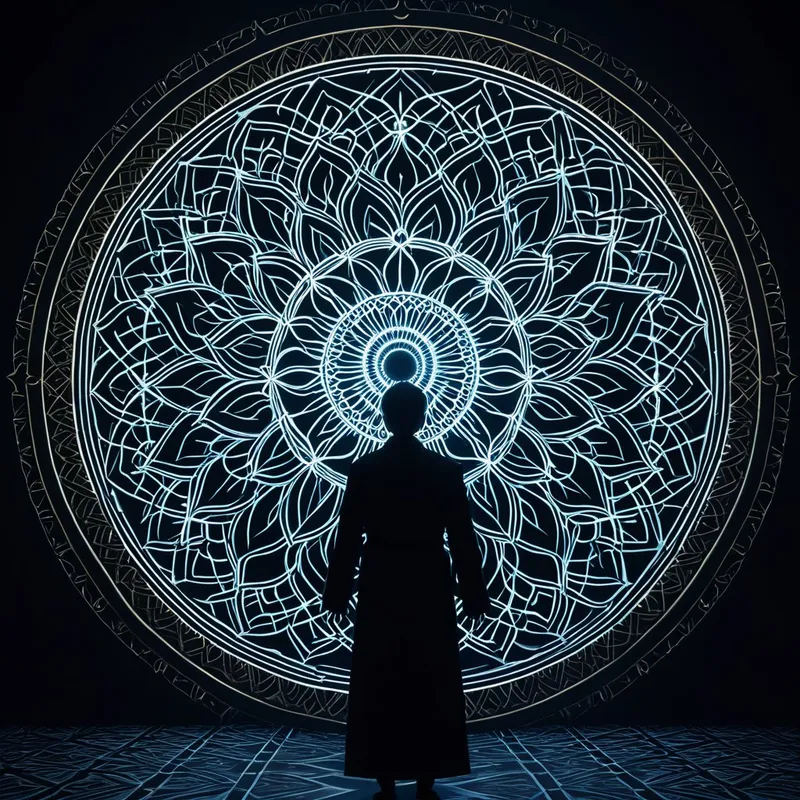
The Ger is a perfect symbol of the mandala—a sacred circle representing wholeness, cosmos, and the Self. Its architecture is a map of existential truth.
The circle does not defend; it contains. The hearth at the center is not a possession, but an altar to the relationship that sustains all life.
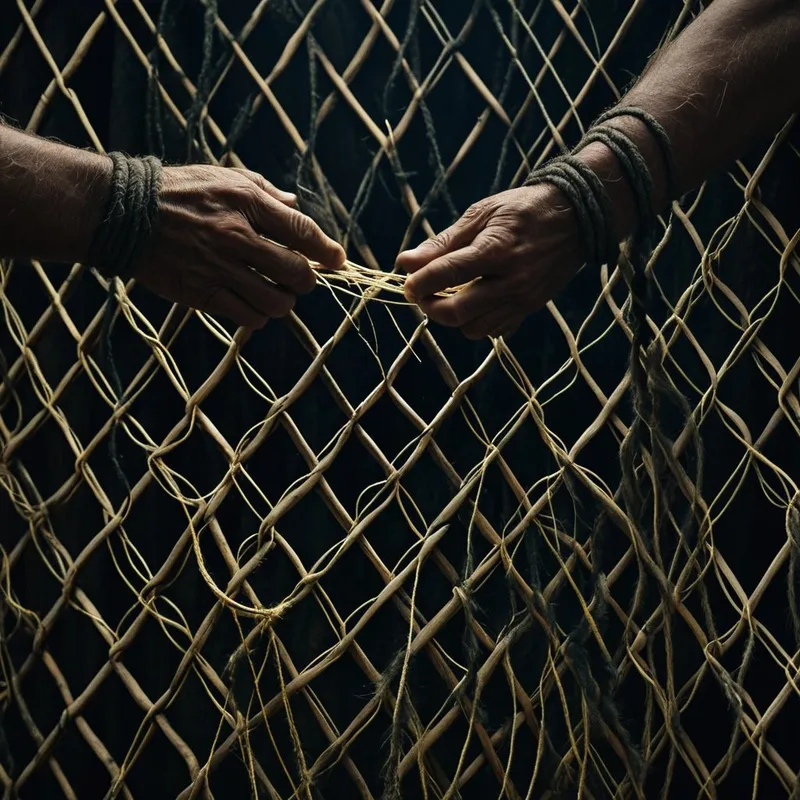
The Lattice Wall (Khana) represents the connective tissue of reality, the interdependent network of relationships (clan, family, nature) that gives structure to life. It is flexible yet strong, capable of expanding or contracting—a symbol of the adaptable psyche. The Roof Poles (Uni) are the paths of aspiration, the individual striving that connects the earthly realm (the wall) to the transcendent (the crown). Each pole is a unique life, yet all are essential to hold up the sky. The Crown (Toono) is the eye of heaven, the point of consciousness and spiritual ingress. It is the opening through which inspiration descends and prayers ascend, the symbol of a permeable boundary between the ego and the greater Self. The Hearth (Golomt) is the anchored core, the source of warmth, nourishment, and spirit. It is the embodied heart, the fixed point around which all else revolves.
Psychologically, the myth of Ger represents the birth of conscious awareness—the temenos or sacred space—within the psyche. It is the moment when raw, undifferentiated experience (the separate sky and earth) is structured into a livable inner world, with a center (the ego/Self axis) and a protected boundary.
The Dreamer's Resonance
When this myth stirs in the modern dreamer, it often manifests as dreams of constructing or discovering a circular space. One might dream of building a shelter from found materials, of arranging furniture in a round room, or of finding a hidden, perfectly circular clearing in a forest. The somatic feeling is one of profound relief, of coming home to oneself after a period of psychic dispersal or homelessness.
To dream of the Ger is to feel the soul’s architecture reassembling itself. The body may relax as the dream-mind lays down the khana of personal boundaries and raises the uni of forgotten aspirations.
This dream pattern signals a process of re-centering. The individual is psychologically moving from a state of fragmentation or alienation (the unbridged gap between Tengri and Etugen) towards integration. The conflict in the dream is often the struggle to find the correct materials or the right location—the search for one's own authentic foundation and spiritual orientation. The resolution is the serene, secure feeling of standing within the completed, sacred circle, with a fire lit at its heart.
Alchemical Translation
The alchemical journey modeled by the Ger myth is not one of conquest, but of sacred marriage and conscious containment. The modern individuation process often begins with a state of inner dichotomy: the soaring, abstract ideals of the spirit (Tengri) feel utterly disconnected from the messy, embodied realities of instinct and earth (Etugen). We feel either ungrounded or trapped.
The first stage of transmutation is the "falling tear"—a moment of poignant awareness, a suffering or a longing that bridges the gap. This emotion catalyzes the growth of the "golden birch," the nascent structure of the individual psyche. The work then is the patient, rhythmic labor of the Sulde—the attentive breath of consciousness—weaving together these opposites.
Individuation is the raising of the sacred tent within. The lattice is woven from the truths of one's life, the poles are the values one lives by, and the crown is kept open to mystery.
We must construct our khana from the relationships and responsibilities we consciously choose to uphold. We must erect our uni by aligning our daily actions with our highest values, creating a reliable structure that connects our base to our summit. Most crucially, we must tend the golomt, the inner hearth of emotional and spiritual warmth, and keep the toono open, refusing to seal ourselves off from the numinous, whether it comes as inspiration or as challenging insight.
The triumph is not in becoming a fortress, but in becoming a dwelling—a permeable, centered, whole space where the great opposites of one's nature can commune, generating the warm smoke of a life that is both grounded and sacred. The Ger teaches that wholeness is not a static achievement, but a portable, living structure that we carry with us, able to be pitched anew in every landscape of our journey.
Associated Symbols
Explore related symbols from the CaleaDream lexicon: