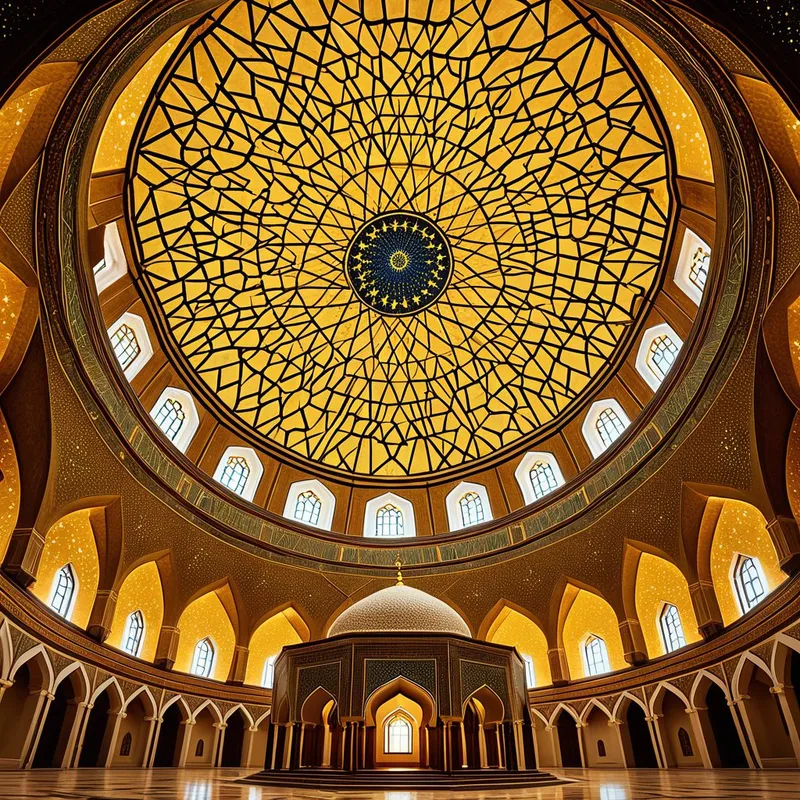
Geometric Tessellation Myth Meaning & Symbolism
A sacred story of the cosmos woven from a single, perfect point, unfolding into an infinite pattern that reveals the hidden unity of all creation.
The Tale of Geometric Tessellation
In the beginning, before the world was woven from clay and breath, there was a single, silent point. It was not a place, but a Potential. A stillness so profound it contained every sound, a darkness so complete it held every color. And within that point dwelled the Architect of Symmetry, whose thought was not a word, but a shape.
From the solitude of the point, a longing arose—not for company, but for expression. The Architect breathed upon the point, and it awoke. It trembled, and from its heart, a line was born. It was the First Line, straight and true, a ray of intention stretching into the void. It was the axis of all that would be. But a line alone is a road to nowhere. So the Architect caused the line to turn upon itself, to curve back and meet its own beginning. Thus was the circle drawn, the perfect shape, without beginning or end, a boundary that contained infinite space.
Yet the circle was a secret, closed and complete. The longing turned to a desire to reveal. The Architect divided the circle, not with violence, but with a glance of knowing. Lines crossed at its center, angles were born—first the right angle, a declaration of balance; then the acute, a spark of aspiration; then the obtuse, a gesture of embrace. From these primal gestures, the first polygons emerged: the steadfast square, the equitable triangle, the noble hexagon. They were not mere shapes, but the first families of form, each with its own nature and law.
But they stood apart, islands of meaning in a sea of emptiness. The conflict was not one of war, but of isolation. The square did not know the hexagon; the triangle saw only its own sharpness. The void between them ached.
Then the Spirit of the Tessellation whispered. It did not command the shapes to change, but showed them a mystery. It took the edge of a square and showed it how to become a bridge. It taught the triangle how to lock with its twin, not to consume, but to support. One by one, the shapes learned to repeat, to rotate, to reflect. They learned to share their edges, to make their boundaries not walls, but meeting places.
And so the weaving began. A hexagon embraced six triangles. A star, born from squares rotated, interlaced with an octagon. Lines extended, met, and branched, creating smaller shapes within larger ones. The pattern began to grow, not outwards like a conquering army, but inwards and outwards simultaneously, filling every gap with a new harmony. It became a carpet of logic, a wall of revelation, a dome of the cosmos. The individual shapes were not lost; they were fulfilled. In giving up their isolation, they found their purpose in an infinite, unified whole. The silence was now a visible, vibrating hymn of connection. The single point had spoken, and its language was a universe of interlocking light.

Cultural Origins & Context
This "myth" was never written in a single sacred text with characters and plot. It is a silent narrative, inscribed in stone, plaster, wood, and glaze across the Islamic world, from the Umayyad Mosque to the Taj Mahal, from the pages of illuminated manuscripts to the borders of textiles. It emerged from a confluence of sources: the Greco-Roman love of geometry, Persian artistic sensibilities, and a core Islamic theological principle—Tawhid.
In a culture that generally prohibited the representation of sentient beings in sacred contexts to avoid idolatry, geometry became the primary visual language for expressing the divine. Artisans and mathematicians were the myth-keepers. They passed down knowledge through guilds and workshops, their rule-and-compass techniques guarded secrets. The societal function was multifaceted: to beautify spaces of worship, to inspire contemplation, to demonstrate the orderliness of God's creation, and to provide a visual proof of the underlying unity (Tawhid) behind apparent multiplicity. To gaze upon a perfect tessellation was to receive a sermon without words, a mathematical proof of spiritual truth.
Symbolic Architecture
The myth of tessellation is a profound map of the psyche and the cosmos. The single point represents the Self in its primordial, potential state. It is the soul before it enters the world of duality.
The circle is the psyche’s boundary, the totality of the individual. The intersecting lines that divide it are the necessary conflicts, the differentiations of consciousness that create identity—thinking, feeling, sensation, intuition.
The polygons are the archetypal structures of the personality: the stable, earthly square of the persona; the aspirational, spiritual triangle; the integrating, communal hexagon. The initial "conflict" of their isolation mirrors the human condition of experiencing these parts of ourselves as separate, often conflicting, entities.
The true magic—the Spirit of the Tessellation—is the reconciling function of the psyche, what Jung called the transcendent function. It does not destroy differences but finds the pattern in which opposites can interlock. The infinite, repeating pattern is the symbolic expression of eternity and the interconnectedness of all things. It shows that wholeness is not a bland uniformity, but a dynamic, complex harmony of distinct parts.
The Dreamer's Resonance
When the geometric tessellation appears in a modern dream, it is rarely a static image. It is often active. Perhaps the dreamer is lost in an endless, repeating corridor of patterns, feeling both awe and anxiety. Or they are painstakingly trying to fit a mismatched piece into a mosaic, frustrated. The tessellation may start small and pristine on a single tile, then begin to grow uncontrollably, covering everything.
Somatically, this can feel like a humming vibration, a sense of being "locked in" or, conversely, of exhilarating expansion. Psychologically, it signals a process of psychic integration. The unconscious is presenting the mind's own innate structure-seeking principle. The dream is working to find order in chaos, to connect disparate experiences or parts of the self. The anxiety of being "lost" in the pattern speaks to the ego's fear of being dissolved into a larger, impersonal order. The act of fitting a piece is the conscious effort to understand how a recent event, emotion, or relationship fits into the larger narrative of one's life.
Alchemical Translation
The individuation process is precisely the journey from the solitary point to the infinite pattern. We begin life in a state of unconscious unity (the point). The trauma of becoming conscious—of realizing our separateness—is the drawing of the First Line. Our development of a personality, with its strengths and flaws, is the creation of our primary "polygons."
The alchemical nigredo, the dark night of the soul, is experienced as the painful isolation of these shapes, the feeling that our traits are fragmented and at odds.
The work of analysis and self-reflection is the application of the compass and straightedge. We measure our angles, observe our repetitions, trace our lines of destiny. The shadow work is the discovery of the negative space, the gaps that our conscious identity has left unfilled.
The moment of symbolic realization—the arrival at a new, more encompassing understanding of oneself—is the moment the tessellation "clicks" into place. A new pattern of meaning emerges. We see how our pain connects to our growth, how our weakness supports our strength. We do not become someone else; we become more perfectly what we are, finding our unique place in the infinite pattern of being. The ego is not erased but becomes a conscious participant in a design far greater than itself. This is the alchemical gold: the realization that one's individual life is a necessary, beautiful, and interlocking tile in the sacred mosaic of existence.
Associated Symbols
Explore related symbols from the CaleaDream lexicon: