
General Eulji Mundeok
A brilliant Goguryeo general whose cunning military strategies repelled Sui dynasty invasions, becoming a legendary symbol of Korean resistance and tactical genius.
The Tale of General Eilji Mundeok
The year is 612, and the earth trembles under the march of a million men. The Sui Emperor Yang, in his celestial arrogance, has unleashed the largest army ever assembled upon the ancient kingdom of Goguryeo. His goal is not merely conquest, but erasure—to fold the rugged, defiant spirit of the mountains into the smooth, bureaucratic order of his empire. The Goguryeo capital, Pyongyang, seems a ripe fruit ready to fall. The Sui host, a serpent of steel and silk, slithers across the Yalu River, its scales glittering with the confidence of inevitable victory.
Against this tide stands a man of granite and silence: General Eilji Mundeok. He is not a king, but the kingdom’s will incarnate. He does not meet the serpent head-on. Instead, he becomes the land itself—patient, treacherous, and knowing. As the Sui vanguard plunges deep into Goguryeo territory, Eilji Mundeok orders a retreat, a calculated yielding that looks like fear. He offers skirmishes, then melts away; he presents weak defenses that break just convincingly enough. His letters to the advancing Sui commanders are masterpieces of psychological warfare, feigning despair and flattering their might, all while luring them further into the dragon’s jaws—the Korean peninsula’s unforgiving terrain.
The emperor, sensing a final, crushing victory, detaches a colossal force of over 300,000 of his best troops—the “Mobile Corps”—to sprint ahead and seize Pyongyang. They are a spear thrown with all of China’s might. Eilji Mundeok lets the spear fly past, then quietly severs its shaft. He fortifies the city, not to withstand a siege forever, but to become an anvil. The real hammer is the land itself.
His genius culminates at the Salsu River. Here, he has waited. He has studied the rhythms of the water and the lay of the earth. As the exhausted, frustrated Sui Mobile Corps turns back from Pyongyang, they find the river before them, its waters deceptively shallow. It is a trap woven from geography and foresight. Unbeknownst to them, Eilji Mundeok’s engineers have upstream, building a dam, holding back the mountain’s tears and the sky’s rain. When the Sui army is mid-crossing, mired in the riverbed, the general gives the signal.
The dam is broken.
What comes is not merely water, but the unleashed fury of the landscape. A wall of liquid death roars downstream, sweeping away men, horses, and ambition in a chaotic deluge. The river runs red, not with symbolic sacrifice, but with the literal blood of an army. Those not drowned are set upon by Goguryeo warriors emerging from the forests, like spirits of the mountain exacting vengeance. Of the 305,000 Sui soldiers who crossed the Yalu, legend claims fewer than 3,000 returned. The Battle of Salsu was not a fight; it was an execution by geography, a testament to the fact that the greatest general commands not just men, but rivers and hills. Eilji Mundeok did not defeat the Sui; he convinced the very earth to reject them.
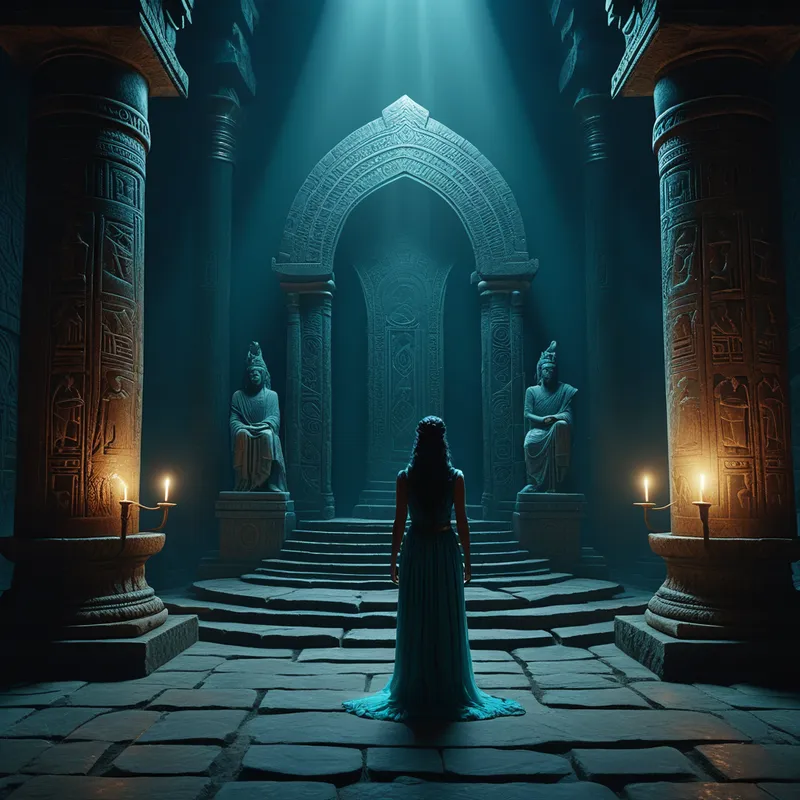
Cultural Origins & Context
Eilji Mundeok emerges from the crucible of Goguryeo, the most militant and expansive of the Three Kingdoms of Korea. This was a culture forged in the harsh landscapes of Manchuria and the northern Korean peninsula, where survival depended on a blend of steppe-like cavalry prowess and fortified mountain citadels. The Goguryeo spirit was one of fierce independence, a bulwark against the periodic gravitational pull of the Chinese dynastic empires to the west. Eilji Mundeok is not a myth from a misty, primordial past, but a legend born from recorded history, his deeds chronicled in the Samguk Sagi and Samguk Yusa. This proximity to history makes his mythic stature more potent; he is the point where the human individual, through sheer strategic intellect and will, bends the arc of destiny.
His story is the foundational narrative of Korean military defiance. In a cultural psyche that has often faced the threat of absorption by larger neighbors, Eilji Mundeok becomes the archetypal proof that cunning, patience, and intimate knowledge of one’s own land can triumph over overwhelming brute force. He represents the strategic mind as the ultimate national resource. He is not a god-king, but a servant of the state, whose loyalty and genius are the shields of the people. In this, he contrasts with more personally ambitious warrior heroes; his glory is entirely in service to Goguryeo’s preservation. His myth solidified during later periods of foreign threat, such as the Mongol invasions and Japanese incursions, serving as a timeless reminder that the homeland itself, when understood and wielded by a devoted mind, is the ultimate weapon.
Symbolic Architecture
The myth of Eilji Mundeok is built upon a profound symbolic triad: the General, the River, and the Retreat.
The General here is not a berserker or a charismatic leader in the thick of melee. He is the embodiment of the observing, calculating ego, the conscious mind that orchestrates reality. He stands for the principle of Ji (知, wisdom) and Rye (慮, foresight). He is the chess master who sees the board not as it is, but as it will be, transforming his own apparent weaknesses—fewer men, less empire—into the very conditions of victory.
The River, specifically the Salsu in flood, is the unleashed unconscious. It is the pent-up force of nature, history, and collective will that, when directed by the conscious strategy of the General, becomes an instrument of apocalyptic transformation. The dam is a powerful symbol of conscious containment—holding back the chaotic, emotional, destructive potential until the precise moment it can be deployed with maximum effect. The crossing army represents the invasive, rigid consciousness of the Sui, stuck literally and symbolically in a transitional, vulnerable state, where it is swept away by the raw power it ignored.
The Retreat is the most psychologically sophisticated element. It is the strategic withdrawal of the ego, the willingness to be perceived as weak, to let the enemy’s arrogance inflate. This is not cowardice, but the ultimate act of control—controlling the enemy’s perception and, therefore, his actions. It is the art of yielding space to gain power over time and terrain.

The Dreamer's Resonance
To dream of Eilji Mundeok is to encounter the part of the psyche that knows how to win by seeming to lose. He appears when the dreamer faces an overwhelming force—an external pressure, an internal complex, a seemingly insurmountable problem. The Sui army in the dream could be a domineering boss, a suffocating responsibility, a tidal wave of anxiety, or a deeply ingrained pattern of thought that threatens to occupy the entire psychic landscape.
The General’s message is not to muster a larger, louder ego to fight fire with fire. Instead, he advocates for tactical silence, deep observation, and strategic retreat. He asks the dreamer: Where is your high ground? What is the terrain of this conflict? What resource are you holding back? He represents the intelligence that can use the energy of the attacking complex against itself. To be visited by this archetype is to be shown that victory may not look like a glorious charge, but like a patient, cunning orchestration of circumstances, allowing the problematic force to overextend and exhaust itself, setting the stage for a natural, transformative resolution. He is the patron of those who must outthink, not out-muscle, their dragons.

Alchemical Translation
In the alchemical vessel of the Korean soul, Eilji Mundeok’s campaign is a perfect operation of Solve et Coagula—to dissolve and to coagulate. The invasive Sui force, representing undifferentiated, imperial prima materia (the raw, foreign mass), is first solved. It is dissolved not by direct attack, but by being lured into a labyrinth (the Korean peninsula), separated from its source, and stretched thin. Its order is broken down through fatigue, deception, and terrain.
Then, at the Salsu, the coagula occurs with violent swiftness. The dissolved, chaotic elements of the invading army are utterly transformed and fixed into a new, permanent state: not as conquerors, but as legend-fodder, as the defining “other” against which Goguryeo’s identity is hardened. The general is the alchemist, using the fire of warfare and the water of the river to transmute the lead of invasion into the gold of national myth and enduring sovereignty.
The true alchemical gold produced is not just victory, but a lasting archetype: the proof that intelligence, when married to unwavering purpose and intimate knowledge of one’s own nature (the land), can catalyze a transformation of impossible odds into foundational strength. The ego (General) successfully channels the immense, often chaotic powers of the unconscious (the dammed river) to defend the integrity of the Self (the kingdom).
Associated Symbols
Explore related symbols from the CaleaDream lexicon:
- Water — The primordial, transformative, and destructive force; held back as potential and released as cataclysmic change, representing the unconscious directed by will.
- Strategy — The art of arranging reality through foresight and deception, turning weakness into advantage and the enemy’s strength into his downfall.
- General — The archetype of the conscious, directing mind; the ego in its role as commander, planner, and servant of a larger cause.
- Mountain — The immutable, defensive homeland; representing the enduring spirit and fortified identity that provides the general with his strategic high ground.
- River — The boundary and the passage; a place of transition that, when its nature is manipulated, becomes a site of decisive transformation and cleansing.
- Retreat — The conscious, strategic withdrawal that creates space for a greater victory; the wisdom of yielding the immediate battle to win the war.
- Trap — A reality engineered by foresight; the environment itself turned into a weapon against those who misperceive it.
- War — The field of forced transformation and ultimate contest, where the survival of an identity (cultural or personal) is at stake.
- Hero — One who defends the community through exceptional acts, not merely of strength, but of transcendent intelligence and sacrifice.
- Resistance — The active principle of maintaining integrity against an overwhelming force; the will to remain distinct and self-governed.
- Land — The ultimate ally and weapon; the intimate knowledge of one’s own terrain—internal or external—as the source of ultimate power.
- Patience — The temporal weapon; the capacity to wait, observe, and hold potential energy until the precise moment of its catalytic release.