Garuda Myth Meaning & Symbolism
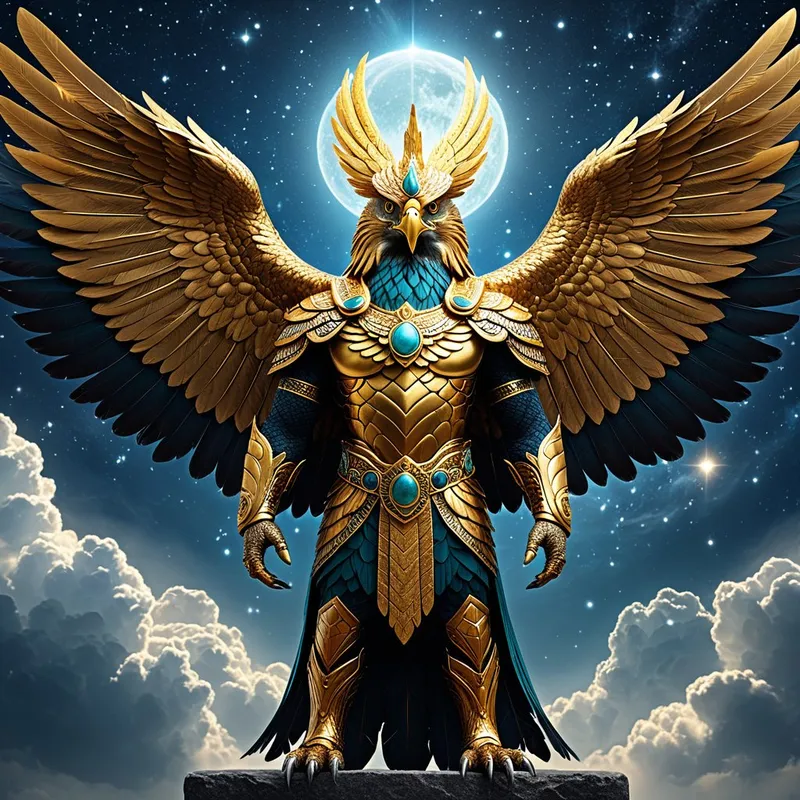
The celestial eagle Garuda, born to free his mother from bondage, undertakes a perilous quest for the nectar of immortality, embodying the ultimate sacrifice for liberation.
The Tale of Garuda
Hear now the tale of the one whose wings eclipse the sun, whose cry splits the silence of the heavens. It begins not in light, but in shadow, with a mother’s lament.
The sage Kashyapa had two wives: Aditi, radiant and serene, and Kadru, cunning and ambitious. Kadru, desiring sons, received a boon: she would bear a thousand eggs. Vinata, another wife, desiring but two sons of unparalleled power, received a similar promise. Time, that great incubator, passed. Kadru’s eggs hatched first, spilling forth a thousand mighty serpents, the Nagas. Impatient, Vinata cracked open her first egg prematurely. There, half-formed, was Aruna, the dawn, who cursed his mother with servitude for her haste before ascending to his celestial post.
The second egg pulsed with a patient, terrifying light. When its time was full, it did not hatch but erupted. From it came a being whose brilliance forced the gods to shield their eyes. He was Garuda. His form was a storm of contradictions: the torso and arms of a mighty warrior, burnished gold; the head, beak, and wings of a colossal eagle, fierce and noble; talons that could grasp mountains. His birth shook the foundations of the worlds.
His first sight was his mother, Vinata, bowed in slavery to her co-wife Kadru. The cause was a wager lost through the serpents’ deceit. The price of her freedom? The amrita, the nectar of immortality, held in the highest heaven under the watch of the gods themselves. Garuda’s heart, vast as the sky, knew its purpose. He would storm heaven itself.
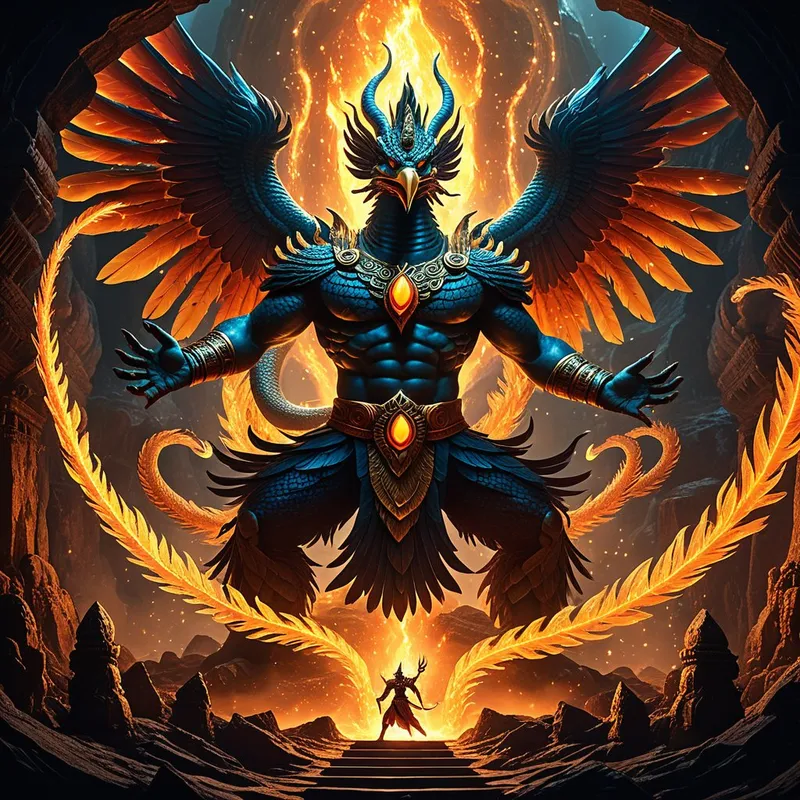
His journey was an odyssey of cosmic scale. He drank entire rivers to slake his thirst. When the gods arrayed against him, he scattered them like leaves in a hurricane. He encountered his father, Kashyapa, who warned of the final guardians: twin spinning wheels of razor-sharp steel, and two deadly, ever-wakeful serpents. With a sage’s wisdom, Garuda shrank himself to the size of a mote of dust, slipped between the lethal blades, and with a speed that outran thought, blinded the serpent sentinels.
There, in the innermost sanctum, it glowed—the amrita in its pot of moonstone. He seized it, not for himself, but as ransom. As he fled, the great god Vishnu appeared, not in wrath, but in admiration. He offered a boon for the nectar’s return. Garuda asked for immortality without drinking the amrita, and for the eternal station of being Vishnu’s own mount. Vishnu agreed. Then, the king of gods, Indra, gave chase, hurling his thunderbolt. It only polished a feather on Garuda’s mighty frame, which henceforth shone with a blue-green luster—the color of the vajra.
Garuda descended to the serpent realm, placed the amrita upon a bed of sacred kusha grass, and commanded the Nagas to purify themselves before drinking. While they slithered away to bathe, Indra swiftly retrieved the nectar. The serpents returned to find only droplets. In their desperate licking, they split their tongues on the sharp grass, a mark they bear to this day. But the pact was fulfilled. Vinata was free. Garuda, having fulfilled his dharma, took his place at Vishnu’s side, his wings forever outstretched across the cosmos, a perpetual testament to a son’s devotion that moved heaven and earth.
Cultural Origins & Context
The myth of Garuda is woven into the ancient fabric of Vedic and Puranic literature, most prominently in the first book of the great epic, the Mahabharata, and in various Brahmana texts. It is a story told and retold not merely as entertainment, but as a foundational narrative encoding profound societal and cosmological truths.
Its function was multifaceted. For the royal and warrior (Kshatriya) classes, Garuda was the ultimate emblem of sovereign power, martial prowess, and relentless pursuit of a righteous goal. His image adorned banners and standards, symbolizing speed, ferocity, and protection. For the broader culture, the myth served as a cosmic map. It delineated the eternal struggle and interdependence between opposing forces: the solar, aerial Garuda (representing the Devas) and the chthonic, earthly serpents (the Asuras/Nagas). This was not simple good versus evil, but a dynamic tension necessary for the balance of the universe. Furthermore, the story reinforced the supreme value of dharma</ab—here, the sacred duty of a son to liberate his mother—even when it required confronting the divine order itself. Garuda’s eventual alliance with Vishnu and Indra illustrates how raw, disruptive power, when guided by dharma, is ultimately integrated into the cosmic framework, becoming a protective, preserving force.
Symbolic Architecture
Garuda is not merely a bird or a hybrid creature; he is a complete symbolic system. He is the embodiment of the liberated mind, the soaring intellect (buddhi) that can ascend beyond the murky coils of instinctual, unconscious life represented by the serpents.
His very birth from the second egg signifies the triumph of patience and right timing over impulsive action (his brother Aruna’s fate). He is the puer aeternus who successfully matures, channeling his immense potential into a sacred purpose. The amrita he seeks is the ultimate prize: immortality, wholeness, or Self-realization. Yet, the core alchemy of the myth lies in his relationship to it.
He is the only being who wins immortality by relinquishing the immortalizing nectar. His power comes not from consuming the prize, but from the strength gained in the quest and the act of sacrificial return.
His foes, the serpents, symbolize the primal, binding energies of the unconscious—our instincts, fears, and possessive desires (the Nagas hoard treasures and guard the underworld). Garuda’s eternal enmity with them represents the necessary, ongoing struggle of consciousness to free itself from these entanglements. His position as Vishnu’s vehicle (vahana) is the final symbolic integration. He becomes the means by which the preserving, sustaining principle of the universe (Vishnu) traverses and oversees all realms. The individual will, perfected through dharma, becomes the instrument of a transcendent will.
The Dreamer's Resonance
When the archetype of Garuda stirs in the modern psyche, it often manifests in dreams of immense, transformative pressure and the promise of liberation. One might dream of being pursued by serpents or entangled in coils, only to discover a sudden, shocking capacity for flight—wings bursting from the back, or leaping from a great height and soaring. These are not dreams of gentle escape, but of powerful, almost violent, emancipation.
Somatically, this can correlate with sensations of constriction in the chest or diaphragm suddenly giving way to a feeling of expansive breath, or a kundalini-like surge of energy up the spine. Psychologically, the dreamer is likely in a crucible phase. They feel bound—by a situation, a relationship, a pattern of thought, or a deep-seated obligation (like Garuda’s to his mother). The Garuda dream is the psyche’s announcement that the strength for the breakout has been incubated and is now available. It signals a readiness to undertake a daunting quest for one’s own “amrita”—be it psychological freedom, creative expression, or spiritual insight—knowing it will require facing inner “gods” and “serpents” (internalized authorities and primal fears). The dream is a promise: the power to succeed is born within you, but you must be willing to become the storm.
Alchemical Translation
The myth of Garuda is a precise manual for the alchemical process of individuation. It maps the transformation of base, bound consciousness into liberated, golden awareness.
The initial state is servitude (Vinata’s bondage). This is the ego identified with, and enslaved by, complex familial or cultural patterns (the feud between the wives). The call is the unbearable sight of this condition, which ignites the heroic resolve. The quest involves the successive confrontations: drinking the rivers (assimilating vast emotional and psychic energies), battling the gods (overcoming internalized ideals and super-ego structures), and outwitting the mechanical, razor-sharp defenses (navigating the logical, analytical mind that can trap spirit).
The climax at the amrita represents the confrontation with the Self, the treasure of the innermost center. Here lies the supreme alchemical secret:
The goal is not to possess the Self, but to be possessed by it. Garuda’s immortality is granted because he proves he does not need to consume the symbol of wholeness; he has become the vessel for a higher principle through his actions.
Returning the amrita is the act of offering the realized insight back to the cosmic order (the gods). The reward is not the nectar, but a new, eternal function: to be the vehicle for the preserving, conscious principle (Vishnu). For the modern individual, this translates to a profound inner shift. The struggle for personal freedom and achievement, when undertaken with integrity and sacrifice, does not end in solitary possession of a prize. It culminates in discovering one’s unique station—one’s dharma—within a larger order. The liberated individual finds their purpose not in ruling from a isolated peak, but in serving as a conduit for something greater, carrying wisdom and protection across the landscapes of the world and the soul. The poison of the quest (the struggle, the pain) is transmuted, through right action, into the nectar of meaningful existence.
Associated Symbols
Explore related symbols from the CaleaDream lexicon: