Garmr Myth Meaning & Symbolism
The great hound bound before Hel's gate, whose howl signals the end and whose battle with Tyr embodies the ultimate confrontation with fate.
The Tale of Garmr
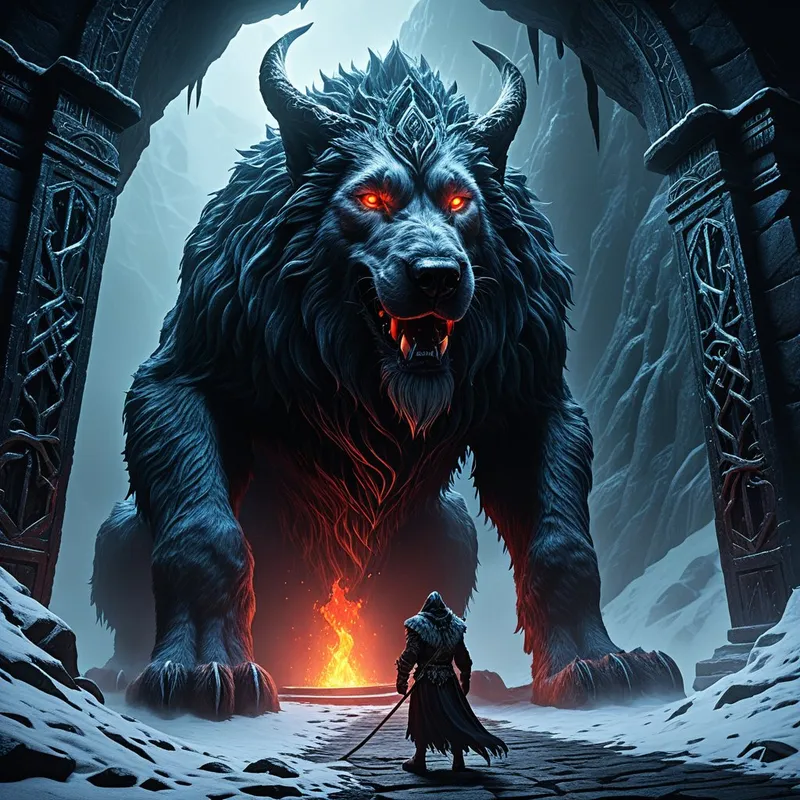
Hear now the howl that splits the root of the world. Not from the high halls of the gods, nor from the deep mines of the dwarves, but from a place where the sun’s memory has grown cold. Before the gaping maw of Gnipahellir, where the river of knives whispers and the air is the breath of the dead, he is bound.
They call him Garmr. A hound, but no companion to man. His size is that of a hill, his pelt the grey of tomb-moss and clotting blood. His eyes are not eyes, but windows into a furnace that burns without warmth. A chain, forged in a sigh of despair, holds him fast to the stone. And there he waits, his growl the grinding of continental plates, his slaver a poison that seeps into the soil of Hel.
The gods on high know the sound. It is the clock-tick of their doom. For the prophecy is clear: when the bonds of the world slacken, Garmr’s chain will snap. His liberation will be a herald’s cry, the first true note of Ragnarök. He will run then, not to hunt deer, but to run alongside the rising dead, his howl tuning their march to the rhythm of ending.
But this binding… it was no simple feat. It required a pledge, a token of ultimate surety. The one who stepped forward was not the thunderer, nor the all-father in his wisdom. It was Tyr, whose word was law and whose courage was a stark, unadorned thing. The Æsir needed to bind the beast, to lull the apocalypse into a temporary sleep. They crafted the fetter Gleipnir, from the sound of a cat’s footfall and the beard of a woman—impossible things made substance.
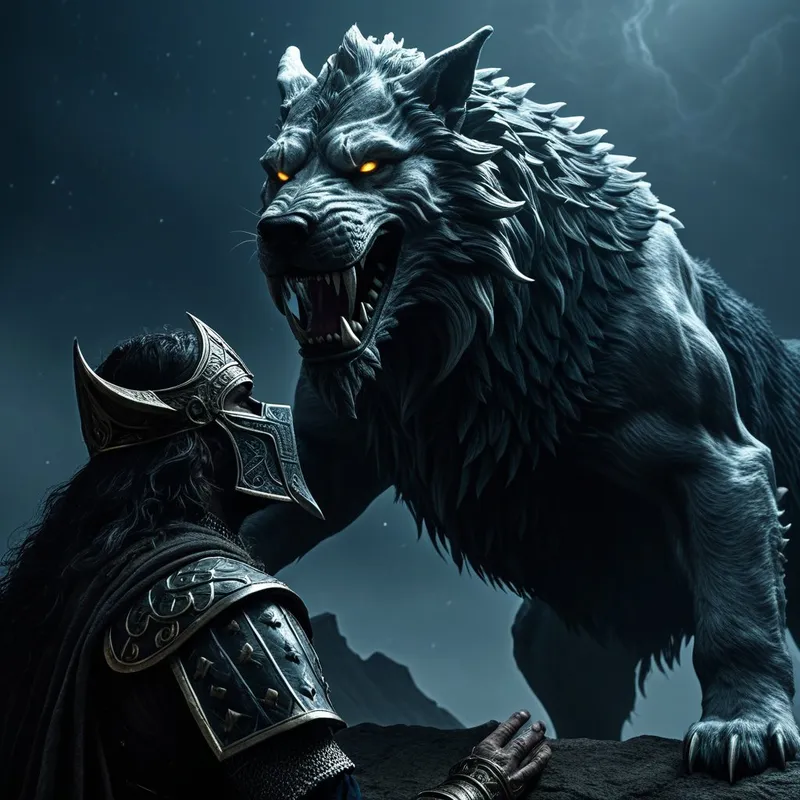
They came to the cave’s mouth. Garmr sensed the trickery in the slender ribbon. He would not be bound unless one of the gods placed a hand in his mouth as a pledge of good faith. A hand in those jaws was a hand forever lost. All knew it. Tyr knew it. And without a word, he extended his right hand—the hand of oath, the hand of justice—and laid it between the hound’s teeth. As the magical bond tightened, Garmr’s shock became fury. His jaws clamped shut. The crunch of bone was lost in his roar of betrayal. Tyr stood, bleeding, his honor intact, his body forever marked by the price of restraint.
And so, the howl continues, a low, constant pressure at the edge of hearing. It is the sound of the boundary itself, straining. It is the promise of the final battle, where the one-handed god and the freed hound will meet again, not as binder and bound, but as destined opponents, to finish in mutual annihilation what began with a solemn, sacrificial lie.
Cultural Origins & Context
The myth of Garmr reaches us through the fractured lens of the Poetic Edda and the later, prose Prose Edda. These were not holy texts, but repositories of a worldview, recorded in Christianized Iceland centuries after the belief system had faded. Garmr is never the subject of a full saga; he is a presence, a detail in the grand, grim tapestry of Ragnarök. His story was likely part of the oral tradition of skalds—poets who served as historians, entertainers, and custodians of cosmic law.
In the Norse mind, the universe was not safe. Order was a temporary clearing in a forest of chaos, maintained by the gods through effort, sacrifice, and cunning. Garmr, stationed at the entrance to Hel, embodies the ever-present threat of that chaos breaking through. He is the guardian, but not a guardian for the living; he guards the integrity of the boundary between the realms of the dead and the living. His binding is a crucial act of cosmic maintenance, a delaying action against the inevitable. The myth served to explain the precariousness of the world and the severe cost (Tyr’s hand) of maintaining societal order and oath-keeping, the very fabric of Norse law. He was a personification of the ultimate consequence, the price of broken promises on a world-scale.
Symbolic Architecture
Garmr is not merely a monster. He is the psychological and cosmological embodiment of The Threshold Guardian. He does not reside in the underworld, but at its gate. He is the personified resistance encountered at any point of profound transition—death, initiation, or any ego-shattering transformation.
The guardian of the threshold is not there to keep you out, but to ensure you are prepared to pay the price of entry.
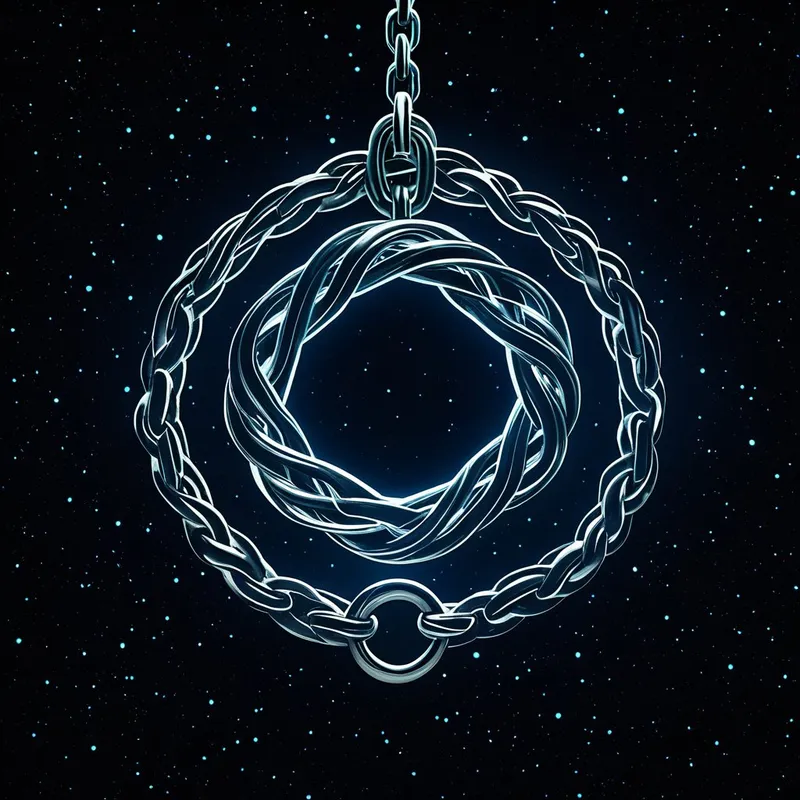
His chain, Gleipnir, symbolizes the fragile, paradoxical nature of consciousness itself. It is woven from impossibilities (a cat’s footfall, a woman’s beard)—the stuff of dreams and the unconscious. Our conscious world is bound together by such tenuous, psychological constructs that hold back the raw, undifferentiated energies of the psyche (Garmr). Tyr’s sacrifice is the core of the symbol. The god of law and justice must sacrifice his instrumental hand—his capacity for action, control, and the enforcement of order—to enact a greater, temporary order. This represents the ultimate paradox: to gain control (binding chaos), one must first relinquish control (the hand). True commitment to any profound oath or life-path requires a part of the self to be given over, irrevocably.
The Dreamer's Resonance
When Garmr bays in the modern dreamscape, he rarely appears as a literal, mythological hound. The dreamer may instead encounter a terrifying, immovable presence blocking a doorway, a bridge, or a path. There is a deep, resonant growl vibrating through the dream’s foundation, or a feeling of being stalked by an inevitability just outside the dream’s frame. The somatic experience is one of visceral dread, a freezing in the chest, a sense of a looming, non-negotiable confrontation.
Psychologically, this signals the dreamer is approaching a critical inner threshold. This could be the need to confront a long-buried trauma (entering the underworld), to initiate a major life change (crossing the bridge), or to face a shadow aspect of the self so potent it feels world-ending. Garmr’s dream-presence asks the terrifying question: What are you willing to lose to move forward? The dreamer is at their own Gnipahellir, and the beast is the embodied resistance of the psyche, protecting the status quo of the unconscious, demanding a price for its revelation.
Alchemical Translation
The alchemical process modeled here is the Nigredo—the blackening, the confrontation with the primal, chaotic materia prima of the soul. Garmr is the raw, unintegrated instinctual force, the fury and grief and rage we chain at the gates of our personal Hel. The individuation journey requires not that we slay this hound, but that we do the equivalent of Tyr’s deed: approach it, acknowledge its power, and willingly offer a sacrifice to integrate it.
The hand fed to the beast is the ego’s claim to total sovereignty. What is severed is the illusion of control.
The modern “binding” is not about repression, but about conscious relationship. We must offer our old ways of controlling the world (the “hand” of rigid habits, defended identities, and outdated oaths) into the maw of our deepest nature. This sacrifice feels like annihilation, a Ragnarök of the personality. Yet, from this dissolution, a new integrity is forged. The one-handed Tyr is not diminished, but transformed into a more complete symbol of justice—one who understands law because he has paid its ultimate price. In our lives, this translates to the courage to face our deepest fears, losses, or shames, not to conquer them, but to lose our old self to them. In doing so, we don’t prevent our personal Ragnarök; we undergo it consciously, and from its ashes, the capacity for a truer, more grounded life is born, no longer fearing the howl from the cave, for we have met its source.
Associated Symbols
Explore related symbols from the CaleaDream lexicon: