Galileo's Telescope Myth Meaning & Symbolism
A mortal artisan, aided by a Titan, crafts a device to see the divine machinery of the cosmos, challenging the celestial order and paying a terrible price.
The Tale of Galileo's Telescope
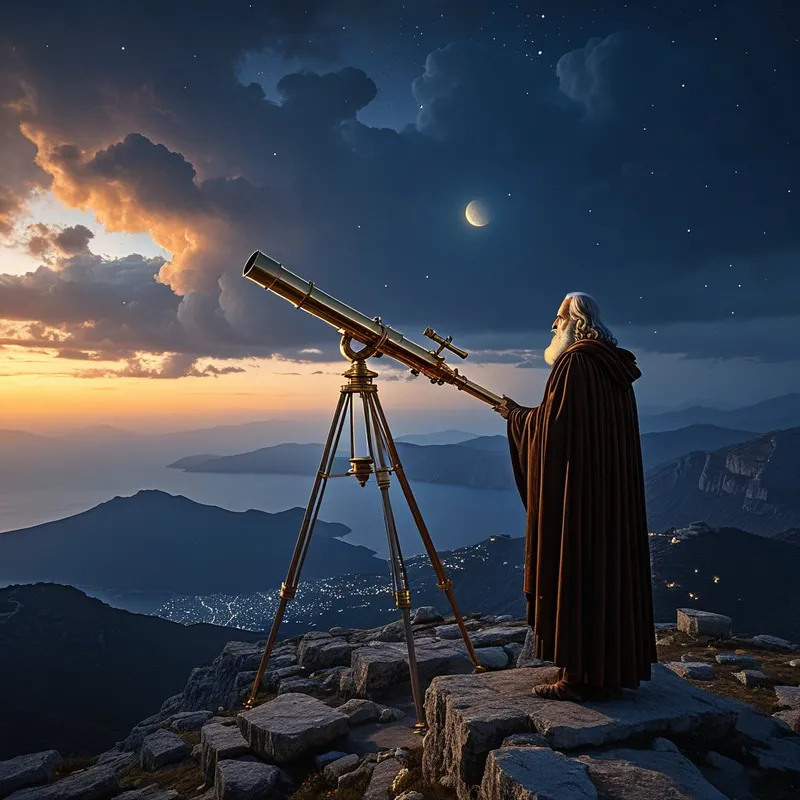
Hear now, a tale not of heroes who wrestle beasts, but of a mind that wrestled with the heavens themselves. In the age when the laughter of the gods still echoed from Olympus, there lived a mortal named Galileo. He was no king, no warrior, but an artisan of Rhodes, whose hands shaped bronze and whose mind hungered for shapes unseen.
His nights were spent not in revelry, but on the lonely cliffs, his eyes scouring the velvet dark. He saw the wanderers—the planets—and the fixed dance of the stars, but it was a dance viewed through a thick veil. He burned to see the steps, the true countenance of the celestial dancers. This hunger became a silent, screaming prayer that did not ascend to Zeus, but descended, through stone and fire, to the one god who understood the marriage of vision and craft: Hephaestus, the smith of the gods, who labored in his volcanic forge on Lemnos.
Driven by a madness the poets call inspiration, Galileo built a fragile boat and sailed into the heart of the wine-dark sea, guided only by his longing. The waves tried to claim him, the winds mocked him, but his purpose was an anchor. He found the island wreathed in smoke and the scent of ozone. Before the great cavern forge, he stood, a speck before the divine. Hephaestus, his mighty form bent over an anvil, did not turn. “Mortals seek gifts of war or love,” the god’s voice rumbled like subterranean stone. “What do you seek?”
“Sight, my lord,” Galileo whispered, his voice hoarse. “Not to possess, but to see. The machinery behind the sky.”
A silence fell, broken only by the hiss of hot metal. Hephaestus turned, his eyes not of pity, but of recognition. Here was a kindred spirit, one who also sought the hidden blueprint of things. A pact was struck, not of words, but of shared labor. For seven days and seven nights, they worked. Hephaestus drew forth a crystal from the heart of the mountain, clearer than any water. Galileo, with his mortal patience, ground it with sands finer than dust, his entire being focused into the curve of the lens. The god forged a tube of orichalcum and star-iron, inscribing upon it the secret names of the celestial spheres.
At last, it was complete. The Telescope. It lay between them, cold and inert. Hephaestus placed it in Galileo’s trembling hands. “The eye will have what it seeks,” the Titan said, his tone grave. “But the soul must bear what the eye reveals.”
Galileo climbed to the highest peak. As the sun fled and the first star—Hesperos—pierced the twilight, he raised the instrument. He put his eye to the lens.
And the veil tore.
He did not see points of light. He saw worlds. The wandering star Zeus was a vast, banded sphere, storm-wracked and mighty. The chaste Artemis was not a silver disc, but a cratered, barren rock. The celestial spheres were not perfect crystal but deep, empty voids, and the fixed stars were suns, terrifying in their lonely multitude. He saw the gears of the cosmos, vast and impersonal. And then, turning the tube toward the distant glow of Olympus itself, he saw the gods. Not as radiant ideals, but as figures, arguing, feasting, existing within a realm that was simply another place, not the ultimate height.
A cry escaped him, part wonder, part devastation. The perfect order was a beautiful lie. The divine mystery was not magic, but mechanism.
The air grew cold. A shadow fell across the moon. Athena, she who gifts cunning, stood before him, her grey eyes cold. “You have taken what was not given, mortal. You have seen the unmediated truth. The order of the world rests on a necessary distance. You have collapsed it.”
There was no trial. His fate was in the seeing. The Telescope was shattered with a touch from the goddess’s spear. The knowledge it granted was not taken from him—that was impossible—but was sealed within him, a burning, isolating coal. He was returned to Rhodes, his eyes now forever seeing two worlds: the comforting, human-scale world of myth and meaning, and the terrifying, magnificent truth of infinite space. He became a whisper, a prophet of a reality for which his people had no language, living out his days in the profound solitude of one who has seen the blueprint of the gods and found it to be architecture, not divinity.
Cultural Origins & Context
This myth, while bearing the name of a historical figure from millennia later, is rooted in the profound tension at the heart of the Greek worldview. It emerges not from a single epic cycle, but from the philosophical undercurrents of the pre-Socratic and later Hellenistic periods, a time when natural philosophers began to speculate on the mechanics of the cosmos apart from the pantheon. The tale was likely propagated not by rhapsodes in grand courts, but by thinkers in the Stoa and the Academy, a cautionary narrative for those who dared to apply the lens of logos (reason) directly to mythos (story).
Its societal function was dual. For the orthodox, it was a powerful reinforcement of the cosmic order (Dike), warning against the hubris of seeking to dismantle the sacred mysteries that bind society and the cosmos. For the intellectual, it was a tragic archetype of the seeker’s dilemma: the realization that transcendent knowledge does not confer transcendence, but exile. The myth acknowledges the awe of discovery while solemnly charting its existential cost, serving as a foundational story for the birth of the scientific consciousness—and its inherent alienation.
Symbolic Architecture
At its core, the Telescope is the Symbol of Directed Consciousness. It is not mere curiosity; it is the will to focus the light of the mind onto a single, forbidden point until it burns through the obscuring veil.
The ultimate heresy is not defiance, but clarity. The Telescope does not attack the gods; it simply renders them finite.
Galileo represents the Ego in service to the Self, driven by an insatiable need for wholeness of understanding. Hephaestus is the Archetype of the Wounded Creator, the divine aspect within that facilitates the construction of the tool of revelation. His warning is crucial: the psyche can build the instrument of its own unraveling. Athena’s intervention symbolizes the Conscious Mind's Defense. She is not evil; she is the guardian of the meaningful world-picture. Her shattering of the Telescope is the psyche’s self-protective fragmentation when faced with a truth too large to integrate.
The vision of the gods as finite beings is the myth’s central psychic trauma: the moment the parental, omnipotent images of the unconscious (the gods) are seen as partial, psychological constructs rather than absolute external realities. This is the death of naive projection, the end of childhood for the soul.
The Dreamer's Resonance
When this myth stirs in the modern dreamer, it manifests not as a historical drama, but as a profound somatic experience. To dream of crafting or finding a telescope, periscope, or any device that grants "special sight" indicates a psyche preparing for a revelation. The body may feel tense, the eyes strained within the dream.
The critical moment is the act of looking through the device. If the dreamer sees chaotic stars, mechanistic gears, or the flawed humanity of authority figures (parents, leaders, internal "gods"), it signals an active, often painful, process of De-projection. The dream-ego is seeing the underlying structure of a relationship, a belief system, or a self-image, stripping it of its magical, absolute power. The subsequent feeling in the dream—awe, terror, loneliness—is the direct somatic registration of this psychic shift. The dream may end with the device breaking or being taken, reflecting the ego’s temporary retreat from the overwhelming magnitude of what has been glimpsed. This is not failure, but necessary pacing.

Alchemical Translation
The myth of Galileo’s Telescope is a precise map of the Individuation process, specifically the Nigredo—the blackening, the confrontation with the shadow of absolute truth.
The first stage is the Calling: Galileo’s nocturnal hunger. This is the soul’s dissatisfaction with received reality, the itch of the Self pushing consciousness toward deeper inquiry. The journey to Lemnos is the descent into the Unconscious Forge, where conscious skill (Galileo) allies with instinctual, creative power (Hephaestus) to build the tool of transformation.
The forging of the Telescope itself is the Coniunctio (sacred marriage) of intellect and intuition, focused into a single, potent instrument of perception. The act of looking is the Mortificatio—the death of the old worldview. The perfect, animated cosmos "dies," revealed to be static, mechanical. The parental gods "die," revealed as psychological complexes.
The alchemical gold is not the vision itself, but the capacity to hold the vision without being annihilated by it.
Athena’s shattering of the tool is not the end, but a crucial part of the Separatio. The raw, unintegrated vision is too powerful; it must be broken down and digested. Galileo’s final state—bearing the knowledge in solitude—is the beginning of true integration. He does not go mad; he becomes a vessel for a paradoxical consciousness. He lives in two worlds, a citizen of neither, which is the hallmark of the individuating person. The psychic transmutation is complete not when the truth is seen, but when the individual can contain the searing loneliness of that truth and still find a way to belong, humbly, to a human community. The myth thus models the ultimate alchemy: turning the leaden weight of disillusionment into the sober, unflinching gold of conscious existence.
Associated Symbols
Explore related symbols from the CaleaDream lexicon: